Event has already taken place. Experience the masterpiece Carmina Burana, beloved for its power and mystique. This thundering drama with the Gothenburg Symphony Orchestra, choir and vocal soloists is conducted by Emilia Hoving.
Concert length: 2 h incl. intermission
Scene: Stora salen
400-560 SEK Student 200-280 SEK
Young up to 29 200-280 SEK
Experience Carl Orff’s masterpiece Carmina Burana, beloved for its power and mystique. This thundering drama for choir and orchestra is conducted by Emilia Hoving. We also experience the Swedish premiere of a new, exciting French composition in which composer Camille Pépin depicts atmospheric charges before a storm.
The popular choral work Carmina Burana had its world premiere in 1937 and depicts life’s pleasures – celebrations, money and other delights – not infrequently with sexual undertones. The lyrics come from fierce Medieval manuscripts that mocked the king and the church. The introduction’s O Fortuna has become one of the greatest hits of choral music.
Carl Orff was politically and aesthetically provocative with this evocative drama. He was fascinated by the passionate folklore poems and sought that same intensity in the music. In addition to soprano, tenor, baritone and boys’ choir, he appointed trios of woodwinds and brass, five timpani, six percussionists, a celesta, two pianos and strings – all to capture the good things in life.
Performed here with the Gothenburg Symphony Orchestra, Gothenburg Symphony Choir, Gothenburg Symphony Vocal Ensemble and vocal soloists David Roy baritone, Clarice Granado soprano and Michael Smallwood tenor.
Programme
Pépin Aux confins de l'orage 15 min
Camille Pépin (f 1990)
Aux confins de l’orage (Swedish premiere)
Sphères jaune-orange - Sylphes rouges - Jets bleus
"At the Edge of the Storm" is a work inspired by three transient luminous phenomena preceding the storm. They occur in the upper atmosphere and are invisible from Earth (we can only observe lightning). To set to music to it, I imagined orchestral colors specific to each.
The Yellow-Orange Spheres are disks of light propagating through space in concentric circles. Born from an electromagnetic impact in the ionosphere, they change color as they propagate, passing from yellow to orange-red. I represented this transformation with chord-spheres traveling from one music stand to another.
From a thunderous aggregate, the Red Sylphs are born, lower in the mesosphere. They are liquid and incandescent filaments flowing towards the Earth and resolving into luminous volutes of intense red. Played by the high woodwinds, these threads never stop despite the explosions presaging the storm (timpani, bass drum, low winds).
The final movement opens with a windy episode. Dark and mysterious with the deep colors of the orchestra, it makes the transition to the stratosphere. It is in this layer of the atmosphere, closest to us, that the Blue Jets burst forth at a hallucinatory speed. As brief as they are rapid, these veritable rocketing streaks of light are played by the woodwinds tinged with the brilliance of the keyboards. As they approach Earth, the sound becomes increasingly abrupt and dry. Finally, a final tumultuous rumble, a final clap of thunder: it's the storm.
Camille Pépin
Intermission25 min
Orff Carmina Burana 1 h
Carl Orff (1895-1982)
Carmina Burana
Fortuna imperatrix mundi - Primo vere - In taberna´- Cour d'amours - Blanziflor et Helena - Fortuna imperatrix mundi
During the 1930s, Carl Orff was one of the most noted composers in Germany. Much of his fame came with Carmina burana which was composed in 1935-1936. Its subtitle reads "secular songs for soli and choir accompanied by orchestra and with magical images" - a scenography of a medieval kind where evocative paintings and decorations in concert with the large choir create an overwhelming impression. Carmina burana was first performed in Frankfurt am Main in 1937, given at La Scala in 1942 and shortly afterwards also in Vienna, but despite this Orff only became more widely known as a composer after the war.
The music was not like anything else, it felt original and stood outside contemporary trends and schools. His musical inspiration can be said to have its roots in the dramatic imagery, with Greek tragedy and Italian baroque opera as two major sources of inspiration. Musically, there is a closer influence: Stravinsky's dramatic cantata Oedipus Rex and above all Les noces - rhythmically marked music of a deliberately simple style with a sparse orchestral movement (lots of percussion) and the choir as basic elements.
Orff's work often grew out of a combined vision of the scenic and the musical - everything he created reveals a lush, visible imagination. Most of what he produced is intended for the stage, including Carmina burana. But the piece has shown its strength even without stage arrangements and is just as often performed in the concert hall with great success.
Friday 10 October 2025: The event ends at approx. 20.00
Participants
Gothenburg Symphony Orchestra
The Gothenburg Symphony was formed in 1905 and today consists of 109 musicians. The orchestra's base is Gothenburg Concert Hall at Götaplatsen that has gathered music lovers since 1935. Since the 2019-2020 season, Barbara Hannigan is Principal guest conductor. We are also a proud partner of Barbara Hannigan's Equilibrium mentoring program focusing on young singers at the start of their careers. The title Principal Guest Conductor is shared by Pekka Kuusisto from 2025.
Wilhelm Stenhammar was the orchestra's chief conductor from 1907 to 1922. He gave the orchestra a strong Nordic profile and invited colleagues Carl Nielsen and Jean Sibelius to the orchestra. Under the direction of conductor Neeme Järvi from 1982-2004, the orchestra made a series of international tours as well as a hundred disc recordings and established themselves among Europe's leading orchestras. In 1996, the Swedish Riksdag appointed the Gothenburg Symphony as Sweden's National Orchestra.
In recent decades, the orchestra has had prominent chief conductors such as Santtu-Matias Rouvali, Mario Venzago and Gustavo Dudamel, following Kent Nagano as Principal Guest conductor. Anna-Karin Larsson is CEO and artistic director, Gustavo Dudamel honorary conductor and Neeme Järvi chief conductor emeritus. The orchestra's owner is the Västra Götaland Region.
The Gothenburg Symphony works regularly with conductors such as Herbert Blomstedt, Joana Carneiro, Jukka-Pekka Saraste, Christian Zacharias and Anja Bihlmaier.
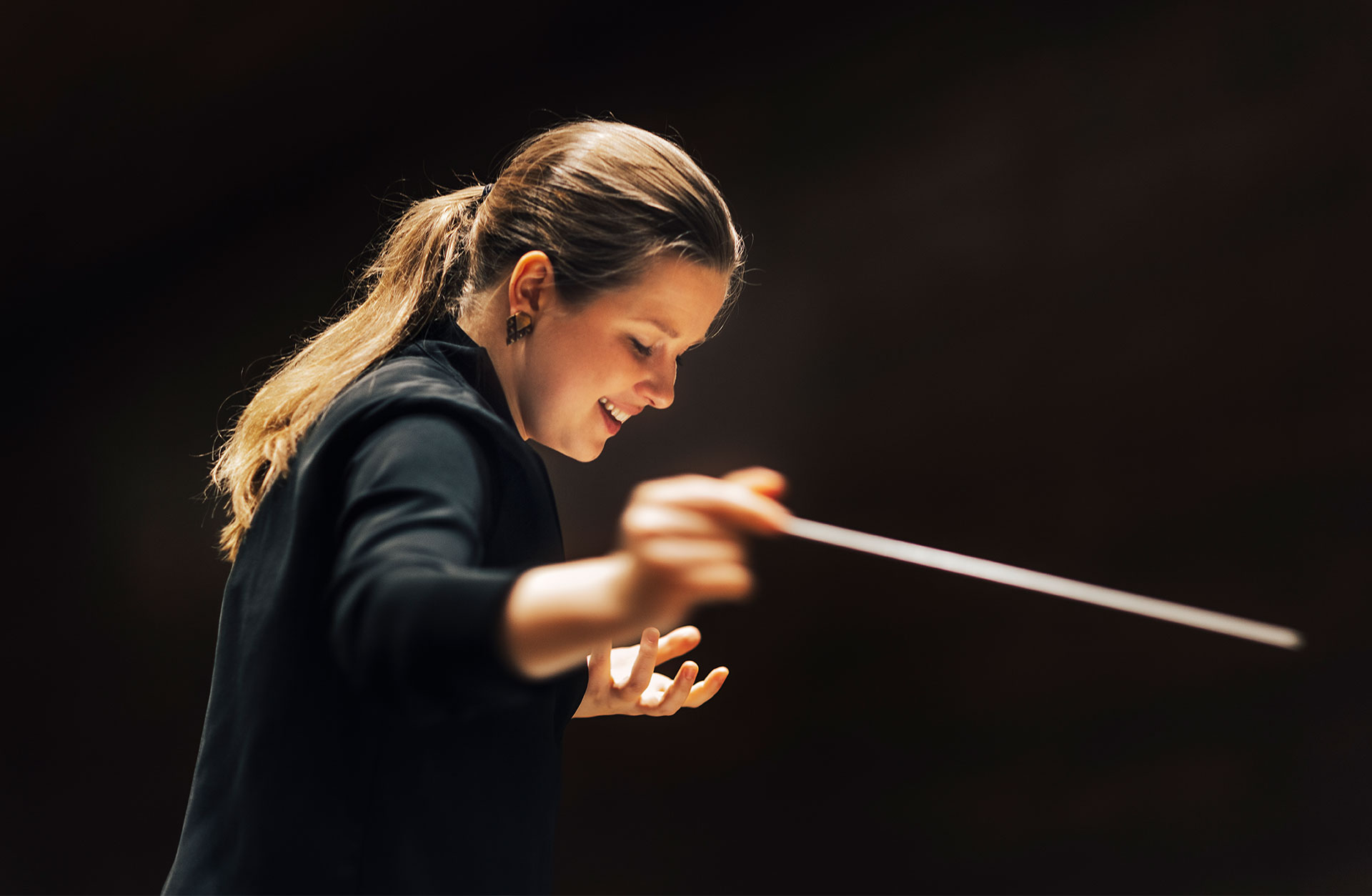
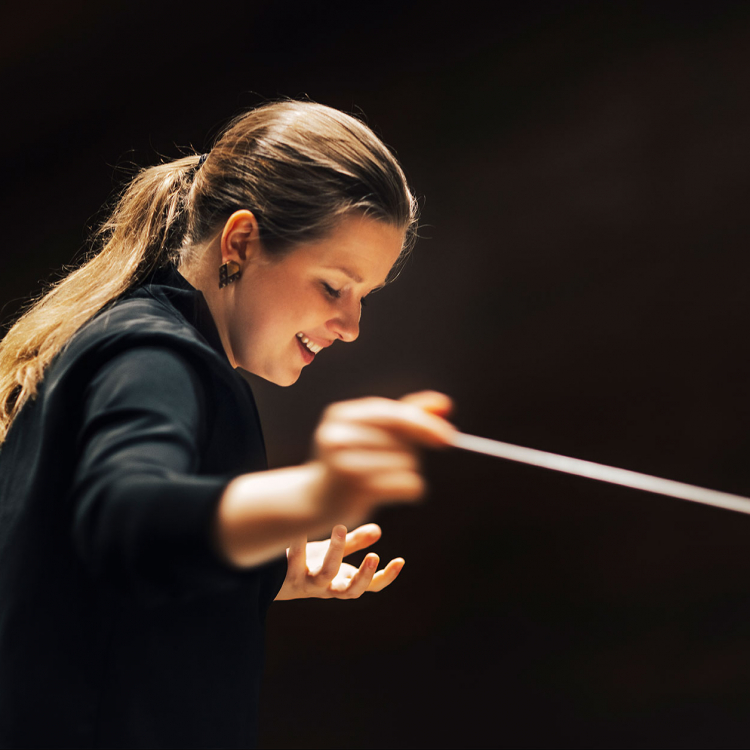
Emilia Hoving conductor
Emilia Hoving has emerged as one of the most exciting young Finnish conductors today. In 2024-2025 she returned to prominent orchestras such as the Philharmonia Orchestra, the Swedish Royal Philharmonic Orchestra, the Helsinki Philharmonic, the BBC National Orchestra of Wales, the Norwegian Radio Orchestra, Malmö Symphony Orchestra, the Gothenburg Symphony and the Adelaide Symphony. She also made her debuts with the Strasbourg Philharmonic, the Belgian National, the Trondheim Symphony, the Stavanger Symphony, the Royal Scottish National, the Orquesta Castilla y Leon, the Tasmanian Symphony and the Netherlands Radio Philharmonic (at the Concertgebouw).
Other highlights of the past season were the Orchestre Philharmonique de Radio France, the BBC Symphony, the Royal Philharmonic, the Tonkünstler Orchestra Wien, the Tenerife Symphony and the Swedish Radio Symphony Orchestra.
Emilia Hoving conducted the final concert at Side by Side in 2025 and 2024 and the school concert Bubblor at the Gothenburg Symphony in 2023. In the summer of 2022, she made her Tokyo debut at Suntory Hall as conductor of the Yomiuri Nippon Symphony and her UK debut at the Philharmonia, where she has now become a regular guest. Hoving has conducted many works by living (especially Finnish) composers and gave the Australian premiere of Missy Mazzoli's Procession at the Adelaide Festival.
Hoving studied at the Sibelius Academy in Helsinki with Sakari Oramo, Atso Almila and Jorma Panula. She received the Finnish Critics' Prize in 2021 as best newcomer and was an assistant to Hannu Lintu at Finnish Radio (2019) and to Mikko Franck at Radio France (2020-22).
David Roy baryton
The young Polish baritone David Roy has performed in Gianni at the Teatro Comunale Bolzano, in La traviata at the Opera Nova in Bydgoszcz and made his debut at the Royal Swedish Opera in The Barber of Seville. He also sang in Carmina Burana with the Kalisz Philharmonic. From the 2025-2026 season, he will join the Junges Ensemble at the Semperoper in Dresden. He is currently studying in the soloist class at the Hannover University of Music, Drama and Media.
David Roy took his first steps on stage at the Opera Nova in Bydgoszcz. Since 2022, he has collaborated with the Royal Polish Opera in Warsaw and participated in the Rossini Festival in Pesaro. He has also won prizes in several prominent competitions.
Michael Smallwood tenor
Australian tenor Michael Smallwood commenced vocal training while completing a law degree the University of Melbourne. He joined the Opera Studio at the Hamburg State Opera in 2001. His wide repertoire ranges from Monteverdi, Handel, Gluck and Mozart via Flotow, Wagner and Verdi to Richard Strauss, Janacek, Britten and Berg.
Guest engagements have taken him to La Scala in Milan, the Paris National Opera, the Opéra de Lyon, the Flemish Opera and the Dutch National Opera, the Gran Teatre del Liceu in Barcelona and the Teatro Real in Madrid. He works closely with the Staatsoper Unter den Linden in Berlin, where he has performed roles such as Mercure in Rameau's Hippolyte et Aricie, Monostatos in The Magic Flute, Goro in Madama Butterfly and Spoletta in Tosca.
He has worked with renowned conductors such as Daniel Barenboim, Philippe Jordan, Sir Simon Rattle, Marek Janowski, René Jacobs and Vladimir Jurowski. His most recent engagements include Tosca at the Semperoper Dresden and the Opéra de Lyon. He has also sung Hansel and Gretel at the Nederlandse Reisopera and The Magic Flute at the Sydney Opera.
Clarice Granado soprano
Swedish soprano Clarice Granado recently had great success in Carmina Burana at Folkoperan in Stockholm. She studied musical and acting at The American Musical and Dramatic Academy in New York and at the University College of Opera in Stockholm where she graduated in 2024.
Clarice Clarice Granado made her operatic debut in the lead in Il Colore fa la Regina by Carlo Francesco Pollarolo in 2022 at the Vadstena Academy. In spring 2025 she sang Pamina at Folkoperan. She is also sought after as a concert singer with a wide ranging repertoir.
Göteborgs Symfoniska Kör
The choir was founded in 1917 by cousins Elsa and Wilhelm Stenhammar. Elsa Stenhammar was one of the driving forces in turn-of-the-century choir life in Gothenburg and became the choir's first rehearser. On December 8, 1917, the choir debuted in Beethoven's Choir Fantasy with Wilhelm Stenhammar as soloist at the grand piano. As the country's oldest symphonic choir, they were able to celebrate their 100th anniversary in 2017 with a big celebratory concert where Mozart and Brahms as well as Stenhammar, Elfrida Andrée and Björn & Benny were on the program.
The Gothenburg Symphony Choir is a non-profit association that is linked to the Gothenburg Symphony. The choir participates in concerts and performances under both the orchestra's and its own auspices. The music is mixed and the repertoire extensive. The Gothenburg Symphony Choir has participated in concerts in, among other places, the Royal Albert Hall and Canterbury Cathedral in England, as well as participated with the Gothenburg Symphony in the annual music festival in the Canary Islands and on a tour to China.
Göteborgs Symfonikers Vokalensemble
The Gothenburg Symphony Vocal Ensemble (GSVE) was formed in 2016 and consists of 12 professional singers. The ensemble works both as part of the Gothenburg Symphony Choir in major symphonic works performed together with the Gothenburg Symphony, and as an independent ensemble under the direction of Katie Thomas.
GSVE is a group of experienced and versatile singers, who perform varied programs and explore a wide repertoire, from medieval music to newly commissioned works. The ensemble has previously collaborated with, among others, the Helsingborg Symphony Orchestra and the Barockakademin Göteborgs Symfoniker and performs regular vocal programs both in Gothenburg's Concert Hall and around the Västra Götaland region.
Katie Thomas choirmaster
Katie Thomas is a choral conductor from Wales and since 2023 the choirmaster of the Gothenburg Symphony Orchestra. She is also the conductor and artistic director of the Gothenburg Symphony Vocal Ensemble.
Previous engagements include nine years as a voice coach for the BBC Chorus, assignments as a guest choirmaster and conductor with the BBC Singers, MDR Rundfunkchor, National Youth Choirs of Great Britain and the Junior Royal College of Music, as well as a guest lecturer in choral conducting and director of the chamber choir at the University of Music and Performing Arts in Gothenburg. She has been a teacher of choral conducting techniques at the Association of British Choral Directors and a judge at choral festivals worldwide within the organization Interkultur.
As a professional soprano, Katie Thomas has been engaged with the UK's leading choirs, such as the Monteverdi Choir under the direction of Sir John Eliot Gardiner, Polyphony and the Academy of Ancient Music. She has appeared in major concert venues in Europe and the USA, including the Concertgebouw Amsterdam, the Musikverein Vienna and Carnegie Hall in New York. Together with London Voices, she has recorded several soundtracks for films and video games, often at the renowned Abbey Road Studios, as well as concerts for both television and radio. Katie Thomas is a graduate of Cardiff University and the Royal Academy of Music in London. In 2020, she was appointed an Associate of the Royal Academy of Music (ARAM) in the United Kingdom for outstanding contributions to professional music and significant achievements in conducting and choral music.


 031-726 53 00
  biljett@gso.se