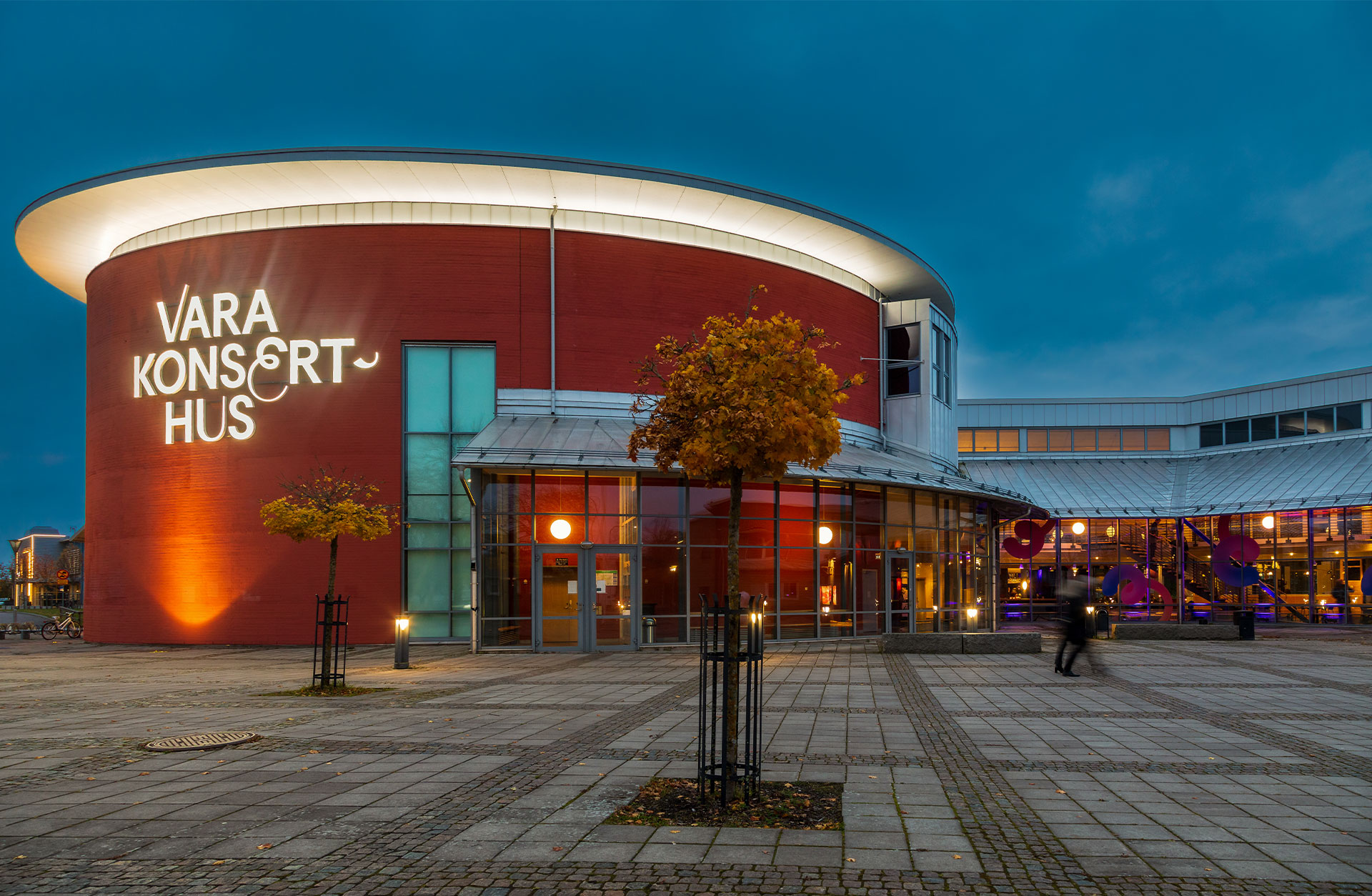
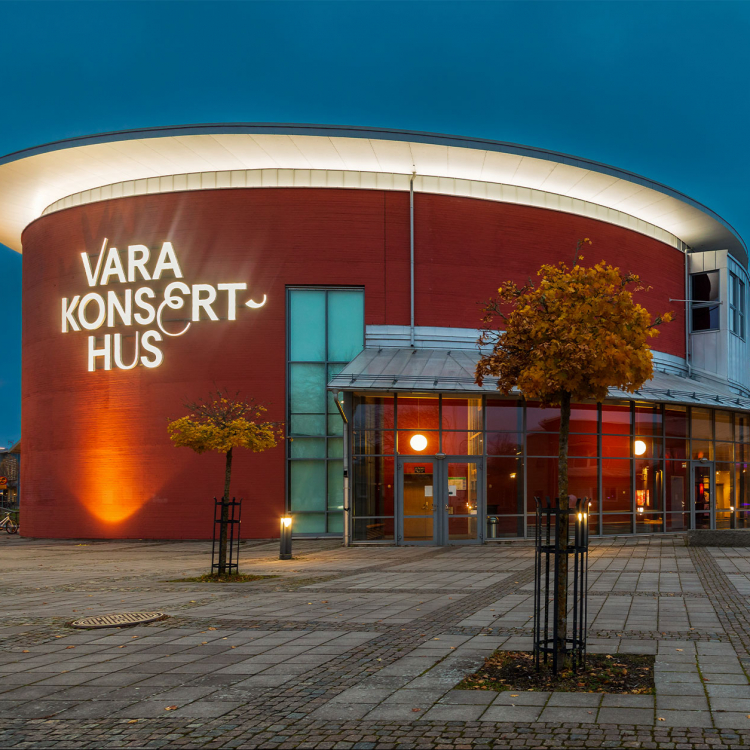
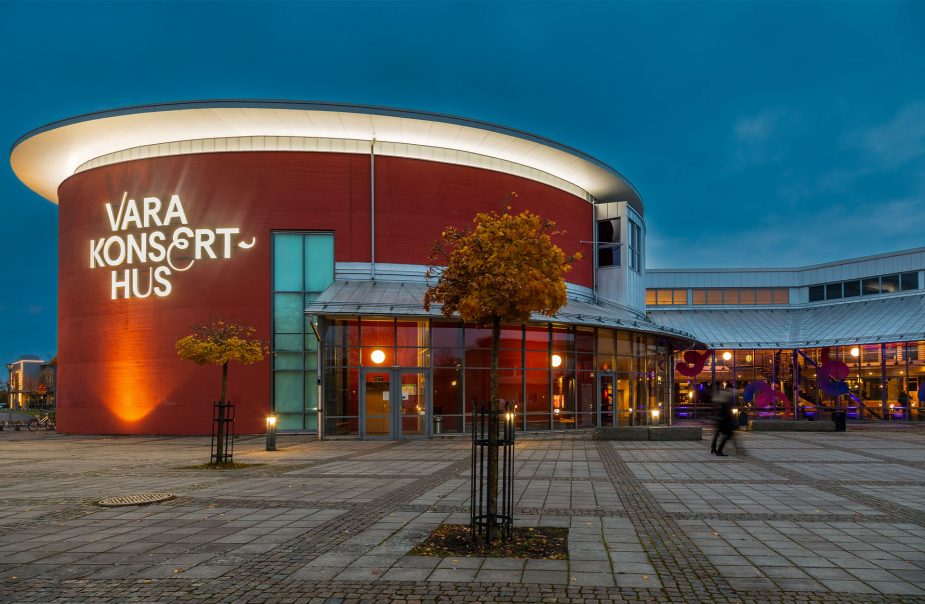
Vara Konserthus, Stora Salen
Gothenburg Symphony Orchestra plays in Vara Konserthus
Event has already taken place. Gothenburgs Symphony Orchestra plays beautiful music in Vara Konserthus under the leadership of concert master and violinist Sara Trobäck.
Wolfgang Amadeus Mozart (1756-1791)
Eine kleine Nachtmusik
Allegro
Romanze: Andante
Menuetto e Trio
Rondo: Allegro
One might wonder if there is a more beautifully crafted and polished gem than Eine kleine Nachtmusik - so appealing, so perfect. Nachtmusik is German for "serenade", and when it was composed, Mozart had already composed twelve serenades. Compared to the earlier serenades, it truly lives up to its name - a little one. It becomes a miniature, a simple, classically pure and easily accessible trifle, in terms of scope. The earlier serenades could be 45 minutes long. A serenade should also be intended to be played outdoors, but that does not work at all with Eine kleine Nachtmusik with its lovely and intimate string music.
Mozart included Eine kleine Nachtmusik in his own catalogue of compositions in Vienna on August 10, 1787, and listed it as having five movements. There was another minuet - but this movement disappeared early in the work's history and has never been found. It has also not been possible to find out why Mozart wrote this lovely entertainment music. In any case, it does not seem to have been a commission, but that he wrote music out of his own interest.
It has been surprising that the mature master of cosmopolitan Vienna interrupted the demanding work of orchestrating the exciting nighttime moods of the opera Don Giovanni in favor of this delicacy. Was it the contrast he needed? Was the inspiration pressing?
Söderlundh Oboe Concertino 15 min
Lille Bror Söderlundh (1912-1957)
Oboe Concertino
Lille Bror Söderlundh was a composer, singer-songwriter, conductor at various theaters in Stockholm from 1936 to 1941, and a choir conductor in Leksand and Borlänge. He became known for his songs to texts by Nils Ferlin, published in collections such as När skönheten kom till byn, Prästkrage and Sorgmantel. He also composed children's operas, chamber music, choral and instrumental music, and was strongly influenced by folk music.
The Concertino for oboe and string orchestra was written in 1944 and dedicated to the oboist Rolf Lännerholm. It was premiered at a concert that Söderlundh had arranged himself in the Grünewald Hall with his songs and newer compositions. Unfortunately, the reception was skeptical, to say the least. It was not until the 1950s that Söderlundh had his breakthrough as a composer, primarily with his violin concerto from 1954.
Intermission25 min
R Schumann Abendlied (string orchestra, arr. Svendsen) 4 min
Robert Schumann (1810-1856)
Abendlied (string orchestra, arr. Svendsen)
Abendlied, ‘evening song’, was originally a piano piece. Robert Schumann composed it in 1849 for his collection of 12 piano pieces “for small and large children” (Op 85). In 1872, the Norwegian composer Johan Svendsen wrote this arrangement for string orchestra, one of many he made of Schumann’s rich piano music. The most extensive Schumann arrangement dates from the summer of 1866, when Svendsen orchestrated Faschingsschwank aus Wien, Op 26, for large orchestra.
Schubert Symphony No. 5 30 min
Franz Schubert (1797-1828)
Symphony No. 5 D. 485
No great composer received as little international attention during his lifetime as Schubert. When he died, aged 31, he was practically unknown outside Vienna, and in Vienna he was best known for his songs. Schubert's vocal singing style is also found in his instrumental compositions.
Franz Schubert's Fifth Symphony, without trumpets and timpani, is a youthful masterpiece – written when he was 19. The work carries a lightness, elegance and luminosity. Mozart had been dead for 25 years and his music was more popular than ever. For a young composer, Mozart was the model to emulate. Symphony No. 5 is a chamber symphonic gem in which every instrument is allowed to breathe. Parts of the melody echo in the lower instruments as accompaniment, a technique that can be heard throughout the symphony's four movements. The opening Allegro movement bubbles with energy, and the finale after the minuet sparkles with playful brilliance. The slow second movement is perhaps the most original. The singable melodies (cantilenas) carry an operatic calm. The duet between violins and woodwinds has a dreamy sharpness.
A couple of months before the work was completed (1816), Schubert wrote in his diary: "O Mozart, immortal Mozart! What countless impressions, of a brighter and better life, you have stamped on our souls."
Saturday 25 October 2025: The event ends at approx. 18.00
Participants
Gothenburg Symphony Orchestra
The Gothenburg Symphony was formed in 1905 and today consists of 109 musicians. The orchestra's base is Gothenburg Concert Hall at Götaplatsen that has gathered music lovers since 1935. Since the 2019-2020 season, Barbara Hannigan is Principal guest conductor. We are also a proud partner of Barbara Hannigan's Equilibrium mentoring program focusing on young singers at the start of their careers. The title Principal Guest Conductor is shared by Pekka Kuusisto from 2025.
Wilhelm Stenhammar was the orchestra's chief conductor from 1907 to 1922. He gave the orchestra a strong Nordic profile and invited colleagues Carl Nielsen and Jean Sibelius to the orchestra. Under the direction of conductor Neeme Järvi from 1982-2004, the orchestra made a series of international tours as well as a hundred disc recordings and established themselves among Europe's leading orchestras. In 1996, the Swedish Riksdag appointed the Gothenburg Symphony as Sweden's National Orchestra.
In recent decades, the orchestra has had prominent chief conductors such as Santtu-Matias Rouvali, Mario Venzago and Gustavo Dudamel, following Kent Nagano as Principal Guest conductor. Anna-Karin Larsson is CEO and artistic director, Gustavo Dudamel honorary conductor and Neeme Järvi chief conductor emeritus. The orchestra's owner is the Västra Götaland Region.
The Gothenburg Symphony works regularly with conductors such as Herbert Blomstedt, Joana Carneiro, Jukka-Pekka Saraste, Christian Zacharias and Anja Bihlmaier.
Sara Trobäck artistic director
Sara Trobäck has been Principal concertmaster of the Gothenburg Symphony Orchestra since 2002. She studied with Tibor Fülep at the Gothenburg Academy of Music and with György Pauk at the Royal Academy of Music in London. In connection with her graduation concert in 2001, she received the academy's prestigious Professional Diploma and the Dove Award. Sara Trobäck has also participated in master classes with Lord Yehudi Menuhin, Ruggiero Ricci and Joshua Bell.
As a soloist, she has appeared with the Gothenburg Symphony Orchestra, the Swedish Chamber Orchestra, the Stockholm Sinfonietta and the Helsingborg Symphony Orchestra, among others. In 2010, she premiered a violin concerto by Johannes Jansson dedicated to her and the Gothenburg Symphony Orchestra. Her London debut took place in the summer of 1999 when she performed Tchaikovsky's Violin Concerto with the London Soloists in St Martin-in-the-Fields. Sara Trobäck has also given concerts in Scotland, Germany, France, Spain, Portugal and China.
In 2002 she formed Trio Poseidon together with solo cellist Claes Gunnarsson and pianist Per Lundberg. The trio has among other things recorded Beethoven's Triple Concerto. Sara Trobäck plays a Giovanni Battista Guadagnini on loan from the Järnåker Foundation.
Mårten Larsson oboe
Mårten Larsson was born in Örebro and trained at the Royal Academy of Music under Alf Nilsson. He has been a leading oboist in Sweden for many years and is solo oboist in the Gothenburg Symphony Orchestra. He has also been a member of the Stockholm Sinfonietta. Mårten Larsson teaches at the Gothenburg Academy of Music and Drama and has released albums with music by Johan Helmich Roman, JS Bach and Keith Jarrett, among others.


 031-726 53 00
  biljett@gso.se