Göteborgs Konserthus
Side by Side 2025: Closing Concert
Event has already taken place. Festive concert in Gothenburg Concert Hall with Gothenburg Symphony and advanced orchestras and choirs from Side by Side music camp. A programme full of classical masterpieces performed by the stars of today and tomorrow.
Concert length: 1 h 40 min incl. intermission
Scene: Stora salen
180 SEK Young up to 29 80 SEK
Student 80 SEK
Children 80 SEK
Welcome to conclude Gothenburg Concert Hall’s spring season together with the international music camp Side by Side. In Closing Concert, the virtuosos of tomorrow share the stage with Gothenburg Symphony Orchestra in a powerful symphonic concert in the Great Hall. The program offers, among other things, music from Stravinsky, Bernstein and Helena Munktell, and is also streamed live on GSOplay.
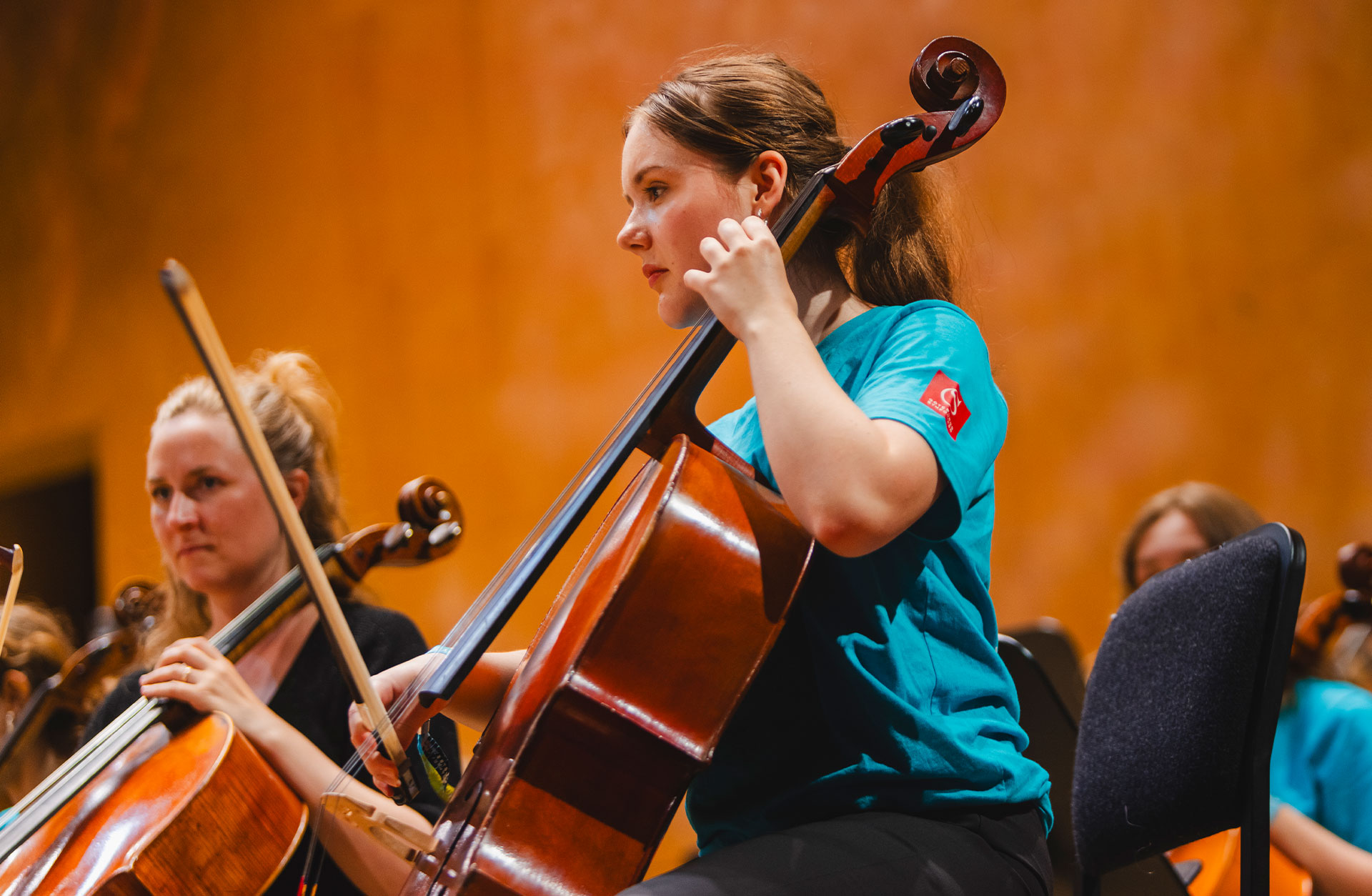
Advanced and Pre-advanced Orchestra are Side by Side’s musical spearhead and during the evening they form a double symphony orchestra together with Gothenburg Symphony Orchestra. Accompanied by Youth Choir and Gothenburg Symphony’s Vocal Ensemble, they offer, among other things, Brorodin’s Prins Igor and Mozart’s very last work, the unforgettable Lacrimosa from Requiem. All under the direction of conductors Emilia Hoving and Marjolein Vermeeren, and choir conductor Birgitta Mannerström Molin.
The evening’s musical procession includes well-known pieces such as Bernstein’s Mambo and an excerpt from Helena Munktell’s Suite Dalécarlienne. The program also boasts music by both Anna Clyne and Copland. Of course, there will be some movie magic too, this time with a piece from Jurassic Park by the masterful John Williams. Music from Stravinsky’s magnificent ballet The Firebird then concludes the concert, Gothenburg Symphony Orchestra’s spring season, and the entire Side by Side 2025.
The international music camp Side by Side is organized by Gothenburg Symphony Orchestra and open to participants 6-23 years old. Side by Side creates meeting places where children and young people from different cultures and backgrounds can sing and play together, side by side with professional musicians. The camp promotes classical music and works for tolerance, cooperation, and equality.
Programme
Bernstein West Side Story: Mambo 3 min
Munktell Andante from Suite Dalécarlienne 5 min
Helena Munktell (1852 – 1919)
Suite Dalécarlienne Op 22
Helena Munktell, born at Grycksbo manor, has been noticed in recent years. For example, her vocal pieces, violin sonatas and the opera In Florence have been recorded on disc. She studied in Paris like many other Swedish colleagues, including for the composer Vincent d'Indy. She wrote four symphonic works, a series of songs and choral works and was the first woman to compose an opera. The Dala suite had its premiere in Paris in 1910 and depicts the beautiful Swedish Dalarna, where the church boats pull up on Siljan and the fiddlers arrive. In 1916, the work had its Swedish premiere in Stockholm. Helena Munktell was one of the founders of the Association of Swedish Composers in 1918.
Cederberg Orreteg That Night of Falling Stars 6 min
Mozart Lacrimosa from Requiem 3 min
Eight movements, a mysterious visitor and a hastily deceased composer. Rarely has a work been more mythologized than Mozart's Requiem in D minor, K. 626. A requiem is a Catholic death mass, which is set to music after the texts of the Latin service, the first line of which reads: "Requiem aeternam dona eis, Domine" (Giv them, O Lord, the eternal rest). Mozart's Requiem consists of eight movements, but how these actually came about has puzzled people for centuries.
Lacrimosa means "weeping" and was one of the parts completed by colleague Süssmayr after Mozart's death. The work was delivered to the client in 1792.
Williams Theme from Jurassic Park 6 min
Borodin Finale from Symphony No. 2 7 min
Alexander Borodin (1833-1887)
Symphony No. 2
Alexander Borodin composed his second symphony over a long period of time, between 1869 and 1876, and continued to polish it until his death. In his early works, he was influenced by classical music that originated in Russian folk music. The second symphony shows a developed and more original style.
The symphony opens with a powerful unison theme that gives associations to Beethoven's Fifth. There is plenty of drama there. Parts of the symphony's material were also originally written for the abandoned opera Prince Igor (which he then picked up again in 1874). In the light and exuberant second movement, you can hear how Borodin was inspired by new brass instruments that he got to see and feel thanks to Rimsky-Korsakov. The finale is an exuberant and grand finale in major.
Intermission25 min
Copland Hoe Down from Rodeo 3 min
Clyne River from Abstractions 4 min
Anna Clyne (f 1980)
Abstractions
Abstractions is a suite in five movements inspired by five contrasting contemporary artworks from the Baltimore Museum of Art and from the private collection of Rheda Becker and Robert Meyerhoff. The work premiered in North Bethesda, Maryland in 2016 with the Baltimore Symphony conducted by Marin Alsop.
"By drawing inspiration from these works of art, I have tried to capture emotions or imagery that they evoke, the concept of the work or the process that the artists adopted. Some common threads between the artworks are their use of limited color palettes, references to nature and capturing time as a flowing stream, distilling and preserving it for us to contemplate. I was also attracted to the structures in these works, which at first glance could be seen as random, and even chaotic, but which are in fact created within a sense of order – they feel both dynamic and structural.” (Anna Clyne)
Gipps Adagio from Symphony No. 2 3 min
Borodin from Prince Igor: Polovetsian Dances 9 min
Stravinsky from Suite from The Firebird (1919) 11 min
Igor Stravinsky (1882-1971)
Suite from The Firebird (1919), selection
Dance of the princesses
Kastchei's infernal dance
Finale
The Firebird was an unparalleled success for the Russian Ballet in Paris and even Stravinsky was at the top of the list. What a luxury to make use of the giant orchestra that the dance director Djagilev placed at his disposal with the ulterior motive of creating a sensation - "biggest, best and most beautiful!" The trick worked. Even today, The Firebird in its various forms is Stravinsky's most played work. His own memories of the premiere are fragmentary: "The first Firebird! I stood in the dark in the opera during eight orchestral rehearsals with Pierné as conductor. The stage and the entire theater sparkled at the premiere and I don't remember anything else".
Wednesday 18 June 2025: The event ends at approx. 20.40
Participants
Gothenburg Symphony Orchestra
The Gothenburg Symphony was formed in 1905 and today consists of 109 musicians. The orchestra's base is Göteborgs Konserthus, the funk gem at Götaplatsen that has gathered music lovers since 1935. Since the 2019-2020 season, Barbara Hannigan is Principal guest conductor. We are also a proud partner of Barbara Hannigan's Equilibrium mentoring program focusing on young singers at the start of their careers. The title Principal Guest Conductor is shared by Pekka Kuusisto effectively in 2025-2026.
Wilhelm Stenhammar was the orchestra's chief conductor from 1907 to 1922. He gave the orchestra a strong Nordic profile and invited colleagues Carl Nielsen and Jean Sibelius to the orchestra. Under the direction of conductor Neeme Järvi from 1982-2004, the orchestra made a series of international tours as well as a hundred disc recordings and established themselves among Europe's leading orchestras. In 1996, the Swedish Riksdag appointed the Gothenburg Symphony as Sweden's National Orchestra.
In recent decades, the orchestra has had prominent chief conductors such as Santtu-Matias Rouvali, Mario Venzago and Gustavo Dudamel, following Kent Nagano as Principal Guest conductor. Anna-Karin Larsson is CEO and artistic director, Gustavo Dudamel honorary conductor and Neeme Järvi chief conductor emeritus. The orchestra's owner is the Västra Götaland Region.
The Gothenburg Symphony works regularly with conductors such as Herbert Blomstedt, Joana Carneiro, Jukka-Pekka Saraste, Christian Zacharias and Anja Bihlmaier.
Emilia Hoving conductor
Emilia Hoving has emerged as one of most exciting young Finnish conductors of today. She was the winner of the Finnish critics’ prize 2021 for the Best Newcomer in the Arts. Her assignments as Assistant to Hannu Lintu at the Finnish Radio (2019) and to Mikko Franck at Radio France (2020-22) both led to international appearances with orchestras such as the Royal Stockholm Philharmonic, Luxembourg Philharmonic, BBC Symphony and Orchestre National de Lille as well as with the Helsinki Philharmonic.
Emilia Hoving has conducted at Wiener Konzerthaus and made her German debut with the Orchestre Philharmonique de Radio France in their Berlin Philharmonie concert 2022 at only a few hours’ notice. In 2023-2024 she debuted with Swedish Radio Symphony, Netherlands Radio Philharmonic, Royal Philharmonic, Tonkuenstler Wien, Bournemouth Symphony and Tenerife Symphony orchestra. She also led the closing concert of Side by Side Music camp 2024 and the school concert Bubbles at the Gothenburg Symphony in 2023. In november 2024 she led the Gothenburg Symphony in Dvoráks symphony no 9.
In summer 2022 she made her Tokyo debut at Suntory Hall conducting the Yomiuri Nippon Symphony and her UK debut conducting the Philharmonia, where she has now become a regular guest. Hoving has conducted many works by living (particularly Finnish) composers, and last season gave the Australian premiere of Missy Mazzoli’s Procession at the Adelaide Festival.
Hoving studied at the Sibelius Academy in Helsinki with Professors Sakari Oramo, Atso Almila and Jorma Panula.
Marjolein Vermeeren conductor
Marjolein Vermeeren made her successful professional conducting debut with the Gothenburg Wind Orchestra in May 2022 and she has been back as guest conductor several times since then. She has worked with professional orchestras such as Östgötamusiken, Marinens Musikkår and Helsingborg Symphony Orchestra and has led El Sistema concerts with the Malmö Symphony Orchestra and the Swedish Chamber Orchestra. In the 2024-2025 season, she will make her debut with the Norrköping Symphony Orchestra and Gotlandsmusiken.
Marjolein Vermeeren is flutist in the Gothenburg Symphony and grew up in the southern Netherlands where wind music is big. She has worked a lot with youth orchestras and participated for several years at Side by Side as a conductor and instructor for the oldest participants.
Deltagare från musiklägret Side by Side
Göteborgs Symfonikers Vokalensemble
The Gothenburg Symphony Vocal Ensemble (GSVE) was formed in 2016 and consists of 12 professional singers. The ensemble works both as part of the Gothenburg Symphony Choir in major symphonic works performed together with the Gothenburg Symphony, and as an independent ensemble under the direction of Katie Thomas.
GSVE is a group of experienced and versatile singers, who perform varied programs and explore a wide repertoire, from medieval music to newly commissioned works. The ensemble has previously collaborated with, among others, the Helsingborg Symphony Orchestra and the Barockakademin Göteborgs Symfoniker and performs regular vocal programs both in Gothenburg's Concert Hall and around the Västra Götaland region.
Birgitta Mannerström-Molin körledare
Birgitta Mannerström-Molin is a choir conductor and singing teacher. She also teaches at the University of Stage and Music in Gothenburg and is involved as a course instructor and choir conductor at national level. She has also been involved in the development of El Sistema in Sweden and is the conductor and artistic advisor for Side by Side by El Sistema, which is performed every year by the Gothenburg Symphony. In 2016, Birgitta Mannerström-Molin was appointed Children's and Youth Choir leader of the Year.
She is also a teacher at Hvitfeldtska Musikgymnasiet and project leader for young people at Sweden's Church Song Association.


 031-726 53 00
  biljett@gso.se