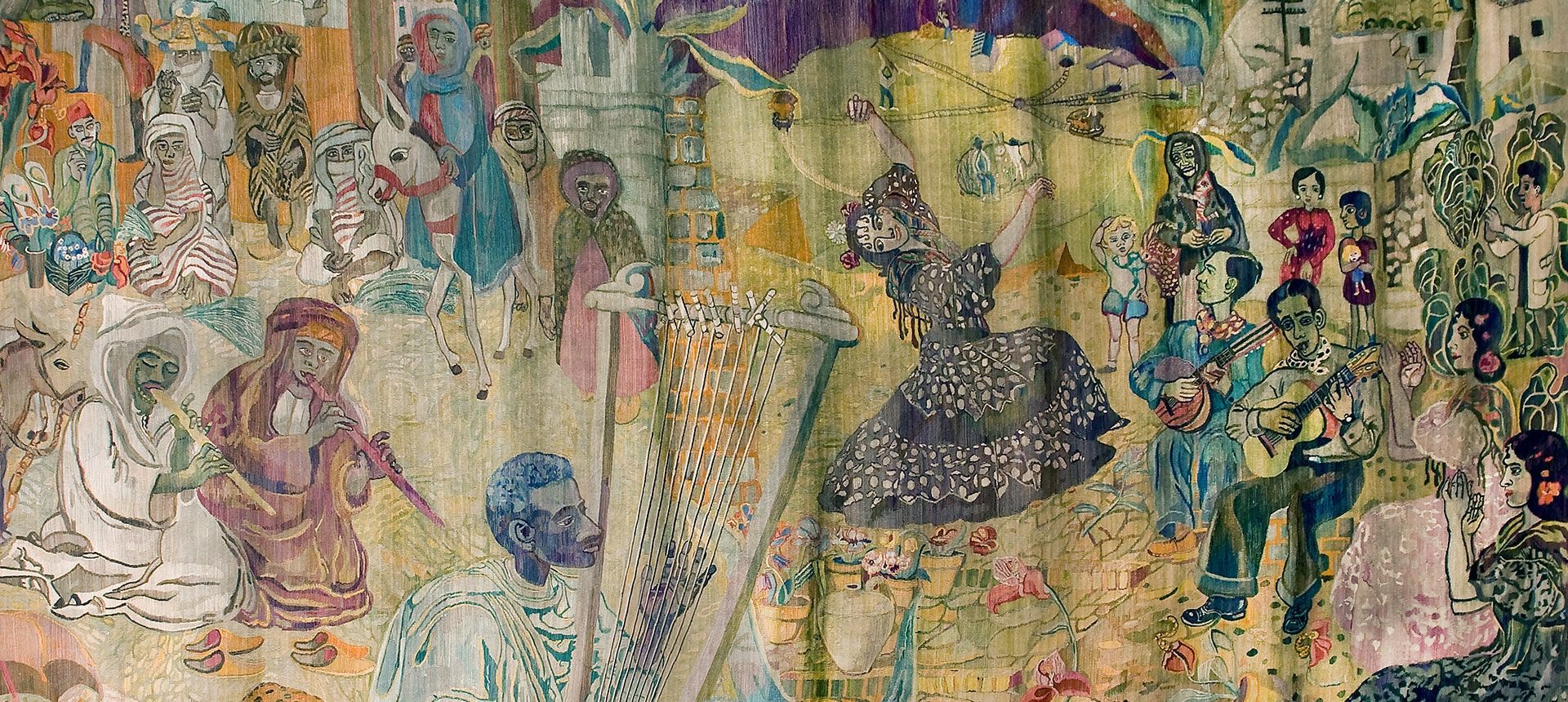
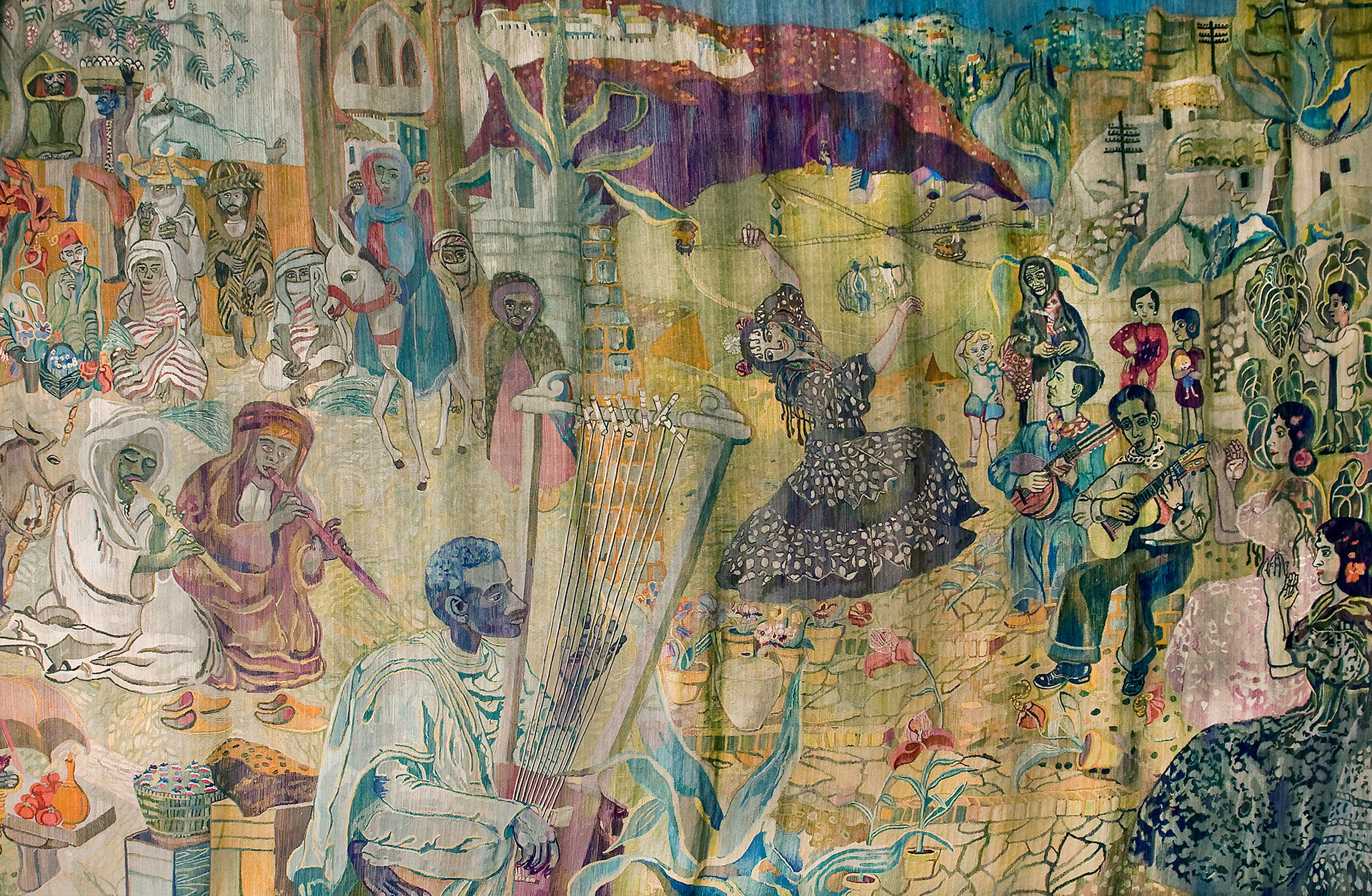
When Gothenburg Concert Hall was completed, a competition was announced in July 1935 for the decoration of the short walls in the foyer at Götaplatsen – either in fresco or textile form. Sven X:et Erixson (1899–1970) was one of the winners with his proposal Melodies by the Square, a monumental tapestry inspired by motifs from Spain and North Africa.
Here the viewer encounters a fiery Spanish dancer, a harpist, two men with stringed instruments, and people in motion, all rendered in a concentrated and daring perspective. The man with the banjo-like instrument is said to be Sven Erixson himself, while the fair-haired boy is his son.
From sketch to tapestry
X:et was renowned for his vivid and expressive works and worked throughout his life across a wide range of techniques and materials – painting, printmaking, glass, fresco and textiles. The original design for Melodies by the Square, the so-called cartoon, is today displayed opposite the entrance to Stenhammar Hall. Here, visitors can follow the development of the work from initial sketch to finished tapestry.
Before the weaving could begin, a full-scale design first had to be produced. X:et painted it on site at Gothenburg Concert Hall over a period of seven months. Once completed, the painting was rolled up and transported to Stockholm, where it served as the weavers’ visual reference during the extensive work at the loom.
Creating the tapestry was both a technical and artistic challenge. Measuring 6 by 9 metres, the work required a specially constructed loom standing an impressive 6.5 metres high. Several different weaving techniques were employed in order to do justice to the painting’s richness of colour and intricate detail. The materials consist of linen yarn and wool.
Barbro Nilsson and six weavers
The work was led by textile artist Barbro Nilsson, who between 1937 and 1939 created the tapestry in close collaboration with Sven Erixson together with six weavers: Astrid Svensson, Brita Eliasson, Ingrid Danielsson, Kerstin Ekman (later Ekman-Zethraeus), Kerstin Fredriksson and Margareta Haggård. In the lower left corner of the tapestry, the six weavers are symbolised as oranges – fruit they consumed in great quantities during the weaving period.
In the painting In the Weaving Studio, now part of the collection at the Gothenburg Museum of Art, the full-scale design can be seen hanging above four of the weavers as the work progresses. After the tapestry was completed, X:et donated the original design to Saltsjöbaden Co-educational School, where it still hangs in the school auditorium today.
In addition to his collaboration with Sven X:et Erixson, Barbro Nilsson also worked with artists such as Endre Nemes and Olle Nyman. She was Head Teacher of Textiles at Konstfack University of Arts, Crafts and Design from 1947 to 1957, and Artistic Director of Märta Måås-Fjetterström’s weaving studio between 1942 and 1970.
A living work
In the book The Art of Sven Erixson (1967), the art historian Lars-Erik Åström described the tapestry in the following words: “It is not a textile translation of a highly complex painting; it is a wall of life, colour and textile material in which everything feels equally natural, fresh and alive.”
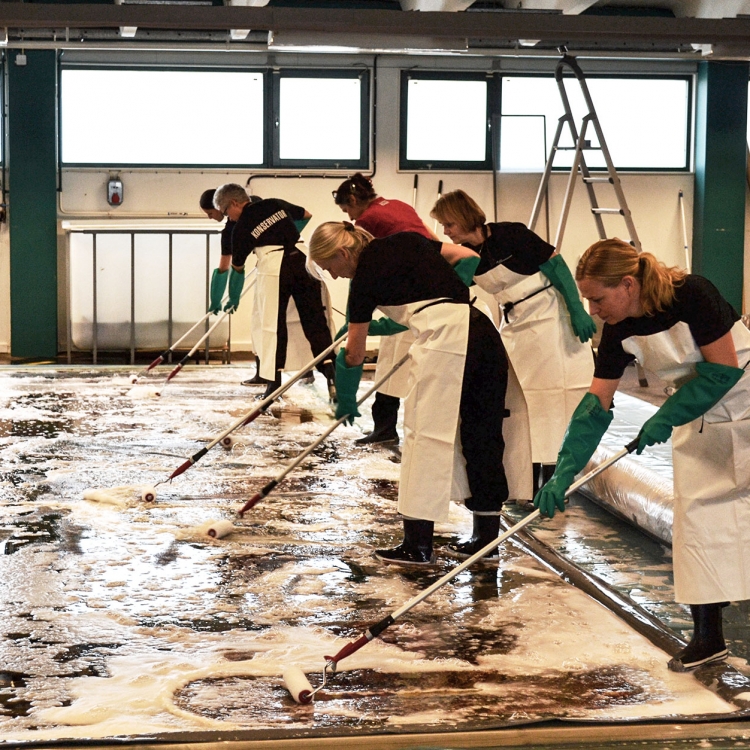
In the spring of 2015, the tapestry was cleaned and restored, giving the colours renewed brilliance and vitality.
Art with music in focus
Many of the works of art in Gothenburg Concert Hall are connected to music or have a relationship with Gothenburg Symphony Orchestra. Here you will find everything from portraits of composers such as Grieg and Sibelius to one of Sweden's largest tapestries, with design by Sven X-et Erixson.
Experience the concert magic
Gothenburg Concert Hall has enchanted music lovers since 1935! It is one of life’s great pleasures to come here, relax and take in the atmosphere in the beautiful surroundings, before being moved, exalted and overwhelmed by the evening’s music.