Göteborgs Konserthus
In the footsteps of Schoenberg
Follow along on a journey through the 20th century, where thrilling modernism and contemporary sounds meet. Barbara Hannigan and musicians from the Gothenburg Symphony Orchestra present music connected to the innovative Arnold Schoenberg.
Concert length: 2 h incl. intermission
Stage: Stenhammarsalen
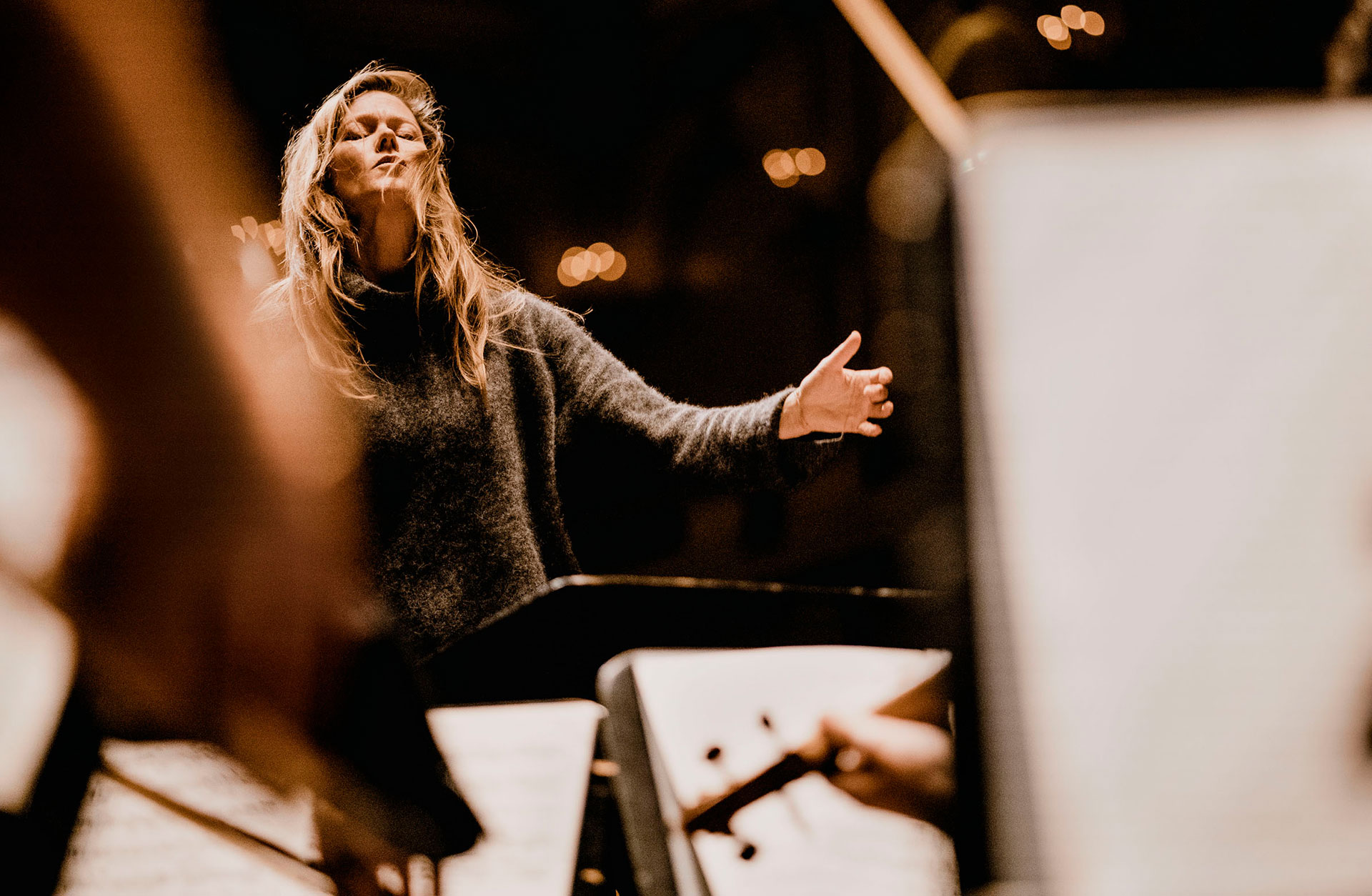
Barbara Hannigan leads an inspiring and captivating programme circling around Arnold Schoenberg and some of his contemporary colleagues, exploring their significance to 20th century music. With her uncompromising presence, she takes us through a concert in which expressionism, modernism and the thrilling new sound-worlds of chamber music all converge.
Arnold Schoenberg was a true revolutionary, one of modernism’s most influential figures and a teacher of several great twentieth-century composers. His Lieder (songs), composed during the transition between the late-romantic period and early modernism, are presented here in arrangements by Danish composer Hans Abrahamsen, who has gently adapted them to an orchestral format. Paul Hindemith studied under Schoenberg and developed his own sound, which can be heard clearly in his Kleine Kammermusik and Chamber Music No. 1, pieces in which tradition meets a modern form. Franz Schreker conducted several works by Schoenberg, and was well acquainted with his music. Schreker’s Der Wind is a golden piece for piano quintet from 1909. It reflects the expressive sound that inspired so many composers in Vienna around the turn of the last century.
We also hear exclusive music from the British-Iranian composers Golfam and Hooshyar Khayam, including a specially written new vocal work for Barbara Hannigan.
Programme
Paul Hindemith—another composer whose music was banned and persecuted by the Nazi regime—was a central figure in the musical life of the Weimar Republic, active as a composer, violinist, and conductor. The evening’s two works, which share musical material, both date back to 1922. Sonically, they differ from one another, yet neither lacks Hindemith’s distinctive signature. In Kleine Kammermusik (Little Chamber Music), we encounter a more matter-of-fact and dry phrasing; various dance forms whirl past, yet without sentimentality. The waltz is played—as the score somewhat pedantically emphasizes—at a consistently very low volume, and the central, tranquil section strips the music down to its barest essentials.
In the next piece, Kammermusik, we meet a bolder composer. Twelve musicians perform, incorporating percussion, piano, accordion, and even a siren and a tin can. Here, too, dances reappear; we hear the foxtrot and the march—echoes of the popular music of the era, yet filtered through Hindemith’s unique touch. The grotesque and the virtuosic coexist with the utterly mundane.
While both works fall under the category of chamber music, they differ fundamentally not only in their instrumentation but likely in their ambition as well. Yet, they are part of the same compositional inquiry: what can chamber music be when liberated from notions of refinement, solemnity, and beauty? With Hindemith, whether the ensemble numbers five or twelve, the music can transport us from the intimate to the grand—and back again.
Hooshyar Khayam (b 1978)
Abr (Clouds), for string quartet, piano and soprano
Abr (Clouds) is a single movement from Royâ, a cycle of dreamlike sonic landscapes. The music unfolds through subtle shifts in timbre, resonance, and density rather than thematic contrasts. Gestures gather and disperse, creating a sense of suspended time, where sound moves like passing formations in the sky.
This piece was composed during a time of deep unrest in Iran, and its presence here is inseparable from that moment. In a period of distance from so much that I held dear—left behind in Iran in times of darkness—I found solace in writing this music and in the presence of those who stayed close from afar. I am deeply grateful to Barbara Hannigan, whose attentiveness, humanity, and willingness to bear witness to what has been unfolding in Iran lend this performance a quiet but profound resonance.
With this concert, Barbara Hannigan brings together two works by my sister Golfam Khayam and me—one of us in Iran, the other far away—and in these times, it feels like the closest way we can still be together…
Abr does not seek to depict clouds, but to evoke their atmosphere—transient, weightless, and in constant motion. This piece is offered as a quiet tribute to the people of Iran, whose enduring cultural voice continues to carry memory, resilience, and poetic imagination across generations.
Hooshyar Khayam
Franz Schreker (1878–1934)
Der Wind (The Wind), for violin, clarinet, horn, cello, and piano
The quintet Der Wind did not see the light of day until 1980, though it was composed as early as 1909. The Austrian composer Schreker—one of the most influential composers of the early 20th century—created this music inspired by a poem and dedicated to the dancing sisters Grete and Elsa Wiesenthal. Schreker, whose relationship with Arnold Schoenberg was complex—a kind of love-hate dynamic—was one of many Jewish composers whose music was branded Entartete Musik (degenerate music) by the Nazis. Unlike Schoenberg, Schreker’s music does not drive quite so consistently toward the dissolution of tonality; instead, it moves through a freer harmonic landscape, one where the key seems to be constantly modulating. In Der Wind, the fluidity of both melody and timbre (the title itself points us in this direction) is palpable.
A remarkable passage stands out just a few minutes into the work. The piano silently depresses a chord while the violin plays a tremolo. The rest of the ensemble joins in, mirroring the piano’s silently held keys, and for a moment, the atmosphere of the room shifts. Perhaps—as others have suggested—this piano technique, unusual for the time, is a nod to Schoenberg’s Op. 11 for solo piano; traces of this approach (however rare) can, in turn, be traced back at least as far as Schumann’s Carnaval from 1835.
Esaias Järnegard
Golfam Khayam (b 1983)
Je ne suis pas une fable à conter
The piece Je ne suis pas une fable à conter ("I am not a tale to be told") is based on a poem published in 1955 by Ahmad Shamlou, a contemporary Iranian poet and one of Persia's cultural icons. Shamlou's poems are beyond time and space, speaking from the depths of an ancient land, speaking to you, me and us on nowhere-land. I had the privilege to grow up in a family to whom Shamlou was a close friend. I used to call him "Uncle". I grew up with his poems, and this particular poem has also been the narrator for so many silent voices seeking light through dark times.
Je ne suis pas une fable à conter includes musical cells/phrases in a controlled improvisation which gives liberty to the instrumentalists and soloist. It creates a Persian "carpet" upon which the soloist can perform. The music gathers vocal and instrumental gestures from Persian music, such as ornamentation, modal contours, and drones which are rooted in our tradition. This also includes Maqam (midal contours) from regional music of the Kurdish provinces, as mourning gestures, and typical modal phrases which are rooted in vocal practice, all reframed as in a new picture. The final phrase being exclaimed, its notes opposing to the constant drone note of b natural, is sung, in Farsi, on b flat: Man dardé moshtarekam, Maraa faryaad kon: "I'm the common pain, scream me out!"
Golfam Khayam 2023
Intermission25 min
Arnold Schönberg (1874-1951)
Lieder, arr. Hans Abrahamsen
The vocal compositions which Schönberg had published between 1903 and 1904 where dedicated to the mentor, friend and brother-in-law Alexander von Zemlinsky. It was Zemlinsky who acquainted the autodidact Schönberg with the inner life of the music of Brahms and Wagner, to which also those four songs which Schönberg later gathered under the opus number 2, bear witness. From Brahms he learned “Economy, but at the same time, richness". He owed Wagner “the ability to turn themes around” by using expanded harmonies.
Like in Verklärte Nacht, he used the publication of mystic Richard Dehmel’s collection of poems “Weib und Welt” (“Woman and World”). In particular Dehmel’s linguistic density in representing colours inspired Schönberg to look for a new “sound.”
Hindemith Kammermusik Nr. 1 15 min
Sunday 8 November 2026: The event ends at approx. 20.00
Participants
Musiker ur Göteborgs Symfoniker
Conductor and soprano Barbara Hannigan is Principal guest conductor of the Gothenburg Symphony Orchestra since 2019, embodying music with an unparalleled dramatic sensibility. She moves freely between the multiple roles of conductor, singer and curator. Over more than three decades, she has forged artistic partnerships with extraordinary musicians, directors and choreographers, including Romeo Castellucci, Claus Guth, Vladimir Jurowski, Katie Mitchell, Simon Rattle, Esa-Pekka Salonen, Kirill Petrenko, Sasha Waltz, and Krzysztof Warlikowski. The late conductor and pianist Reinbert de Leeuw has been an extraordinary influence and inspiration on her development as a musician.
In the 2026-2027 season, Hannigan begins her tenure as Chief Conductor and Artistic Director of the Iceland Symphony Orchestra, where her spirit of discovery will shape an artistic vision rooted in excellence, openness and collaboration, while forging new connections between Iceland and the wider international music community.
Balancing her work as both conductor and soprano, Hannigan maintains long-standing relationships with her colleagues in the orchestral, operatic and chamber music realms. She has maintained multi-year associations with London Symphony Orchestra (as Associate Artist), l'Orchestre de Chambre de Lausanne (as Principal Guest Conductor), and performs regularly with the Munich Philharmonic, Swedish Radio Symphony Orchestra, Swedish Chamber Orchestra, Orchestre Philharmonique de Radio France, and Danish Radio Symphony Orchestra. She makes her Rotterdam Philharmonic Orchestra conducting debut, performing as part of the joint project between the orchestra and Scapino Ballet entitled La Mer, in which she will sing, conduct and also dance with the artists of this world-renowned dance company. She continues to tour her unique production of Poulenc’s La Voix Humaine, after its most recent successes with New York Philharmonic and Czech Philharmonic Orchestras, bringing the work this season to Berlin with the Deutsches Symphonie-Orchester Berlin. Her recital tour with her most important musical partner, pianist Bertrand Chamayou (works by Messiaen, Scriabin and Zorn) continues in the 2026/27 season with performances throughout Europe.
Her awards and honours include the Governor General's Performing Arts Award (2026), the 2025 Polar Music Prize, 2025 Musical America Artist of the Year, "Accademico Onorario (Honorary Academician) (2025) at Accademia di Santa Cecilia, the Order of Canada (2016), Officier des Arts et des Lettres in France (2022), Gramophone Magazine’s 2022 Artist of the Year, Germany's Faust Award (2015), Sweden's Rolf Schock Prize for Musical Arts (2018), and Denmark’s Léonie Sonning Music Prize (2021).
Barbara Hannigan resides in Finistère, on the northwest coast of France, looking over an inlet which leads directly across the Atlantic to where she grew up in Waverley, Nova Scotia.
Marjolein Vermeeren flute
Joel Vaz, born in Portugal, is educated at the Haute École de Musique de Genève, ANSO i Lissabon, EPMVC i Viana do Castelo and at the Académie Musicale de Villecroze. In 2011 he joined the International Ensemble Modern Academy, collaborating closely with members of Ensemble Modern.
Joel has performed with numerous orchestras and ensembles, including the European Union Youth Wind Orchestra, Gulbenkian Orchestra, Portuguese Symphony Orchestra, Orquestra de Cadaqués, Orchestre de la Suisse Romande, Helsingborg Symphony Orchestra, Malmö Symphony Orchestra, Norrköping Symphony Orchestra and Royal Stockholm Philharmonic Orchestra. He played with the Orquestra Metropolitana de Lisboa 2017–2019 and the Banda Sinfónica da GNR 2009–2017. He joined the Gothenburg Symphony Orchestra in 2020.
He has appeared as a soloist with many orchestras in Portugal and is a founding member of Ensemble Palhetas Duplas who performs all over the Iberian peninsula.
Clarinetist Selena Markson Adler was born and raised in Toronto, Canada. Following studies at the Interlochen Arts Academy, The Juilliard School in New York, and The Cleveland Institute of Music, she moved to Sweden with her husband, where she secured her first position as alternating principal clarinetist with the Royal Stockholm Philharmonic Orchestra. After one season in Stockholm, she moved to the Gothenburg Symphony Orchestra, where she has been a member since 1995. Selena Markson Adler has performed at music festivals throughout Sweden, as well as at the Aspen Music Festival in Colorado, USA, and performed as soloist in the orchestra.
Ragnar Arnberg clarinet
Kaitlyn Cameron bassoon
Lisa Ford has been the principal horn player in the Gothenburg Symphony Orchestra for 30 years. Lisa is an active chamber musician and soloist and a member of the ensemble Gageego!. She is a senior lecturer at the Gothenburg Academy of Music and Performing Arts and a mentor in the master's program in symphony orchestra performance, she is a horn teacher and teaches wind and chamber music ensembles. Lisa Ford is educated at the Interlochen Arts Academy. She has been a member of the Civic Orchestra of Chicago and has a diploma from the Norwegian Academy of Music, NMH. She was previously assistant principal horn player in the San Diego Symphony Orchestra. She is also a certified professional coach.
The trumpeter Per Ivarsson has been principal trumpet in the Gothenburg Symphony Orchestra since 2011. He was recruited to the Malmö Symphony Orchestra even before he graduated from the Academy of Music in Karlsruhe, where he studied for six years. Per Ivarsson was born and raised in Malmö and started playing the trumpet when he was six years old. He has studied with Björn Lovén, Reinhold Friedrich and Håkan Hardenberger. Per Ivarsson is also a devoted chamber musician. With the Gothenburg Symphony Orchestra, Per Ivarsson has, among many other things, been a soloist in Jolivet's Heptade for trumpet and percussion and in Jolivet's second trumpet concerto. He has also made several recordings for GSOplay.
Justyna Jara began playing the violin when she was seven years old. After winning a prize at a competition for young violinists in Gdansk, Poland, she continued her studies in Warsaw with Miroslaw Lawrynowicz. During her studies, she won prizes in several violin competitions. She also recorded Wieniawski's Etudes Caprices Op 10 and 18 for the Acte Préalable record label as a tribute to her teacher. She studied for a year at the Chopin University in Warsaw and then at Juilliard in New York, working with orchestras such as the London Symphony Orchestra, the London Philharmonic Orchestra, the Philharmonia Orchestra and the Royal Philharmonic Orchestra, often as assistant concertmaster. In 2014, she was appointed second concertmaster of the Gothenburg Symphony Orchestra.
Norwegian Terje Skomedal is principal for violin 2 in the Gothenburg Symphony. He studied at the Barratt-Due Music Institute in Oslo and with Giuliano Carmignola in Lucerne where he took a soloist diploma. Terje Skomedal has worked as concertmaster in the Norrandsoperan orchestra in Umeå and in several Norwegian orchestras. He has extensive experience as a chamber musician and has toured internationally with the chamber orchestras Oslo Camerata and Spira Mirabilis as well as appeared as a soloist with several Norwegian and foreign orchestras.
Oscar Edin viola
Tuula Fleivik Nurmo viola
Cellist Johan Stern is principal conductor of the Gothenburg Symphony Orchestra and teaches cello, chamber music and orchestral playing at the Academy of Music and Performing Arts. He studied at the Royal Academy of Music in Stockholm and at the Juilliard School in New York. As a member of Gageego!, the Gothenburg Ensemble for New Music, he has premiered several solo works by our leading Nordic composers. Johan Stern has participated in a number of international festivals and as a soloist and chamber musician has performed with figures such as Bobby McFerrin, Edward Gardner, Petri Sakari, Kristjan Järvi, Daniel Müller-Schott and Levon Chilingirian. During his studies at Juilliard, he had the privilege of collaborating with several internationally renowned musical figures, including cellist Yo-Yo Ma and composers Elliott Carter and John Cage.
Jun Sasaki is co-principal cello in Gothenburg Symphony since 2014. He was born in London and studied at the Yehudi Menuhin School and the Royal College of Music with Thomas Carroll before moving to Oslo to study at Norges Musikhögskola with Truls Mørk.
A prizewinner at the Royal Overseas League (UK) and Antonio Janigro (Croatia) competitions, his cello playing has led to appearances on TV and radio, and has taken him to festivals and venues across Europe and beyond - as soloist performing in venues such as the Cadogan Hall, Queen Elizabeth Hall and the Wigmore Hall, and at festivals such as the Schleswig-Holstein (Germany), Edinburgh Fringe (Scotland), and Ultima (Norway).
With a passion for chamber music, Jun has performed with artists such as Leif Ove Andsnes , Barbara Hannigan, Pekka Kuusisto, Corina Belcea and his teacher Truls Mørk. Jun is a member of Ensemble Caplet, as well as member of the musician community of Norwegian Chamber Orchestra.
Marcus Elliott Gaved is Associate Principal Double Bass of the Gothenburg Symphony Orchestra since 2024. He studied at the Yehudi Menuhin School in London, the Curtis Institute of Music in Philadelphia, and with Margaret Urquhart in The Hague.
At the 2026 Yellow Barn Chamber Music Festival, Marcus Elliott Gaved was Artist in Residence with a project centered on the works of György Kurtág. He has also performed at the Alderney Chamber Music Festival and with Curtis on Tour. From 2015 to 2018, he was a member of the international ensemble LGT Young Soloists, with whom he recorded Two Poems by Jan Alm as soloist.
Marcus Elliott Gaved has performed with the Orchestre Philharmonique de Radio France, the Gstaad Festival Orchestra, and the Philharmonia Orchestra, and has served as a guest principal with the Swedish Radio Symphony Orchestra and the BBC National Orchestra of Wales.
Juan Zurutuza is a pianist trained in Mexico and the Netherlands. He studied with Rian de Waal at the Royal Conservatory in The Hague from 2001-2008. He has played solo and chamber music concerts with members of the Rotterdam Philharmonic Orchestra and the Concertgebouw Orchestra in Scandinavia, Europe and North America. Since 2022, Juan Zurutuza is pianist in the Gothenburg Symphony.
He is currently studying with pianist Robert Durso, thanks to several scholarships received from Göteborgs Symfoniker Friend Association, the Marianne & Ary Paley Scholarship Fund, the Eduard Magnus Music Fund and the Mary von Sydows Donation Fund.
Organist Magnus Kjellson is Artistic director of the ensemble Göteborg Baroque. He is educated with a diploma at the University of Theater and Music in Gothenburg and at the Sweelinck Conservatory in Amsterdam after studying with Rune Wåhlberg, Hans Davidsson and Hans van Nieuwkoop. He is organist in Christinae church (German church) in Gothenburg.
1995–2007 Magnus Kjellson taught organ interpretation and liturgical organ at the University of Theater and Music in Gothenburg. He is also involved as a guest teacher at international academies and festivals. He has toured Europe as organ soloist and ensemble leader and made his solo debut in the USA in 2007. In 2007, the Association for Early Music presented its annual award to Magnus Kjellson for his work with early music and ensemble Göteborg Baroque. The ensemble was in charge of the construction of the unique instrument claviorganum, which could be inaugurated in Gothenburg in 2019.


 031-726 53 00
 biljett@gso.se