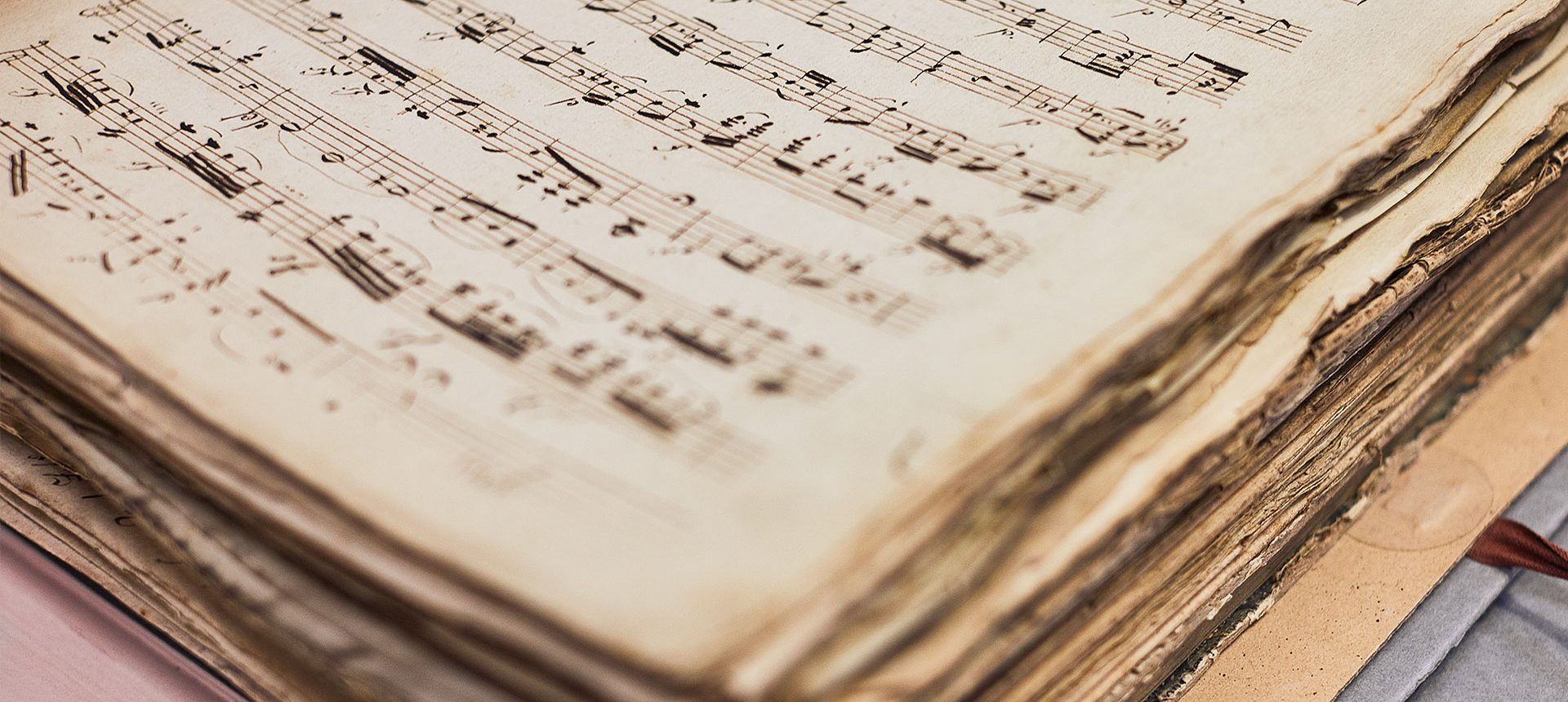
Here you can find almost anything about all the concerts Gothenburg Symphony has played over the years, both in the Concert Hall and on tour.
Search for conductors, soloists and other artists that has played together with us. Or search for composers and music that we have played. And filter on specific seasons. Guesting orchestras and ensembles are also included in the archive.
The result is presented by season.
Sara Trobäck has been Principal concertmaster of the Gothenburg Symphony Orchestra since 2002. She studied with Tibor Fülep at the Gothenburg Academy of Music and with György Pauk at the Royal Academy of Music in London. In connection with her graduation concert in 2001, she received the academy's prestigious Professional Diploma and the Dove Award. Sara Trobäck has also participated in master classes with Lord Yehudi Menuhin, Ruggiero Ricci and Joshua Bell.
As a soloist, she has appeared with the Gothenburg Symphony Orchestra, the Swedish Chamber Orchestra, the Stockholm Sinfonietta and the Helsingborg Symphony Orchestra, among others. In 2010, she premiered a violin concerto by Johannes Jansson dedicated to her and the Gothenburg Symphony Orchestra. Her London debut took place in the summer of 1999 when she performed Tchaikovsky's Violin Concerto with the London Soloists in St Martin-in-the-Fields. Sara Trobäck has also given concerts in Scotland, Germany, France, Spain, Portugal and China.
In 2002 she formed Trio Poseidon together with solo cellist Claes Gunnarsson and pianist Per Lundberg. The trio has among other things recorded Beethoven's Triple Concerto. Sara Trobäck plays a Giovanni Battista Guadagnini on loan from the Järnåker Foundation.
Martin Fröst is chief conductor of the Swedish Chamber Orchestra in Örebro since 2019. Known for pushing boundaries, he constantly seeks new ways to challenge and reshape classical music. In 2014, he became the first clarinetist to be awarded the prestigious Léonie Sonning Music Prize.
Highlights of the 2026–2027 season include a European tour with the Swedish Chamber Orchestra featuring the project Beethoven DNA—a program they also performed at the BBC Proms. As a soloist, is performing concertos by Anders Hillborg, Anna Clyne, HK Gruber, Aaron Copland, Caroline Shaw, and Daniel Mühlrad. He appears with the London Philharmonic Orchestra, Orchestre de Paris, Vienna Symphony, NDR Elbphilharmonie Orchestra, SWR Symphony Orchestra, Musikkollegium Winterthur, Netherlands Radio Philharmonic Orchestra, Norwegian Chamber Orchestra, Polish National Radio Symphony Orchestra, Warsaw Philharmonic, and the Orchestre National de Lille.
He also tours with the Stuttgart Chamber Orchestra, serving as both soloist and artistic director, and embarks on a European tour with pianist Roland Pöntinen, with performances at venues including the Concertgebouw and Wigmore Hall.
Martin Fröst frequently collaborates with artists such as Yuja Wang, Janine Jansen, Leif Ove Andsnes, Roland Pöntinen, and Antoine Tamestit. His recent releases on Sony Classical include *Beyond All Clarinet History (B.A.C.H.)*—in which the timeless melodies of Bach are reimagined through new arrangements—and *Mozart: Ecstasy and Abyss*, recorded with the Swedish Chamber Orchestra. The latter is part of a multi-year project exploring Mozart’s late works. Other recent recordings include albums dedicated to Vivaldi and Messiaen.
Sara Trobäck has been Principal concertmaster of the Gothenburg Symphony Orchestra since 2002. She studied with Tibor Fülep at the Gothenburg Academy of Music and with György Pauk at the Royal Academy of Music in London. In connection with her graduation concert in 2001, she received the academy's prestigious Professional Diploma and the Dove Award. Sara Trobäck has also participated in master classes with Lord Yehudi Menuhin, Ruggiero Ricci and Joshua Bell.
As a soloist, she has appeared with the Gothenburg Symphony Orchestra, the Swedish Chamber Orchestra, the Stockholm Sinfonietta and the Helsingborg Symphony Orchestra, among others. In 2010, she premiered a violin concerto by Johannes Jansson dedicated to her and the Gothenburg Symphony Orchestra. Her London debut took place in the summer of 1999 when she performed Tchaikovsky's Violin Concerto with the London Soloists in St Martin-in-the-Fields. Sara Trobäck has also given concerts in Scotland, Germany, France, Spain, Portugal and China.
In 2002 she formed Trio Poseidon together with solo cellist Claes Gunnarsson and pianist Per Lundberg. The trio has among other things recorded Beethoven's Triple Concerto. Sara Trobäck plays a Giovanni Battista Guadagnini on loan from the Järnåker Foundation.
Norwegian Terje Skomedal is principal for violin 2 in the Gothenburg Symphony. He studied at the Barratt-Due Music Institute in Oslo and with Giuliano Carmignola in Lucerne where he took a soloist diploma. Terje Skomedal has worked as concertmaster in the Norrandsoperan orchestra in Umeå and in several Norwegian orchestras. He has extensive experience as a chamber musician and has toured internationally with the chamber orchestras Oslo Camerata and Spira Mirabilis as well as appeared as a soloist with several Norwegian and foreign orchestras.
Claes Gunnarsson has toured all over the world as a soloist, chamber musician, orchestral musician and teacher. He made an early and acclaimed debut as soloist in Dvorák's Cello Concerto with the Gothenburg Symphony Orchestra. Shortly afterwards he was appointed principal cellist of the orchestra, a position he has held since 1999.
As soloist, Claes has appeared in some of the world's most prestigious concert halls, including Wigmore Hall, Queen Elizabeth Hall, St. Petersburg Philharmonie, Shanghai Symphony Hall, Seoul Arts Center and Singapore Symphony Hall. He has also appeared at leading international festivals such as La Folle Journée in Nantes, Music@Menlo in California, Mecklenburg-Vorpommern, Affinis in Japan, Yuri Temirkanov's Winter Festival in St. Petersburg and the Qingdao International Cello Festival. Conductors he has collaborated with include Neeme Järvi, Kent Nagano, Santtu-Matias Rouvali, Alexander Lazarev, Christian Zacharias and Christopher Warren-Green.
As a chamber musician, Claes has collaborated with prominent musicians such as Leonidas Kavakos, Nikolaj Znaider, Christian Zacharias and Hélène Grimaud. Of particular significance is his nearly 25-year collaboration with violinist Sara Trobäck and pianist Per Lundberg in the piano trio Trio Poseidon. The trio has toured extensively both nationally and internationally and made a critically acclaimed recording of Beethoven's Triple Concerto and Brahms' Double Concerto together with the Gothenburg Symphony Orchestra and Neeme Järvi for Chandos Records.
For Chandos Records, he has also recorded Weinberg's Cello Fantasy and Cello Concerto together with the Gothenburg Symphony Orchestra and Thord Svedlund. The recording of the cello concerto was awarded the Diapason d'Or award. He is also represented on BIS Records with the premiere recording of Albert Schnelzer's cello concerto.
Claes is regularly invited as a guest solo cellist with, among others, the Oslo Philharmonic, the BBC Symphony Orchestra and the London Symphony Orchestra. In parallel with his concert performances, he is active as a teacher at the Academy of Drama and Music at the University of Gothenburg.
Claes plays a cello built in 1707 by David Tecchler, generously on loan from the Järnåker Foundation.
"Now I have freed myself from my last love!" Johannes Brahms wrote to a good friend after completing his second string sextet in 1865. The love was the young singer Agathe von Siebold from Göttingen with whom he had fallen passionately in love in the summer of 1858. At that time he had tried to distance himself from his special relationship with the pianist Clara Schumann, the widow of Robert and mother of seven children. When Brahms moved away from her after her husband's death and met Agathe during his tenure as conductor in Detmold, she was very jealous.
In the second string sextet, which was begun during the summer stay in Lichtental near Baden-Baden, there are clear traces of both of these women who meant so much to Brahms. In 1855, he had enclosed in a letter to Clara a painfully longing melody that now formed the main motif with five variations in the slow third movement, and which also begins the entire work in the form of a couple of transcendental quarter notes. It was his only way of daring to show Clara his multifaceted love while she was still married to Robert and now he showed it again. "I speak in my tones" as he wrote to her in a letter much later.
Urban Claesson is principal clarinetist in the Gothenburg Symphony Orchestra since 1995. He joined the orchestra in 1986 and has appeared as a soloist with the Gothenburg Symphony Orchestra on around 20 occasions, including Mozart's Clarinet Concerto and Sinfonia concertante for wind instruments, Bruch's Concerto for Clarinet, Viola and Orchestra and Corigliano's Clarinet Concerto. As a chamber musician, he has appeared with the Amadeus Quartet and the Britten Quartet, among others. Urban Claesson is also active as a teacher at the Gothenburg Academy of Music and Drama.
Nikolaj Szeps-Znaider is musical director of the Orchestre National de Lyon since 2020. He regularly appears as a guest conductor with world leading orchestras, such as the Cleveland Orchestra, the NDR Elbphilharmonie, the Bamberg Symphony Orchestra, the Oslo Philharmonic and the Royal Liverpool Philharmonic. After a successful debut as conductor of The Magic Flute at the Dresden Semperoper, Znaider was immediately invited back to conduct Der Rosenkavalier in the fall of 2019. He has also conducted the Royal Danish Opera and the Zurich Opera House.
Nikolaj Znaider continues his career as a prominent violinist with concerts and recitals. In recent seasons, he has performed with the Danish Radio Symphony Orchestra, the New York Philharmonic, the Cleveland Orchestra, the Israel Philharmonic as well as the Chicago Symphony and the Singapore Symphony, where he has also combined both playing and conducting. He has also returned to London's Wigmore Hall, for performances with pianist and long-time collaborator Saleem Ashkar.
Znaider is passionate about supporting the next generation of musical talent and is the chairman of the Nielsen Competition, which takes place every three years in Odense, Denmark. He plays a Kreisler Guarnerius del Gesu from 1741, which he has received on generous loan from the VELUX Foundations, the Villum Foundation and the Knud Højgaard Foundation.
Claes Gunnarsson has toured all over the world as a soloist, chamber musician, orchestral musician and teacher. He made an early and acclaimed debut as soloist in Dvorák's Cello Concerto with the Gothenburg Symphony Orchestra. Shortly afterwards he was appointed principal cellist of the orchestra, a position he has held since 1999.
As soloist, Claes has appeared in some of the world's most prestigious concert halls, including Wigmore Hall, Queen Elizabeth Hall, St. Petersburg Philharmonie, Shanghai Symphony Hall, Seoul Arts Center and Singapore Symphony Hall. He has also appeared at leading international festivals such as La Folle Journée in Nantes, Music@Menlo in California, Mecklenburg-Vorpommern, Affinis in Japan, Yuri Temirkanov's Winter Festival in St. Petersburg and the Qingdao International Cello Festival. Conductors he has collaborated with include Neeme Järvi, Kent Nagano, Santtu-Matias Rouvali, Alexander Lazarev, Christian Zacharias and Christopher Warren-Green.
As a chamber musician, Claes has collaborated with prominent musicians such as Leonidas Kavakos, Nikolaj Znaider, Christian Zacharias and Hélène Grimaud. Of particular significance is his nearly 25-year collaboration with violinist Sara Trobäck and pianist Per Lundberg in the piano trio Trio Poseidon. The trio has toured extensively both nationally and internationally and made a critically acclaimed recording of Beethoven's Triple Concerto and Brahms' Double Concerto together with the Gothenburg Symphony Orchestra and Neeme Järvi for Chandos Records.
For Chandos Records, he has also recorded Weinberg's Cello Fantasy and Cello Concerto together with the Gothenburg Symphony Orchestra and Thord Svedlund. The recording of the cello concerto was awarded the Diapason d'Or award. He is also represented on BIS Records with the premiere recording of Albert Schnelzer's cello concerto.
Claes is regularly invited as a guest solo cellist with, among others, the Oslo Philharmonic, the BBC Symphony Orchestra and the London Symphony Orchestra. In parallel with his concert performances, he is active as a teacher at the Academy of Drama and Music at the University of Gothenburg.
Claes plays a cello built in 1707 by David Tecchler, generously on loan from the Järnåker Foundation.
Sara Trobäck has been Principal concertmaster of the Gothenburg Symphony Orchestra since 2002. She studied with Tibor Fülep at the Gothenburg Academy of Music and with György Pauk at the Royal Academy of Music in London. In connection with her graduation concert in 2001, she received the academy's prestigious Professional Diploma and the Dove Award. Sara Trobäck has also participated in master classes with Lord Yehudi Menuhin, Ruggiero Ricci and Joshua Bell.
As a soloist, she has appeared with the Gothenburg Symphony Orchestra, the Swedish Chamber Orchestra, the Stockholm Sinfonietta and the Helsingborg Symphony Orchestra, among others. In 2010, she premiered a violin concerto by Johannes Jansson dedicated to her and the Gothenburg Symphony Orchestra. Her London debut took place in the summer of 1999 when she performed Tchaikovsky's Violin Concerto with the London Soloists in St Martin-in-the-Fields. Sara Trobäck has also given concerts in Scotland, Germany, France, Spain, Portugal and China.
In 2002 she formed Trio Poseidon together with solo cellist Claes Gunnarsson and pianist Per Lundberg. The trio has among other things recorded Beethoven's Triple Concerto. Sara Trobäck plays a Giovanni Battista Guadagnini on loan from the Järnåker Foundation.
Clarinetist Selena Markson Adler was born and raised in Toronto, Canada. Following studies at the Interlochen Arts Academy, The Juilliard School in New York, and The Cleveland Institute of Music, she moved to Sweden with her husband, where she secured her first position as alternating principal clarinetist with the Royal Stockholm Philharmonic Orchestra. After one season in Stockholm, she moved to the Gothenburg Symphony Orchestra, where she has been a member since 1995. Selena Markson Adler has performed at music festivals throughout Sweden, as well as at the Aspen Music Festival in Colorado, USA, and performed as soloist in the orchestra.
Claes Gunnarsson has toured all over the world as a soloist, chamber musician, orchestral musician and teacher. He made an early and acclaimed debut as soloist in Dvorák's Cello Concerto with the Gothenburg Symphony Orchestra. Shortly afterwards he was appointed principal cellist of the orchestra, a position he has held since 1999.
As soloist, Claes has appeared in some of the world's most prestigious concert halls, including Wigmore Hall, Queen Elizabeth Hall, St. Petersburg Philharmonie, Shanghai Symphony Hall, Seoul Arts Center and Singapore Symphony Hall. He has also appeared at leading international festivals such as La Folle Journée in Nantes, Music@Menlo in California, Mecklenburg-Vorpommern, Affinis in Japan, Yuri Temirkanov's Winter Festival in St. Petersburg and the Qingdao International Cello Festival. Conductors he has collaborated with include Neeme Järvi, Kent Nagano, Santtu-Matias Rouvali, Alexander Lazarev, Christian Zacharias and Christopher Warren-Green.
As a chamber musician, Claes has collaborated with prominent musicians such as Leonidas Kavakos, Nikolaj Znaider, Christian Zacharias and Hélène Grimaud. Of particular significance is his nearly 25-year collaboration with violinist Sara Trobäck and pianist Per Lundberg in the piano trio Trio Poseidon. The trio has toured extensively both nationally and internationally and made a critically acclaimed recording of Beethoven's Triple Concerto and Brahms' Double Concerto together with the Gothenburg Symphony Orchestra and Neeme Järvi for Chandos Records.
For Chandos Records, he has also recorded Weinberg's Cello Fantasy and Cello Concerto together with the Gothenburg Symphony Orchestra and Thord Svedlund. The recording of the cello concerto was awarded the Diapason d'Or award. He is also represented on BIS Records with the premiere recording of Albert Schnelzer's cello concerto.
Claes is regularly invited as a guest solo cellist with, among others, the Oslo Philharmonic, the BBC Symphony Orchestra and the London Symphony Orchestra. In parallel with his concert performances, he is active as a teacher at the Academy of Drama and Music at the University of Gothenburg.
Claes plays a cello built in 1707 by David Tecchler, generously on loan from the Järnåker Foundation.
Wolfgang Amadeus Mozart (1756-1791)
Oboe quartett K370
Mozart had just been released from his servitude to the Archbishop of Salzburg. He had also completed the opera *Idomeneo* and was now—in the spring of 1781—poised to blossom with a charmingly fresh chamber music work: his only oboe quartet.
In this quartet, the oboe takes on a brilliant, virtuosic, and soloistic role. It represents chamber music of the highest caliber and is undoubtedly the most frequently performed work of its kind in the repertoire. Mozart takes considerable liberties, particularly in the first movement. While this *Allegro* is grounded in sonata form, it evolves into something approaching a free fantasia. From a traditional perspective, the main theme reappears when least expected—at the very end of the exposition. Mozart dispatches the development section—where composers typically elaborate on their themes and showcase their skill in variation and transformation—in a mere 34 bars. Only when one has mastered a form to perfection can one take such liberties, and when Mozart does so, the result is nothing short of brilliant.
The second movement is reminiscent of an operatic *arioso*, with the oboe playing the lead role as a soloist against a string accompaniment. The finale draws upon the French *rondeau* form—already somewhat old-fashioned by that time—though naturally infused with Mozart’s own characteristic digressions.
Mårten Larsson was born in Örebro and trained at the Royal Academy of Music under Alf Nilsson. He has been a leading oboist in Sweden for many years and is solo oboist in the Gothenburg Symphony Orchestra. He has also been a member of the Stockholm Sinfonietta. Mårten Larsson teaches at the Gothenburg Academy of Music and Drama and has released albums with music by Johan Helmich Roman, JS Bach and Keith Jarrett, among others.
Pianist Bengt Forsberg is a highly regarded and actively engaged chamber musician who collaborates with mezzo-soprano Anne Sofie von Otter, cellists Mats Lidström and Andreas Brantelid and violinist Nils-Erik Sparf. Together with Anne Sofie von Otter, he regularly performs concerts around the world and several of their recordings have been awarded prizes. Bengt Forsberg is often engaged as a soloist and has appeared with all major Swedish symphony orchestras and several foreign ones. He has been artistic director of chamber music at Allhelgonakyrkan in Stockholm as well as a frequent guest at Stockholms Konserthus. He can also be heard in Musikrevyn on P2.
Urban Claesson is principal clarinetist in the Gothenburg Symphony Orchestra since 1995. He joined the orchestra in 1986 and has appeared as a soloist with the Gothenburg Symphony Orchestra on around 20 occasions, including Mozart's Clarinet Concerto and Sinfonia concertante for wind instruments, Bruch's Concerto for Clarinet, Viola and Orchestra and Corigliano's Clarinet Concerto. As a chamber musician, he has appeared with the Amadeus Quartet and the Britten Quartet, among others. Urban Claesson is also active as a teacher at the Gothenburg Academy of Music and Drama.
Wolfgang Amadeus Mozart (1756-1791)
Eine kleine Nachtmusik
Allegro
Romanze: Andante
Menuetto e Trio
Rondo: Allegro
One might wonder if there is a more beautifully crafted and polished gem than Eine kleine Nachtmusik - so appealing, so perfect. Nachtmusik is German for "serenade", and when it was composed, Mozart had already composed twelve serenades. Compared to the earlier serenades, it truly lives up to its name - a little one. It becomes a miniature, a simple, classically pure and easily accessible trifle, in terms of scope. The earlier serenades could be 45 minutes long. A serenade should also be intended to be played outdoors, but that does not work at all with Eine kleine Nachtmusik with its lovely and intimate string music.
Mozart included Eine kleine Nachtmusik in his own catalogue of compositions in Vienna on August 10, 1787, and listed it as having five movements. There was another minuet - but this movement disappeared early in the work's history and has never been found. It has also not been possible to find out why Mozart wrote this lovely entertainment music. In any case, it does not seem to have been a commission, but that he wrote music out of his own interest.
It has been surprising that the mature master of cosmopolitan Vienna interrupted the demanding work of orchestrating the exciting nighttime moods of the opera Don Giovanni in favor of this delicacy. Was it the contrast he needed? Was the inspiration pressing?
Urban Claesson is principal clarinetist in the Gothenburg Symphony Orchestra since 1995. He joined the orchestra in 1986 and has appeared as a soloist with the Gothenburg Symphony Orchestra on around 20 occasions, including Mozart's Clarinet Concerto and Sinfonia concertante for wind instruments, Bruch's Concerto for Clarinet, Viola and Orchestra and Corigliano's Clarinet Concerto. As a chamber musician, he has appeared with the Amadeus Quartet and the Britten Quartet, among others. Urban Claesson is also active as a teacher at the Gothenburg Academy of Music and Drama.
Urban Claesson is principal clarinetist in the Gothenburg Symphony Orchestra since 1995. He joined the orchestra in 1986 and has appeared as a soloist with the Gothenburg Symphony Orchestra on around 20 occasions, including Mozart's Clarinet Concerto and Sinfonia concertante for wind instruments, Bruch's Concerto for Clarinet, Viola and Orchestra and Corigliano's Clarinet Concerto. As a chamber musician, he has appeared with the Amadeus Quartet and the Britten Quartet, among others. Urban Claesson is also active as a teacher at the Gothenburg Academy of Music and Drama.
Wolfgang Amadeus Mozart (1756-1791)
Eine kleine Nachtmusik
Allegro
Romanze: Andante
Menuetto e Trio
Rondo: Allegro
One might wonder if there is a more beautifully crafted and polished gem than Eine kleine Nachtmusik - so appealing, so perfect. Nachtmusik is German for "serenade", and when it was composed, Mozart had already composed twelve serenades. Compared to the earlier serenades, it truly lives up to its name - a little one. It becomes a miniature, a simple, classically pure and easily accessible trifle, in terms of scope. The earlier serenades could be 45 minutes long. A serenade should also be intended to be played outdoors, but that does not work at all with Eine kleine Nachtmusik with its lovely and intimate string music.
Mozart included Eine kleine Nachtmusik in his own catalogue of compositions in Vienna on August 10, 1787, and listed it as having five movements. There was another minuet - but this movement disappeared early in the work's history and has never been found. It has also not been possible to find out why Mozart wrote this lovely entertainment music. In any case, it does not seem to have been a commission, but that he wrote music out of his own interest.
It has been surprising that the mature master of cosmopolitan Vienna interrupted the demanding work of orchestrating the exciting nighttime moods of the opera Don Giovanni in favor of this delicacy. Was it the contrast he needed? Was the inspiration pressing?