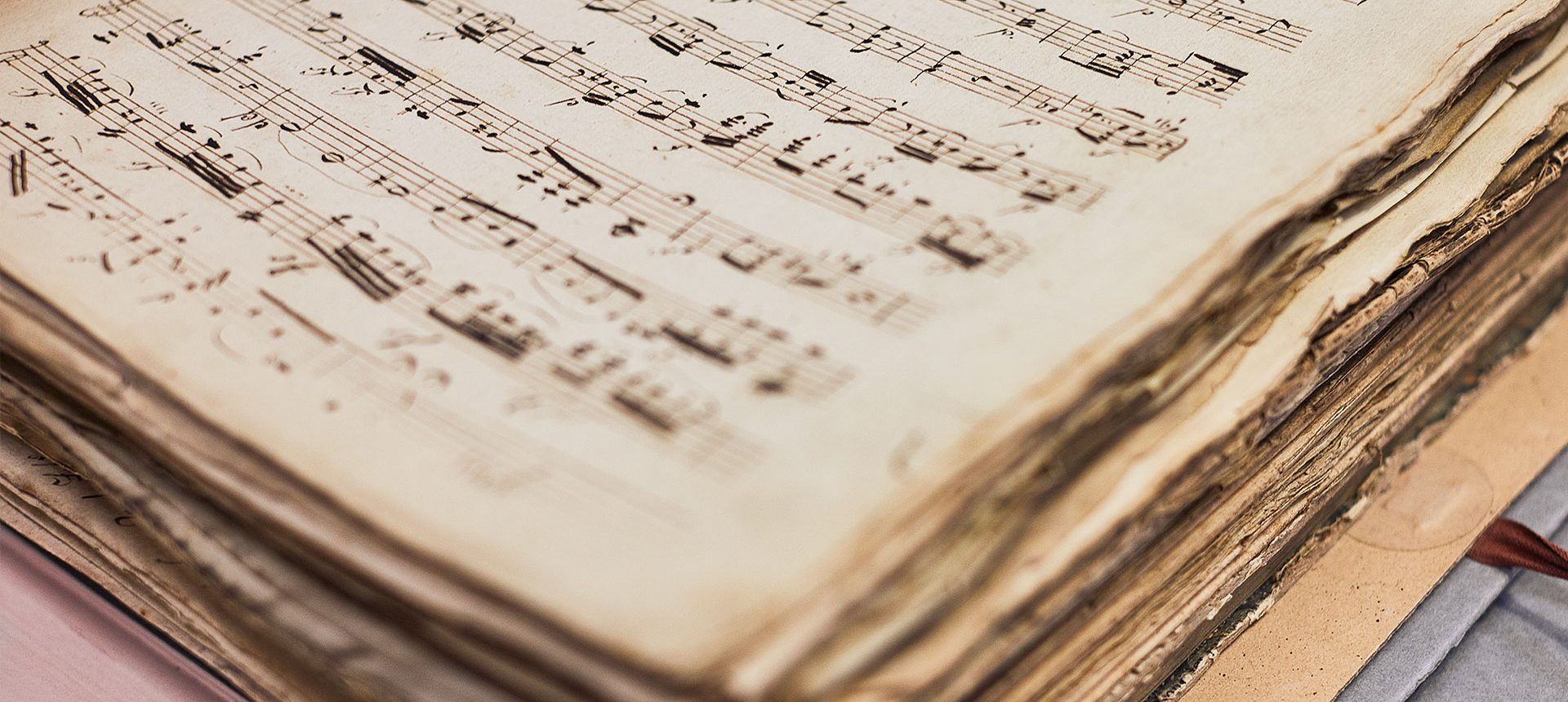
Here you can find almost anything about all the concerts Gothenburg Symphony has played over the years, both in the Concert Hall and on tour.
Search for conductors, soloists and other artists that has played together with us. Or search for composers and music that we have played. And filter on specific seasons. Guesting orchestras and ensembles are also included in the archive.
The result is presented by season.
Richard Strauss wrote his last opera in 1940-41 in the midst of the raging war. The libretto was written by his friend Clemens Krauss, but the idea originally came from the author Stefan Zweig. Perhaps he wanted to write an opera with content that defied the barbarity that was going on around him. If civilized people could converse, why not countries too? And it must have been provocative for those in power that the opera discusses the quality of Couperin's and Rameau's music.
The story takes place around 1775 at a castle in the Paris area. A group has gathered to celebrate Countess Madeleine's birthday. As a newly widowed woman, she is courted by the composer Flamand and the poet Olivier. She is torn between which of them to choose. The two are left to embody the question of which art form comes first, music or literature, a question that can also be said to be the theme of the opera.
The sextet, which serves as an overture, is composed by Flamand in the opera as a love gift to the countess. The style of the work, however, is neither rococo nor modernism. Instead, it contains much of the atmosphere that characterizes Strauss's own late-Romantic style before the turn of the century.
Danish Nancy Dalberg grew up in a manor house on Funen. Her father was the successful pharmacist and industrialist Christian D A Hansen. She started playing the piano early and after her marriage in 1901 and settling in Copenhagen, she continued piano studies with Ove Christensen. A promising career as a concert pianist, however, was cut short by a chronic tendinitis. From 1909-11 she studied music theory and composition with Johan Svendsen and from 1913 with Carl Nielsen. This, incidentally, came to play a big role in her life. Among other things, she was entrusted to instrument parts of Nielsen's Aladdin and Fynsk forår. He would also appear in one of the parts at the premiere of her first string quartet, which took place in her home in 1914. He also premiered in 1915 and 1918 three of her orchestral works, Scherzo for String Orchestra op. 6, Symphony in C sharp minor (1917) and Capriccio for orchestra (1918).
Nancy Dalberg's output is not large. In addition to the aforementioned orchestral works and a few more, she wrote about fifty songs, three of which are for voice and orchestra. Among the latter can be mentioned Marianne Sinclair's song, one of the pieces for a planned opera based on Gösta Berling's saga. Unfortunately, Selma Lagerlöf had already promised away the opera rights, so that venture had to be shelved. Among the chamber music works are a number of smaller works for violin and piano as well as cello and piano. But it is above all the three string quartets that have made themselves known, not least after an excellent recording in 2019.
The third string quartet was never published during Dalberg's lifetime, although in 1946 she attempted to pay for the printing herself. However, it dragged on over time. Only in 1950, a year after her death, was the work published. It was dedicated to teacher and friend Carl Nielsen. He died in 1931, but had hopefully listened to the work at the performances in 1928 and 1929.
Yngve Bernhardsson
Dumka ('thought' in Ukrainian) is the name of traditional Slavic music that moves from melancholy to joy. Melancholy abounded in Rebecca Clarke's life, and few instruments can paint that feeling as tenderly as the viola. The trio is written with deep knowledge of Eastern European music and artistry at the highest level. Among other things, Clarke had compiled a book about the Czech composer Bohuslav Martinu.
Rebecca Clarke, who was born in England and died in the United States, had both English and American citizenship. Viola and singing were her main instruments and she was in demand. One of the orchestras she was a member of had been conducted by Maurice Ravel. As a composer, she was so skilled that when she submitted her viola sonata to a composition competition, she became one of the two winners. The jury believed that a man had written it under a female pseudonym. You can hear for yourself what prejudices are buried in that idea. The truth became too hard-pressed and the prize was awarded to the other composer. Today, her music for viola is a must for any self-respecting viola player.
Katarina A Karlsson
"Concertant symphony" meant a concert for more than one soloist. As public concerts for paying audiences became popular, the need increased for "brilliant" orchestral music in which famous soloists could show off. Preferably several in the same work.
Mozart wrote a Sinfonia Concertante for four wind instruments during his six months in Paris - when his mother died over there. It does not seem to have been performed there and exists today only in a heavily edited version from the 19th century. In Paris he also wrote the concerto for flute and harp. His Concertone from 1773 also belongs to the genre. The Double Piano Concerto in E flat major as well.
The Sinfonia concertante in E flat major for violin and viola with orchestra was probably written in Salzburg sometime during the summer of 1779. The original notes have been lost along the way. This makes it more difficult to date the music. The first known printed edition is from 1801. It is one of Mozart's longest concertos, just over half an hour. The viola part is notated in D major, so the musician had to tune the instrument a semitone higher. The idea was perhaps to get a sharper sound so that the soloist would not be overpowered. It is also said to be easier to play with a "D major grip".
Sara Trobäck has been Principal concertmaster of the Gothenburg Symphony Orchestra since 2002. She studied with Tibor Fülep at the Gothenburg Academy of Music and with György Pauk at the Royal Academy of Music in London. In connection with her graduation concert in 2001, she received the academy's prestigious Professional Diploma and the Dove Award. Sara Trobäck has also participated in master classes with Lord Yehudi Menuhin, Ruggiero Ricci and Joshua Bell.
As a soloist, she has appeared with the Gothenburg Symphony Orchestra, the Swedish Chamber Orchestra, the Stockholm Sinfonietta and the Helsingborg Symphony Orchestra, among others. In 2010, she premiered a violin concerto by Johannes Jansson dedicated to her and the Gothenburg Symphony Orchestra. Her London debut took place in the summer of 1999 when she performed Tchaikovsky's Violin Concerto with the London Soloists in St Martin-in-the-Fields. Sara Trobäck has also given concerts in Scotland, Germany, France, Spain, Portugal and China.
In 2002 she formed Trio Poseidon together with solo cellist Claes Gunnarsson and pianist Per Lundberg. The trio has among other things recorded Beethoven's Triple Concerto. Sara Trobäck plays a Giovanni Battista Guadagnini on loan from the Järnåker Foundation.
Justyna Jara began playing the violin when she was seven years old. After winning a prize at a competition for young violinists in Gdansk, Poland, she continued her studies in Warsaw with Miroslaw Lawrynowicz. During her studies, she won prizes in several violin competitions. She also recorded Wieniawski's Etudes Caprices Op 10 and 18 for the Acte Préalable record label as a tribute to her teacher. She studied for a year at the Chopin University in Warsaw and then at Juilliard in New York, working with orchestras such as the London Symphony Orchestra, the London Philharmonic Orchestra, the Philharmonia Orchestra and the Royal Philharmonic Orchestra, often as assistant concertmaster. In 2014, she was appointed second concertmaster of the Gothenburg Symphony Orchestra.
Jun Sasaki is co-principal cello in Gothenburg Symphony since 2014. He was born in London and studied at the Yehudi Menuhin School and the Royal College of Music with Thomas Carroll before moving to Oslo to study at Norges Musikhögskola with Truls Mørk.
A prizewinner at the Royal Overseas League (UK) and Antonio Janigro (Croatia) competitions, his cello playing has led to appearances on TV and radio, and has taken him to festivals and venues across Europe and beyond - as soloist performing in venues such as the Cadogan Hall, Queen Elizabeth Hall and the Wigmore Hall, and at festivals such as the Schleswig-Holstein (Germany), Edinburgh Fringe (Scotland), and Ultima (Norway).
With a passion for chamber music, Jun has performed with artists such as Leif Ove Andsnes , Barbara Hannigan, Pekka Kuusisto, Corina Belcea and his teacher Truls Mørk. Jun is a member of Ensemble Caplet, as well as member of the musician community of Norwegian Chamber Orchestra.
Juan Zurutuza is a pianist trained in Mexico and the Netherlands. He studied with Rian de Waal at the Royal Conservatory in The Hague from 2001-2008. He has played solo and chamber music concerts with members of the Rotterdam Philharmonic Orchestra and the Concertgebouw Orchestra in Scandinavia, Europe and North America. Since 2022, Juan Zurutuza is pianist in the Gothenburg Symphony.
He is currently studying with pianist Robert Durso, thanks to several scholarships received from Göteborgs Symfoniker Friend Association, the Marianne & Ary Paley Scholarship Fund, the Eduard Magnus Music Fund and the Mary von Sydows Donation Fund.
Richard Strauss wrote his last opera in 1940-41 in the midst of the raging war. The libretto was written by his friend Clemens Krauss, but the idea originally came from the author Stefan Zweig. Perhaps he wanted to write an opera with content that defied the barbarity that was going on around him. If civilized people could converse, why not countries too? And it must have been provocative for those in power that the opera discusses the quality of Couperin's and Rameau's music.
The story takes place around 1775 at a castle in the Paris area. A group has gathered to celebrate Countess Madeleine's birthday. As a newly widowed woman, she is courted by the composer Flamand and the poet Olivier. She is torn between which of them to choose. The two are left to embody the question of which art form comes first, music or literature, a question that can also be said to be the theme of the opera.
The sextet, which serves as an overture, is composed by Flamand in the opera as a love gift to the countess. The style of the work, however, is neither rococo nor modernism. Instead, it contains much of the atmosphere that characterizes Strauss's own late-Romantic style before the turn of the century.
Conductor and soprano Barbara Hannigan is Principal guest conductor of the Gothenburg Symphony Orchestra since 2019, embodying music with an unparalleled dramatic sensibility. She moves freely between the multiple roles of conductor, singer and curator. Over more than three decades, she has forged artistic partnerships with extraordinary musicians, directors and choreographers, including Romeo Castellucci, Claus Guth, Vladimir Jurowski, Katie Mitchell, Simon Rattle, Esa-Pekka Salonen, Kirill Petrenko, Sasha Waltz, and Krzysztof Warlikowski. The late conductor and pianist Reinbert de Leeuw has been an extraordinary influence and inspiration on her development as a musician.
In the 2026-2027 season, Hannigan begins her tenure as Chief Conductor and Artistic Director of the Iceland Symphony Orchestra, where her spirit of discovery will shape an artistic vision rooted in excellence, openness and collaboration, while forging new connections between Iceland and the wider international music community.
Balancing her work as both conductor and soprano, Hannigan maintains long-standing relationships with her colleagues in the orchestral, operatic and chamber music realms. She has maintained multi-year associations with London Symphony Orchestra (as Associate Artist), l'Orchestre de Chambre de Lausanne (as Principal Guest Conductor), and performs regularly with the Munich Philharmonic, Swedish Radio Symphony Orchestra, Swedish Chamber Orchestra, Orchestre Philharmonique de Radio France, and Danish Radio Symphony Orchestra. She makes her Rotterdam Philharmonic Orchestra conducting debut, performing as part of the joint project between the orchestra and Scapino Ballet entitled La Mer, in which she will sing, conduct and also dance with the artists of this world-renowned dance company. She continues to tour her unique production of Poulenc’s La Voix Humaine, after its most recent successes with New York Philharmonic and Czech Philharmonic Orchestras, bringing the work this season to Berlin with the Deutsches Symphonie-Orchester Berlin. Her recital tour with her most important musical partner, pianist Bertrand Chamayou (works by Messiaen, Scriabin and Zorn) continues in the 2026/27 season with performances throughout Europe.
Her awards and honours include the Governor General's Performing Arts Award (2026), the 2025 Polar Music Prize, 2025 Musical America Artist of the Year, "Accademico Onorario (Honorary Academician) (2025) at Accademia di Santa Cecilia, the Order of Canada (2016), Officier des Arts et des Lettres in France (2022), Gramophone Magazine’s 2022 Artist of the Year, Germany's Faust Award (2015), Sweden's Rolf Schock Prize for Musical Arts (2018), and Denmark’s Léonie Sonning Music Prize (2021).
Barbara Hannigan resides in Finistère, on the northwest coast of France, looking over an inlet which leads directly across the Atlantic to where she grew up in Waverley, Nova Scotia.
Justyna Jara began playing the violin when she was seven years old. After winning a prize at a competition for young violinists in Gdansk, Poland, she continued her studies in Warsaw with Miroslaw Lawrynowicz. During her studies, she won prizes in several violin competitions. She also recorded Wieniawski's Etudes Caprices Op 10 and 18 for the Acte Préalable record label as a tribute to her teacher. She studied for a year at the Chopin University in Warsaw and then at Juilliard in New York, working with orchestras such as the London Symphony Orchestra, the London Philharmonic Orchestra, the Philharmonia Orchestra and the Royal Philharmonic Orchestra, often as assistant concertmaster. In 2014, she was appointed second concertmaster of the Gothenburg Symphony Orchestra.
Norwegian Terje Skomedal is principal for violin 2 in the Gothenburg Symphony. He studied at the Barratt-Due Music Institute in Oslo and with Giuliano Carmignola in Lucerne where he took a soloist diploma. Terje Skomedal has worked as concertmaster in the Norrandsoperan orchestra in Umeå and in several Norwegian orchestras. He has extensive experience as a chamber musician and has toured internationally with the chamber orchestras Oslo Camerata and Spira Mirabilis as well as appeared as a soloist with several Norwegian and foreign orchestras.
Claes Gunnarsson has toured all over the world as a soloist, chamber musician, orchestral musician and teacher. He made an early and acclaimed debut as soloist in Dvorák's Cello Concerto with the Gothenburg Symphony Orchestra. Shortly afterwards he was appointed principal cellist of the orchestra, a position he has held since 1999.
As soloist, Claes has appeared in some of the world's most prestigious concert halls, including Wigmore Hall, Queen Elizabeth Hall, St. Petersburg Philharmonie, Shanghai Symphony Hall, Seoul Arts Center and Singapore Symphony Hall. He has also appeared at leading international festivals such as La Folle Journée in Nantes, Music@Menlo in California, Mecklenburg-Vorpommern, Affinis in Japan, Yuri Temirkanov's Winter Festival in St. Petersburg and the Qingdao International Cello Festival. Conductors he has collaborated with include Neeme Järvi, Kent Nagano, Santtu-Matias Rouvali, Alexander Lazarev, Christian Zacharias and Christopher Warren-Green.
As a chamber musician, Claes has collaborated with prominent musicians such as Leonidas Kavakos, Nikolaj Znaider, Christian Zacharias and Hélène Grimaud. Of particular significance is his nearly 25-year collaboration with violinist Sara Trobäck and pianist Per Lundberg in the piano trio Trio Poseidon. The trio has toured extensively both nationally and internationally and made a critically acclaimed recording of Beethoven's Triple Concerto and Brahms' Double Concerto together with the Gothenburg Symphony Orchestra and Neeme Järvi for Chandos Records.
For Chandos Records, he has also recorded Weinberg's Cello Fantasy and Cello Concerto together with the Gothenburg Symphony Orchestra and Thord Svedlund. The recording of the cello concerto was awarded the Diapason d'Or award. He is also represented on BIS Records with the premiere recording of Albert Schnelzer's cello concerto.
Claes is regularly invited as a guest solo cellist with, among others, the Oslo Philharmonic, the BBC Symphony Orchestra and the London Symphony Orchestra. In parallel with his concert performances, he is active as a teacher at the Academy of Drama and Music at the University of Gothenburg.
Claes plays a cello built in 1707 by David Tecchler, generously on loan from the Järnåker Foundation.
Jun Sasaki is co-principal cello in Gothenburg Symphony since 2014. He was born in London and studied at the Yehudi Menuhin School and the Royal College of Music with Thomas Carroll before moving to Oslo to study at Norges Musikhögskola with Truls Mørk.
A prizewinner at the Royal Overseas League (UK) and Antonio Janigro (Croatia) competitions, his cello playing has led to appearances on TV and radio, and has taken him to festivals and venues across Europe and beyond - as soloist performing in venues such as the Cadogan Hall, Queen Elizabeth Hall and the Wigmore Hall, and at festivals such as the Schleswig-Holstein (Germany), Edinburgh Fringe (Scotland), and Ultima (Norway).
With a passion for chamber music, Jun has performed with artists such as Leif Ove Andsnes , Barbara Hannigan, Pekka Kuusisto, Corina Belcea and his teacher Truls Mørk. Jun is a member of Ensemble Caplet, as well as member of the musician community of Norwegian Chamber Orchestra.
Richard Strauss wrote his last opera in 1940-41 in the midst of the raging war. The libretto was written by his friend Clemens Krauss, but the idea originally came from the author Stefan Zweig. Perhaps he wanted to write an opera with content that defied the barbarity that was going on around him. If civilized people could converse, why not countries too? And it must have been provocative for those in power that the opera discusses the quality of Couperin's and Rameau's music.
The story takes place around 1775 at a castle in the Paris area. A group has gathered to celebrate Countess Madeleine's birthday. As a newly widowed woman, she is courted by the composer Flamand and the poet Olivier. She is torn between which of them to choose. The two are left to embody the question of which art form comes first, music or literature, a question that can also be said to be the theme of the opera.
The sextet, which serves as an overture, is composed by Flamand in the opera as a love gift to the countess. The style of the work, however, is neither rococo nor modernism. Instead, it contains much of the atmosphere that characterizes Strauss's own late-Romantic style before the turn of the century.
Erik Risberg was employed as a pianist in the Gothenburg Symphony Orchestra from 1995 to 2023, also performing on organ, harpsichord and other keyboard instruments. He regularly performed as a chamber musician, including in a piano duo with Bengt Forsberg. Erik Risberg has also been a valued teacher of musical performance at the Gothenburg Academy of Music and Drama for many years and also gives introductions at the Symphony Orchestra's concerts.
Lisa Ford has been the principal horn player in the Gothenburg Symphony Orchestra for 30 years. Lisa is an active chamber musician and soloist and a member of the ensemble Gageego!. She is a senior lecturer at the Gothenburg Academy of Music and Performing Arts and a mentor in the master's program in symphony orchestra performance, she is a horn teacher and teaches wind and chamber music ensembles. Lisa Ford is educated at the Interlochen Arts Academy. She has been a member of the Civic Orchestra of Chicago and has a diploma from the Norwegian Academy of Music, NMH. She was previously assistant principal horn player in the San Diego Symphony Orchestra. She is also a certified professional coach.
Claes Gunnarsson has toured all over the world as a soloist, chamber musician, orchestral musician and teacher. He made an early and acclaimed debut as soloist in Dvorák's Cello Concerto with the Gothenburg Symphony Orchestra. Shortly afterwards he was appointed principal cellist of the orchestra, a position he has held since 1999.
As soloist, Claes has appeared in some of the world's most prestigious concert halls, including Wigmore Hall, Queen Elizabeth Hall, St. Petersburg Philharmonie, Shanghai Symphony Hall, Seoul Arts Center and Singapore Symphony Hall. He has also appeared at leading international festivals such as La Folle Journée in Nantes, Music@Menlo in California, Mecklenburg-Vorpommern, Affinis in Japan, Yuri Temirkanov's Winter Festival in St. Petersburg and the Qingdao International Cello Festival. Conductors he has collaborated with include Neeme Järvi, Kent Nagano, Santtu-Matias Rouvali, Alexander Lazarev, Christian Zacharias and Christopher Warren-Green.
As a chamber musician, Claes has collaborated with prominent musicians such as Leonidas Kavakos, Nikolaj Znaider, Christian Zacharias and Hélène Grimaud. Of particular significance is his nearly 25-year collaboration with violinist Sara Trobäck and pianist Per Lundberg in the piano trio Trio Poseidon. The trio has toured extensively both nationally and internationally and made a critically acclaimed recording of Beethoven's Triple Concerto and Brahms' Double Concerto together with the Gothenburg Symphony Orchestra and Neeme Järvi for Chandos Records.
For Chandos Records, he has also recorded Weinberg's Cello Fantasy and Cello Concerto together with the Gothenburg Symphony Orchestra and Thord Svedlund. The recording of the cello concerto was awarded the Diapason d'Or award. He is also represented on BIS Records with the premiere recording of Albert Schnelzer's cello concerto.
Claes is regularly invited as a guest solo cellist with, among others, the Oslo Philharmonic, the BBC Symphony Orchestra and the London Symphony Orchestra. In parallel with his concert performances, he is active as a teacher at the Academy of Drama and Music at the University of Gothenburg.
Claes plays a cello built in 1707 by David Tecchler, generously on loan from the Järnåker Foundation.
Sara Trobäck has been Principal concertmaster of the Gothenburg Symphony Orchestra since 2002. She studied with Tibor Fülep at the Gothenburg Academy of Music and with György Pauk at the Royal Academy of Music in London. In connection with her graduation concert in 2001, she received the academy's prestigious Professional Diploma and the Dove Award. Sara Trobäck has also participated in master classes with Lord Yehudi Menuhin, Ruggiero Ricci and Joshua Bell.
As a soloist, she has appeared with the Gothenburg Symphony Orchestra, the Swedish Chamber Orchestra, the Stockholm Sinfonietta and the Helsingborg Symphony Orchestra, among others. In 2010, she premiered a violin concerto by Johannes Jansson dedicated to her and the Gothenburg Symphony Orchestra. Her London debut took place in the summer of 1999 when she performed Tchaikovsky's Violin Concerto with the London Soloists in St Martin-in-the-Fields. Sara Trobäck has also given concerts in Scotland, Germany, France, Spain, Portugal and China.
In 2002 she formed Trio Poseidon together with solo cellist Claes Gunnarsson and pianist Per Lundberg. The trio has among other things recorded Beethoven's Triple Concerto. Sara Trobäck plays a Giovanni Battista Guadagnini on loan from the Järnåker Foundation.
Richard Strauss wrote his last opera in 1940-41 in the midst of the raging war. The libretto was written by his friend Clemens Krauss, but the idea originally came from the author Stefan Zweig. Perhaps he wanted to write an opera with content that defied the barbarity that was going on around him. If civilized people could converse, why not countries too? And it must have been provocative for those in power that the opera discusses the quality of Couperin's and Rameau's music.
The story takes place around 1775 at a castle in the Paris area. A group has gathered to celebrate Countess Madeleine's birthday. As a newly widowed woman, she is courted by the composer Flamand and the poet Olivier. She is torn between which of them to choose. The two are left to embody the question of which art form comes first, music or literature, a question that can also be said to be the theme of the opera.
The sextet, which serves as an overture, is composed by Flamand in the opera as a love gift to the countess. The style of the work, however, is neither rococo nor modernism. Instead, it contains much of the atmosphere that characterizes Strauss's own late-Romantic style before the turn of the century.
"Now I have freed myself from my last love!" Johannes Brahms wrote to a good friend after completing his second string sextet in 1865. The love was the young singer Agathe von Siebold from Göttingen with whom he had fallen passionately in love in the summer of 1858. At that time he had tried to distance himself from his special relationship with the pianist Clara Schumann, the widow of Robert and mother of seven children. When Brahms moved away from her after her husband's death and met Agathe during his tenure as conductor in Detmold, she was very jealous.
In the second string sextet, which was begun during the summer stay in Lichtental near Baden-Baden, there are clear traces of both of these women who meant so much to Brahms. In 1855, he had enclosed in a letter to Clara a painfully longing melody that now formed the main motif with five variations in the slow third movement, and which also begins the entire work in the form of a couple of transcendental quarter notes. It was his only way of daring to show Clara his multifaceted love while she was still married to Robert and now he showed it again. "I speak in my tones" as he wrote to her in a letter much later.