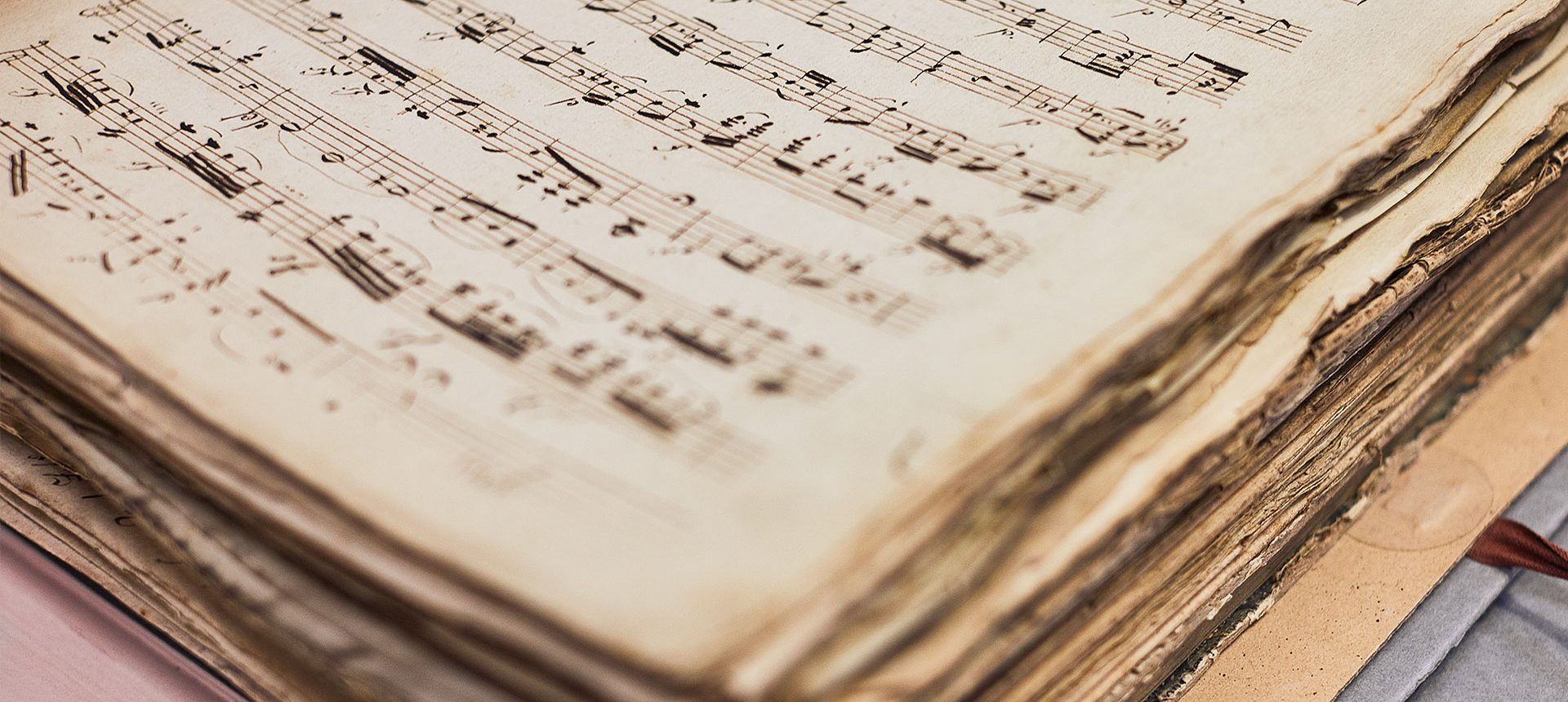
Here you can find almost anything about all the concerts Gothenburg Symphony has played over the years, both in the Concert Hall and on tour.
Search for conductors, soloists and other artists that has played together with us. Or search for composers and music that we have played. And filter on specific seasons. Guesting orchestras and ensembles are also included in the archive.
The result is presented by season.
The Gothenburg Symphony was formed in 1905 and today consists of 109 musicians. The orchestra's base is Gothenburg Concert Hall at Götaplatsen that has gathered music lovers since 1935. Since the 2019-2020 season, Barbara Hannigan is Principal guest conductor. We are also a proud partner of Barbara Hannigan's Equilibrium mentoring program focusing on young singers at the start of their careers. The title Principal Guest Conductor is shared by Pekka Kuusisto from 2025.
Wilhelm Stenhammar was the orchestra's chief conductor from 1907 to 1922. He gave the orchestra a strong Nordic profile and invited colleagues Carl Nielsen and Jean Sibelius to the orchestra. Under the direction of conductor Neeme Järvi from 1982-2004, the orchestra made a series of international tours as well as a hundred disc recordings and established themselves among Europe's leading orchestras. In 1996, the Swedish Riksdag appointed the Gothenburg Symphony as Sweden's National Orchestra.
In recent decades, the orchestra has had prominent chief conductors such as Santtu-Matias Rouvali, Mario Venzago and Gustavo Dudamel, following Kent Nagano as Principal Guest conductor. Anna-Karin Larsson is CEO and artistic director, Gustavo Dudamel honorary conductor and Neeme Järvi chief conductor emeritus. The orchestra's owner is the Västra Götaland Region.
The Gothenburg Symphony works regularly with conductors such as Herbert Blomstedt, Joana Carneiro, Jukka-Pekka Saraste, Christian Zacharias and Anja Bihlmaier.
Conductor and soprano Barbara Hannigan is Principal guest conductor of the Gothenburg Symphony Orchestra since 2019, embodying music with an unparalleled dramatic sensibility. She moves freely between the multiple roles of conductor, singer and curator. Over more than three decades, she has forged artistic partnerships with extraordinary musicians, directors and choreographers, including Romeo Castellucci, Claus Guth, Vladimir Jurowski, Katie Mitchell, Simon Rattle, Esa-Pekka Salonen, Kirill Petrenko, Sasha Waltz, and Krzysztof Warlikowski. The late conductor and pianist Reinbert de Leeuw has been an extraordinary influence and inspiration on her development as a musician.
In the 2026-2027 season, Hannigan begins her tenure as Chief Conductor and Artistic Director of the Iceland Symphony Orchestra, where her spirit of discovery will shape an artistic vision rooted in excellence, openness and collaboration, while forging new connections between Iceland and the wider international music community.
Balancing her work as both conductor and soprano, Hannigan maintains long-standing relationships with her colleagues in the orchestral, operatic and chamber music realms. She has maintained multi-year associations with London Symphony Orchestra (as Associate Artist), l'Orchestre de Chambre de Lausanne (as Principal Guest Conductor), and performs regularly with the Munich Philharmonic, Swedish Radio Symphony Orchestra, Swedish Chamber Orchestra, Orchestre Philharmonique de Radio France, and Danish Radio Symphony Orchestra. She makes her Rotterdam Philharmonic Orchestra conducting debut, performing as part of the joint project between the orchestra and Scapino Ballet entitled La Mer, in which she will sing, conduct and also dance with the artists of this world-renowned dance company. She continues to tour her unique production of Poulenc’s La Voix Humaine, after its most recent successes with New York Philharmonic and Czech Philharmonic Orchestras, bringing the work this season to Berlin with the Deutsches Symphonie-Orchester Berlin. Her recital tour with her most important musical partner, pianist Bertrand Chamayou (works by Messiaen, Scriabin and Zorn) continues in the 2026/27 season with performances throughout Europe.
Her awards and honours include the Governor General's Performing Arts Award (2026), the 2025 Polar Music Prize, 2025 Musical America Artist of the Year, "Accademico Onorario (Honorary Academician) (2025) at Accademia di Santa Cecilia, the Order of Canada (2016), Officier des Arts et des Lettres in France (2022), Gramophone Magazine’s 2022 Artist of the Year, Germany's Faust Award (2015), Sweden's Rolf Schock Prize for Musical Arts (2018), and Denmark’s Léonie Sonning Music Prize (2021).
Barbara Hannigan resides in Finistère, on the northwest coast of France, looking over an inlet which leads directly across the Atlantic to where she grew up in Waverley, Nova Scotia.
Peter Tchaikovsky (1840-1893)
Symphony No. 6 Pathetique Op 74
Adagio;Allegro non troppo - Allegro con grazia - Allegro molto vivace - Finale:Adagio lamentoso
Few symphonies contain as many outbursts of emotion and sudden mood swings as Tchaikovsky's Sixth, with the telling title Pathétique ("passionate suffering"). It reflects his manic-depressive personality, he suffered throughout his life from crises and often struggled with illness and depression. Tchaikovsky's death in Saint Petersburg, just nine days after he conducted the premiere, also gave the work a tragic aura right from the start. It was even said that the music deliberately foreshadowed his own death, which occurred after he drank cholera-tainted water. Even today, musicologists disagree whether it was an accident or a forced suicide, to avoid public scandal as a homosexual.
Is the sixth symphony really a self-composed requiem? This theory is fueled by the "dark" key of B minor, which stands for great passion and tragedy, and by the unusual structure. The main motif that runs throughout the work consists of a plaintive, descending second interval. The gloomy character of the symphony is clear already in the first movement, with its slow, dark introduction. The second movement is reminiscent of Don José's flower aria from Bizet's opera Carmen, which Tchaikovsky greatly admired. Towards the end of the movement there is a chorale-like funeral march, and even a quote from the Russian Orthodox funeral liturgy. The second movement provides some lightening, and Tchaikovsky wrote it in an elegant 5/4 time signature, which is a fairly common time signature in Russian folk music. The "limping" character makes the movement almost humorous, despite the loving waltz or minuet-like style.
In the third movement he returns to the march as idea, but it begins as an cheerful scherzo that gradually unfolds in its full life-affirming power. The fourth movement is the most famous in the symphony, and is partly reminiscent of a mournful requiem. The main theme is characterized by sighing motifs, and at the end the music fades into a low string chord in B minor.
Tchaikovsky considered the symphony to be his most important, most personal composition, but the premiere was received cautiously.
Participants
The Gothenburg Symphony was formed in 1905 and today consists of 109 musicians. The orchestra's base is Gothenburg Concert Hall at Götaplatsen that has gathered music lovers since 1935. Since the 2019-2020 season, Barbara Hannigan is Principal guest conductor. We are also a proud partner of Barbara Hannigan's Equilibrium mentoring program focusing on young singers at the start of their careers. The title Principal Guest Conductor is shared by Pekka Kuusisto from 2025.
Wilhelm Stenhammar was the orchestra's chief conductor from 1907 to 1922. He gave the orchestra a strong Nordic profile and invited colleagues Carl Nielsen and Jean Sibelius to the orchestra. Under the direction of conductor Neeme Järvi from 1982-2004, the orchestra made a series of international tours as well as a hundred disc recordings and established themselves among Europe's leading orchestras. In 1996, the Swedish Riksdag appointed the Gothenburg Symphony as Sweden's National Orchestra.
In recent decades, the orchestra has had prominent chief conductors such as Santtu-Matias Rouvali, Mario Venzago and Gustavo Dudamel, following Kent Nagano as Principal Guest conductor. Anna-Karin Larsson is CEO and artistic director, Gustavo Dudamel honorary conductor and Neeme Järvi chief conductor emeritus. The orchestra's owner is the Västra Götaland Region.
The Gothenburg Symphony works regularly with conductors such as Herbert Blomstedt, Joana Carneiro, Jukka-Pekka Saraste, Christian Zacharias and Anja Bihlmaier.
Richard Strauss’s symphonic poem Till Eulenspiegels lustige Streiche is one of the great masterpieces of the orchestral repertoire. Until this point the composer had been known as a scholarly and rather serious young master, but after the premiere of Till in Cologne on 5 November 1895, it became clear that he also possessed a sparkling sense of humour.
Formally the work resembles a rondo, inviting us to follow the various escapades of the title character. Till Eulenspiegel, a famous trickster who had appeared in literature since the Middle Ages, is introduced in unmistakably fairy-tale fashion: the violins begin the piece with a dreamy phrase that seems to sing, “Once upon a time...”.
We then encounter Till as an itinerant preacher, see him fall in love, watch as he is brought to trial and sentenced to death, and finally witness his hanging. No name was inscribed on his gravestone, but an image of an owl and a mirror got to illustrate an old proverb: “Man sees his own faults as little as an owl recognizes his ugliness in looking into a mirror.” Hence the name Eulenspiegel (The Owl’s Mirror).
Participants
The Gothenburg Symphony was formed in 1905 and today consists of 109 musicians. The orchestra's base is Gothenburg Concert Hall at Götaplatsen that has gathered music lovers since 1935. Since the 2019-2020 season, Barbara Hannigan is Principal guest conductor. We are also a proud partner of Barbara Hannigan's Equilibrium mentoring program focusing on young singers at the start of their careers. The title Principal Guest Conductor is shared by Pekka Kuusisto from 2025.
Wilhelm Stenhammar was the orchestra's chief conductor from 1907 to 1922. He gave the orchestra a strong Nordic profile and invited colleagues Carl Nielsen and Jean Sibelius to the orchestra. Under the direction of conductor Neeme Järvi from 1982-2004, the orchestra made a series of international tours as well as a hundred disc recordings and established themselves among Europe's leading orchestras. In 1996, the Swedish Riksdag appointed the Gothenburg Symphony as Sweden's National Orchestra.
In recent decades, the orchestra has had prominent chief conductors such as Santtu-Matias Rouvali, Mario Venzago and Gustavo Dudamel, following Kent Nagano as Principal Guest conductor. Anna-Karin Larsson is CEO and artistic director, Gustavo Dudamel honorary conductor and Neeme Järvi chief conductor emeritus. The orchestra's owner is the Västra Götaland Region.
The Gothenburg Symphony works regularly with conductors such as Herbert Blomstedt, Joana Carneiro, Jukka-Pekka Saraste, Christian Zacharias and Anja Bihlmaier.