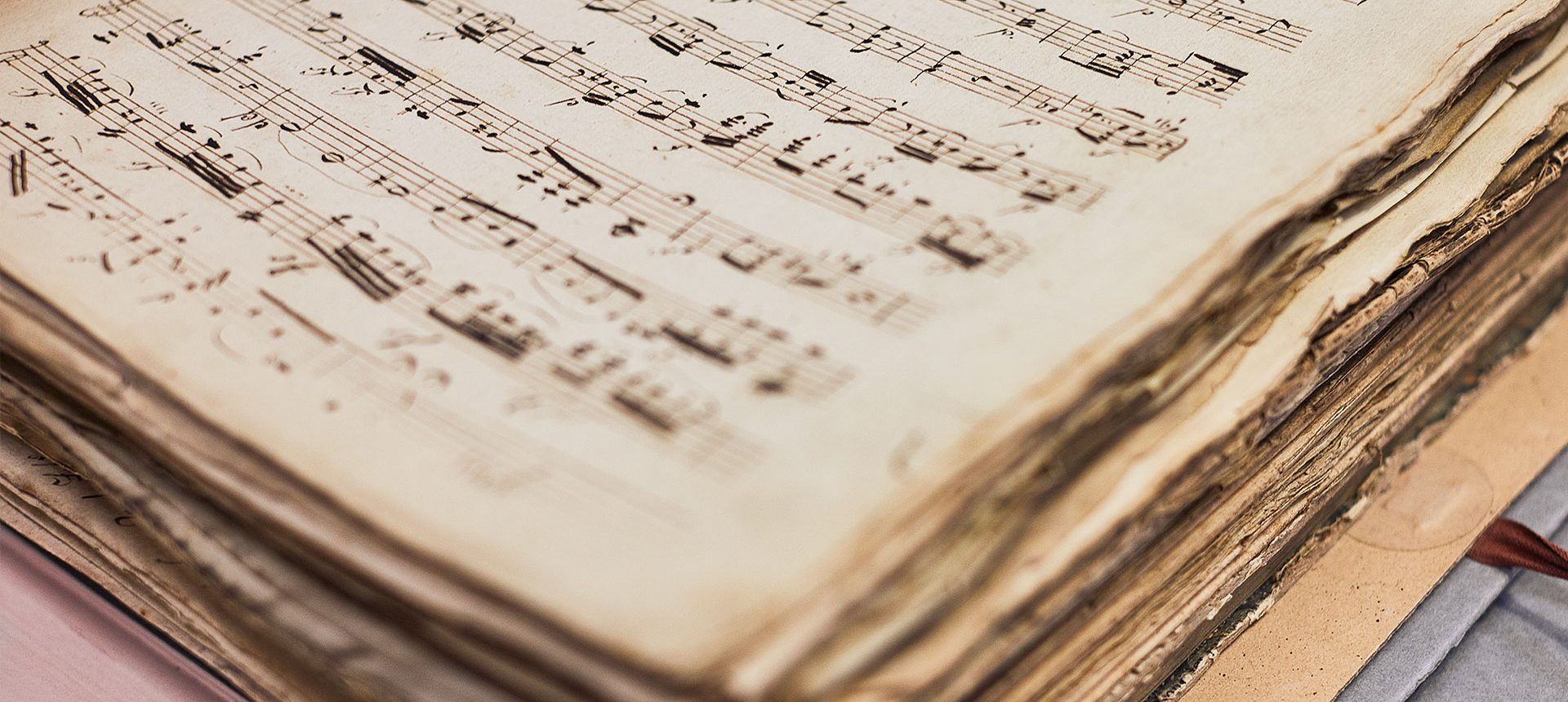
Here you can find almost anything about all the concerts Gothenburg Symphony has played over the years, both in the Concert Hall and on tour.
Search for conductors, soloists and other artists that has played together with us. Or search for composers and music that we have played. And filter on specific seasons. Guesting orchestras and ensembles are also included in the archive.
The result is presented by season.
Richard Wagner (1813-1883)
Prelude and Liebestod from Tristan and Isolde
The musical language of the opera Tristan und Isolde (1859) is sometimes considered the beginning of musical modernism. Tristan’s harmonic language, filled with linguering and unresolved dissonances, not only realizes the sexual tension between the opera’s two central characters, but also heralds the liberation from the limitations of tonality. The famous “Tristan chord” is an unresolved dissonance, an academic way of saying that it “leads to something”.
The prelude exemplifies Wagner’s forward-looking view of both harmony and the question of musical form. Here Wagner’s Leitmotif technique, i.e. central themes that correspond to characters and ideas, is also developed. Something that became completely self-evident in film music many decades later.
Isolde has just arrived and finds Tristan dead as the famous piece Liebestod (Love's Death) begins. She wants to sink into unconsciousness and finally consummate her love for Tristan by following him into death. The passage builds to a climax when "waves of refreshing winds" begin to envelop Isolde, and again when she imagines dying in "the mighty wave of the world's breath." She sinks everything as the wind floats and dissolves the chord from the prelude.
Participants
The Gothenburg Symphony was formed in 1905 and today consists of 109 musicians. The orchestra's base is Gothenburg Concert Hall at Götaplatsen that has gathered music lovers since 1935. Since the 2019-2020 season, Barbara Hannigan is Principal guest conductor. We are also a proud partner of Barbara Hannigan's Equilibrium mentoring program focusing on young singers at the start of their careers. The title Principal Guest Conductor is shared by Pekka Kuusisto from 2025.
Wilhelm Stenhammar was the orchestra's chief conductor from 1907 to 1922. He gave the orchestra a strong Nordic profile and invited colleagues Carl Nielsen and Jean Sibelius to the orchestra. Under the direction of conductor Neeme Järvi from 1982-2004, the orchestra made a series of international tours as well as a hundred disc recordings and established themselves among Europe's leading orchestras. In 1996, the Swedish Riksdag appointed the Gothenburg Symphony as Sweden's National Orchestra.
In recent decades, the orchestra has had prominent chief conductors such as Santtu-Matias Rouvali, Mario Venzago and Gustavo Dudamel, following Kent Nagano as Principal Guest conductor. Anna-Karin Larsson is CEO and artistic director, Gustavo Dudamel honorary conductor and Neeme Järvi chief conductor emeritus. The orchestra's owner is the Västra Götaland Region.
The Gothenburg Symphony works regularly with conductors such as Herbert Blomstedt, Joana Carneiro, Jukka-Pekka Saraste, Christian Zacharias and Anja Bihlmaier.
Anna-Maria Helsing was appointed Chief Conductor of the BBC Concert Orchestra in 2023, where she had previously been Principal Guest Conductor. Since January 2025, she has also been Chief Conductor of the Vaasa City Orchestra. From 2010 to 2013, Anna-Maria Helsing was Chief Conductor of the Oulu Symphony Orchestra. She is currently Artistic Director of the Rusk Chamber Music Festival in Jakobstad.
In the 2025-2026 season, Helsing returns to the Royal Swedish Opera in Stockholm to conduct Britta Byström's newly written Sami opera Jordens hjärta (Heart of the Earth). She will also make a return visit to Brno, Czech Republic with the BBC Concert Orchestra at the Moravian Autumn Festival. She will make her debut with the Vancouver Symphony Orchestra in Canada, with the Philharmonic of Southern Denmark and with the Wiesbaden State Orchestra in Germany. She returns to the Swedish Radio Symphony Orchestra in Stockholm, the Gothenburg Symphony Orchestra and the City Orchestras of Kuopio and Joensuu.
Beethoven composed over 700 works during his 45-year career. One of the most beloved is his only violin concerto—a work with an unusually dramatic backstory. Legend has it that the concerto was not completed until just before its premiere in Vienna on December 23, 1806. Consequently, the soloist Franz Clement—to whom the work is dedicated—reportedly had to play parts of the music directly from the manuscript. At the premiere, he even inserted an improvised cadenza of his own, which he is said to have played with his violin held upside down.
For its time, the concerto was bold in several respects: it was unusually long, featured a larger orchestra than previous concertos, and included a virtuosic, demanding solo part. It is perhaps not surprising that it took fifty years for the work to become a staple of the concert repertoire.
Musically, Beethoven blends the Classical style with something new and Romantic. The lengthy orchestral introduction presents and develops the musical material before the violin enters. Soloist and orchestra then interact and evolve together throughout the concerto; they share themes, respond to one another, and take turns leading and following.
The violin concerto is cherished by many because it is not merely a display of virtuosity, but a living musical dialogue.
At the very first performance of the German composer Max Bruch’s final version in 1868, the audience embraced the work at once. Bruch’s thoughtful approach to instrumentation allows both soloist and orchestra to shine – their interplay flows with melodic richness and expressive warmth.
Like Felix Mendelssohn, Max Bruch was a musical prodigy. He wrote his first symphony and a string quartet at the age of fourteen. Yet it must have been a strange fate for a composer whose works were widely performed and admired to be celebrated, for the rest of his long life, almost exclusively for a single piece: the Violin Concerto in G minor. The world’s great violinists adored it, the public adored it, but Bruch eventually grew weary of players who wanted to perform only that concerto. Unfortunately, he had sold the rights to his publisher early on, meaning he received no income from the immense number of performances during his lifetime.
Bruch described the first movement as a prelude – a long one – which leads almost imperceptibly into the second movement. Like Mendelssohn, he lets the soloist enter swiftly rather than opening with the full orchestra. Here, inspired melodies unfold in dialogue with the orchestra, interrupted by two brief solo cadenzas. The violin begins the adagio with a nostalgic, heartfelt line, later followed by brilliant solo writing that avoids any hint of undue sentimentality. A short pause leads into an energetic allegro, where a Hungarian-inspired dance takes command, complete with virtuosic solo passages and a romantic theme that captivates and seduces.
The Gothenburg Symphony was formed in 1905 and today consists of 109 musicians. The orchestra's base is Gothenburg Concert Hall at Götaplatsen that has gathered music lovers since 1935. Since the 2019-2020 season, Barbara Hannigan is Principal guest conductor. We are also a proud partner of Barbara Hannigan's Equilibrium mentoring program focusing on young singers at the start of their careers. The title Principal Guest Conductor is shared by Pekka Kuusisto from 2025.
Wilhelm Stenhammar was the orchestra's chief conductor from 1907 to 1922. He gave the orchestra a strong Nordic profile and invited colleagues Carl Nielsen and Jean Sibelius to the orchestra. Under the direction of conductor Neeme Järvi from 1982-2004, the orchestra made a series of international tours as well as a hundred disc recordings and established themselves among Europe's leading orchestras. In 1996, the Swedish Riksdag appointed the Gothenburg Symphony as Sweden's National Orchestra.
In recent decades, the orchestra has had prominent chief conductors such as Santtu-Matias Rouvali, Mario Venzago and Gustavo Dudamel, following Kent Nagano as Principal Guest conductor. Anna-Karin Larsson is CEO and artistic director, Gustavo Dudamel honorary conductor and Neeme Järvi chief conductor emeritus. The orchestra's owner is the Västra Götaland Region.
The Gothenburg Symphony works regularly with conductors such as Herbert Blomstedt, Joana Carneiro, Jukka-Pekka Saraste, Christian Zacharias and Anja Bihlmaier.
Kent Nagano is considered one of today’s outstanding conductors for both operatic and orchestral repertoire. He will be the next Chief conductor and Artistic Director of the Orquesta y Coro Nacionales de España (OCNE) in Madrid starting in September 2026 and is the newly appointed Principal Artistic Partner of Filarmonica Toscanini. In addition, he is committed together with Jan Vogler as Artistic Director of the Ring project “The Wagner Cycles” of Dresdner Musikfestspiele with Dresdner Festspielorchester and Concerto Köln alongside Jan Vogler. He has been Honorary Conductor of the Deutsches Symphonie-Orchester Berlin since 2006, Concerto Köln since 2019, the Orchestre symphonique de Montréal since 2021 and the Philharmonisches Staatsorchester Hamburg since 2023 and is as patron of the Herrenchiemsee Festival.
As a much sought-after guest conductor, Kent Nagano regularly works with leading international orchestras worldwide, 2025-2026 season highlights included several projects with the Deutsches Symphonie-Orchester Berlin, the Munich Philharmonic Orchestra, Maggio Musicale, the Tonhalle Orchestra Zurich, Opera de Paris, and the Philharmonia Orchestra amongst others.
An ever-changing repertoire has played a key role in maintaining mezzo-soprano Anne Sofie von Otter's international profile; from the early role of Octavian (Die Rosenkavalier) to her acclaimed Leonora in the world premiere of Thomas Adès' The Exterminating Angel at the Salzburg Festival and the Royal Opera.
Highlights of recent years include Dialogues des carmélites at the Théâtre des Champs-Élysées, The Marriage of Figaro at the Bayerische Staatsoper, Orpheus in the Underworld at the Salzburg Festival and Oedipus at the Opéra National de Paris. She has also made her role debuts as the Countess in The Queen of Spades and Adelaide in Arabella.
Anne Sofie von Otter's versatility has led her to work with legendary artists such as Carlos Kleiber, Claudio Abbado, Elvis Costello, Brad Mehldau and Rufus Wainwright. She has inspired several contemporary composers, in particular Mikael Karlsson. In 2023 she played Gaby in the world premiere of his opera Melancholia at the Royal Swedish Opera and the role of Justine in Fanny and Alexander, with world premiere at La Monnaie.
The 2025-2026 season will include concert tours in North America with her long-time collaborator Kristian Bezuidenhout in Schubert's Schwanengesang, as well as Japan and Hong Kong with a trio program. She is also singing the Baroness in Barber's Vanessa with the Boston Symphony Orchestra.
The Swedish Chamber Orchestra from Örebro has regularly toured the world in countries such as Japan, the USA, the UK, Germany, Austria and France. They have appeared several times at the BBC Proms and Lincoln Center in New York. In 2019, world-renowned clarinetist Martin Fröst became the orchestra's chief conductor, and together they have renewed the concert format.
For 22 years, the orchestra was led by chief conductor Thomas Dausgaard, something that the New York Times, among others, noted: "The musical language is surprising and new. It buzzes with life and power." The collaboration with Dausgaard included a broad repertoire with recordings of composers such as Beethoven, Schumann, Schubert, Brahms, Bruckner, Tchaikovsky, Dvorak and Wagner. Among the latest album releases is the Swedish Chamber Orchestra's Mozart album with Martin Fröst recorded for Sony Classical (2023).
Danish conductor Thomas Dausgaard was appointed Principal Guest Conductor of the RTVE, Spanish Radio Symphony Orchestra in 2024. He is also Honorary Conductor of the Copenhagen Philharmonic. From 2016 to 2022 he was Chief Conductor of the BBC Scottish Symphony Orchestra and from 1997 to 2019 Chief Conductor of the Swedish Chamber Orchestra in Örebro. 2014-2022 he worked at the Seattle Symphony Orchestra. He has been awarded the Knight's Cross of Denmark and has been appointed an honorary doctor at Örebro University.
Recent successes include returns to the Philharmonia Orchestra, Tokyo Metropolitan; the Brussels, Helsinki and Dresden Philharmonics; the Bamberg, Lucerne and Valencia Symphony Orchestras and the Orchestre de Chambre de Paris. He has also made his debuts with the Warsaw Philharmonic Orchestra, the Orquesta Sinfónica de Galicia, the Malmö Symphony Orchestra and the Brucknerhaus Orchester Linz.
As a guest conductor, Dausgaard has worked extensively with most of the world's leading orchestras in Europe and the United States. He regularly appears at prestigious festivals worldwide and had a residency in Tokyo in 2019, where he presented the BBC Proms in Japan for the first time.
Dausgaard studied piano and composition from an early age with a former student of Carl Nielsen. His international conducting career took off when he was appointed assistant conductor to Seiji Ozawa and the Boston Symphony Orchestra.
He has visited Gothenburg several times with the Swedish Chamber Orchestra and was touring with the Gothenburg Symphony Orchestra in 1998.
The Gothenburg Symphony was formed in 1905 and today consists of 109 musicians. The orchestra's base is Gothenburg Concert Hall at Götaplatsen that has gathered music lovers since 1935. Since the 2019-2020 season, Barbara Hannigan is Principal guest conductor. We are also a proud partner of Barbara Hannigan's Equilibrium mentoring program focusing on young singers at the start of their careers. The title Principal Guest Conductor is shared by Pekka Kuusisto from 2025.
Wilhelm Stenhammar was the orchestra's chief conductor from 1907 to 1922. He gave the orchestra a strong Nordic profile and invited colleagues Carl Nielsen and Jean Sibelius to the orchestra. Under the direction of conductor Neeme Järvi from 1982-2004, the orchestra made a series of international tours as well as a hundred disc recordings and established themselves among Europe's leading orchestras. In 1996, the Swedish Riksdag appointed the Gothenburg Symphony as Sweden's National Orchestra.
In recent decades, the orchestra has had prominent chief conductors such as Santtu-Matias Rouvali, Mario Venzago and Gustavo Dudamel, following Kent Nagano as Principal Guest conductor. Anna-Karin Larsson is CEO and artistic director, Gustavo Dudamel honorary conductor and Neeme Järvi chief conductor emeritus. The orchestra's owner is the Västra Götaland Region.
The Gothenburg Symphony works regularly with conductors such as Herbert Blomstedt, Joana Carneiro, Jukka-Pekka Saraste, Christian Zacharias and Anja Bihlmaier.
Manfred Honeck has a long career as a leading conductor and during the 1990s had a close collaboration with the Gothenburg Symphony. Since 2008, he has been music director of the Pittsburgh Symphony Orchestra, a frequently touring orchestra. In 2000-2006 he was Chief Conductor of the Swedish Radio Symphony Orchestra.
Manfred Honeck's successful work in Pittsburgh has resulted in recordings on the Reference Recordings label with works by Strauss, Beethoven, Bruckner and Tchaikovsky. The recording of Shostakovich's Symphony No. 5 and Barber's Adagio won the 2018 Grammy for Best Orchestral Performance.
Born in Austria, Manfred Honeck received his musical education at the University of Music in Vienna. His many years of experience as a member of the viola section of the Vienna Philharmonic and Vienna State Opera have had a lasting influence on his work as a conductor. He began his conducting career as assistant to Claudio Abbado and as director of the Wiener Jeunesse Orchestra. He has been one of three principal conductors of the MDR Symphony Orchestra Leipzig, music director of the Norwegian National Opera, principal guest conductor of the Oslo Philharmonic Orchestra and the Czech Philharmonic. He was recently appointed Principal Conductor of the Philharmonia Orchestra effective from 2028.
The Gothenburg Symphony was formed in 1905 and today consists of 109 musicians. The orchestra's base is Gothenburg Concert Hall at Götaplatsen that has gathered music lovers since 1935. Since the 2019-2020 season, Barbara Hannigan is Principal guest conductor. We are also a proud partner of Barbara Hannigan's Equilibrium mentoring program focusing on young singers at the start of their careers. The title Principal Guest Conductor is shared by Pekka Kuusisto from 2025.
Wilhelm Stenhammar was the orchestra's chief conductor from 1907 to 1922. He gave the orchestra a strong Nordic profile and invited colleagues Carl Nielsen and Jean Sibelius to the orchestra. Under the direction of conductor Neeme Järvi from 1982-2004, the orchestra made a series of international tours as well as a hundred disc recordings and established themselves among Europe's leading orchestras. In 1996, the Swedish Riksdag appointed the Gothenburg Symphony as Sweden's National Orchestra.
In recent decades, the orchestra has had prominent chief conductors such as Santtu-Matias Rouvali, Mario Venzago and Gustavo Dudamel, following Kent Nagano as Principal Guest conductor. Anna-Karin Larsson is CEO and artistic director, Gustavo Dudamel honorary conductor and Neeme Järvi chief conductor emeritus. The orchestra's owner is the Västra Götaland Region.
The Gothenburg Symphony works regularly with conductors such as Herbert Blomstedt, Joana Carneiro, Jukka-Pekka Saraste, Christian Zacharias and Anja Bihlmaier.
The Estonian-born conductor Neeme Järvi is the Gothenburg Symphony Orchestra's Principal Conductor Emeritus. He conducts many of the world's most prominent orchestras and works with soloists of the highest class. During his long career, he has made over 450 disc recordings. Under Neeme Järvi's direction from 1982-2004, the Gothenburg Symphony made a series of international tours and made around a hundred disc recordings and established itself among Europe's leading orchestras.
Neeme Järvi became chief conductor of the Residentie Orkest in 2005, artistic director of the Estonian National Symphony Orchestra in 2009 and music director of the New Jersey Symphony Orchestra in 2005. He has also been artistic director of the Orchester de la Suisse Romande. He holds the titles of Music Director Emeritus of the Detroit Symphony Orchestra and Conductor Laureate of the Royal Scottish National Orchestra.
Throughout his career, Neeme Järvi has been honored with international honors and awards. In Estonia, these include an honorary doctorate at the Estonian Academy of Music in Tallinn, and the Order of the National Coat of Arms from the President of the Republic of Estonia. He has also received the Commander of the Order of the North Star from King Karl XVI Gustaf.
He most recently guested with the Gothenburg Symphony Orchestra in 2024 at the Hasselblad Concert, which was also recorded for GSOplay and Swedish Radio.
The Gothenburg Symphony was formed in 1905 and today consists of 109 musicians. The orchestra's base is Gothenburg Concert Hall at Götaplatsen that has gathered music lovers since 1935. Since the 2019-2020 season, Barbara Hannigan is Principal guest conductor. We are also a proud partner of Barbara Hannigan's Equilibrium mentoring program focusing on young singers at the start of their careers. The title Principal Guest Conductor is shared by Pekka Kuusisto from 2025.
Wilhelm Stenhammar was the orchestra's chief conductor from 1907 to 1922. He gave the orchestra a strong Nordic profile and invited colleagues Carl Nielsen and Jean Sibelius to the orchestra. Under the direction of conductor Neeme Järvi from 1982-2004, the orchestra made a series of international tours as well as a hundred disc recordings and established themselves among Europe's leading orchestras. In 1996, the Swedish Riksdag appointed the Gothenburg Symphony as Sweden's National Orchestra.
In recent decades, the orchestra has had prominent chief conductors such as Santtu-Matias Rouvali, Mario Venzago and Gustavo Dudamel, following Kent Nagano as Principal Guest conductor. Anna-Karin Larsson is CEO and artistic director, Gustavo Dudamel honorary conductor and Neeme Järvi chief conductor emeritus. The orchestra's owner is the Västra Götaland Region.
The Gothenburg Symphony works regularly with conductors such as Herbert Blomstedt, Joana Carneiro, Jukka-Pekka Saraste, Christian Zacharias and Anja Bihlmaier.
Herbert Blomstedt, born in 1927, continues to be one of the world's most sought-after conductors. He has been a regular and much appreciated guest conductor with the Gothenburg Symphony since 1954 and is also named an honorary symphony conductor. His work as a conductor is inextricably linked to his religious and human ethos, and his interpretations combine great fidelity to the score and analytical precision. In the more than sixty years of his career, he has acquired the unrestricted respect of the musical world.
Born in the USA to Swedish parents and educated in Uppsala, New York, Darmstadt and Basel, Herbert Blomstedt made his debut as a conductor in 1954 with the Stockholm Philharmonic Orchestra and was subsequently chief conductor of the Oslo Philharmonic, the Swedish and Danish Radio symphony orchestras and the Staatskapelle Dresden. During his career, Herbert Blomstedt has been chief conductor of the Gewandhaus Orchestra in Leipzig, the NDR Orchestra in Hamburg and the San Francisco Symphony Orchestra. He has appeared with all the major orchestras, including the Berlin Philharmonic, the Boston and Chicago Symphony Orchestras, the Concertgebouw Orchestra, the New York Philharmonic, the Bavarian Radio Symphony Orchestra and the Vienna Philharmonic. Herbert Blomstedt's discography includes hundreds of recordings. Among his later releases are Stenhammar's Serenade and Symphony No. 2 with the Gothenburg Symphony (BIS).
Herbert Blomstedt holds several Honorary Doctorates and is an elected member of the Royal Swedish Music Academy. He continues to be at the helm of all leading international orchestras with enormous presence, verve and artistic drive.