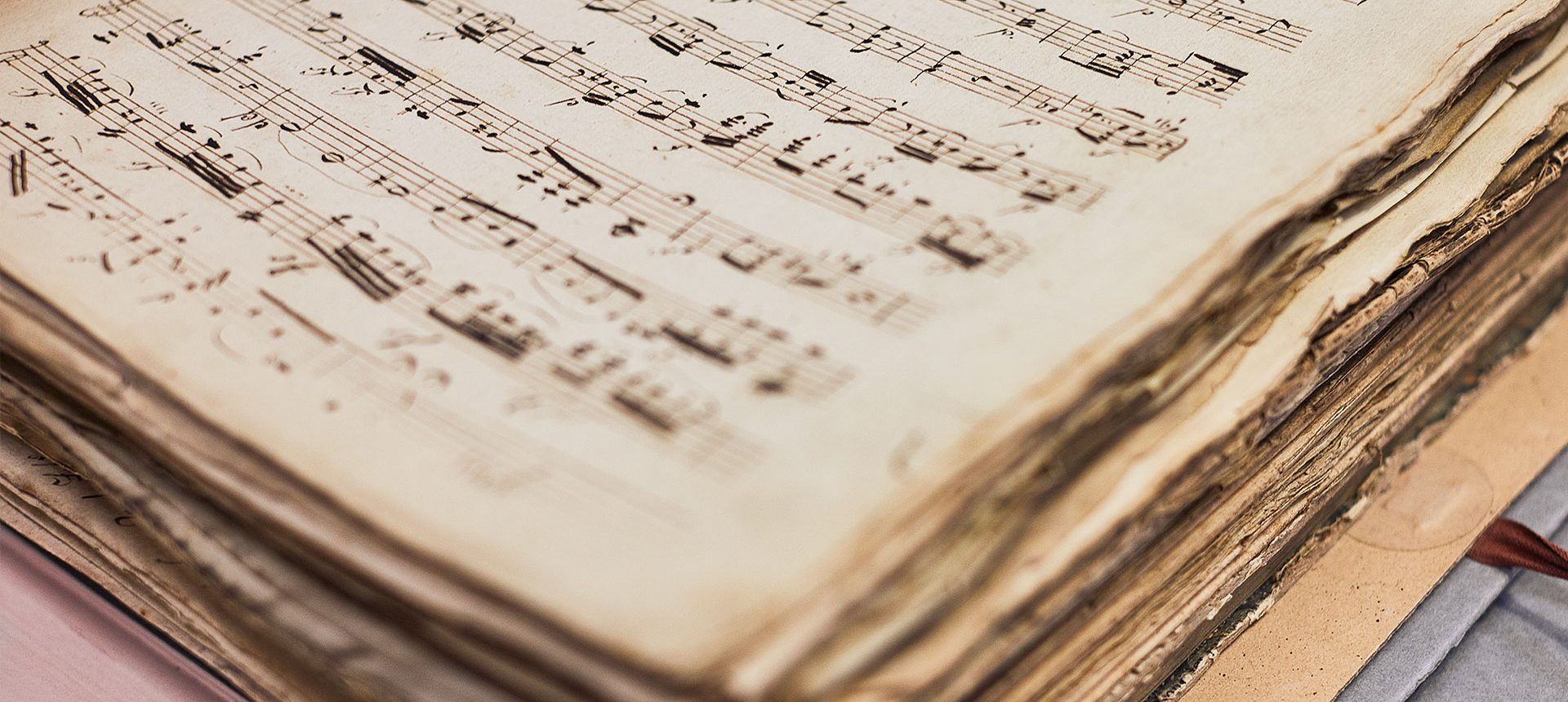
Here you can find almost anything about all the concerts Gothenburg Symphony has played over the years, both in the Concert Hall and on tour.
Search for conductors, soloists and other artists that has played together with us. Or search for composers and music that we have played. And filter on specific seasons. Guesting orchestras and ensembles are also included in the archive.
The result is presented by season.
139 concerts
1937-01-07 20:00 Stora salen
Göteborgs Symfoniker
Programme
With his broad musical experience (he played cornet, percussion and violin), Nielsen has always been popular with orchestras: he is a "musicians' composer" whose parts are almost always rich in content and challenging.
The Fourth Symphony (1916) is dense and intense, but there are also peaceful islands of recovery. The symphony opens with a powerful, completely surprising first movement, moves through a graceful allegretto (in which the wind instruments initially dominate) and a glowing third movement before ending with a blazing finale in which two drummers duel violently - incited and supported by the rest of the orchestra.
This is how Nielsen himself described the symphony: "The title (The Inextinguishable) suggests something that only music itself can express: the elementary will to live. /.../ Life is indelible and inextinguishable, yesterday, today and tomorrow, life was, is and will exist in struggle, conflict, generation and annihilation."
The Gothenburg Symphony was formed in 1905 and today consists of 109 musicians. The orchestra's base is Gothenburg Concert Hall at Götaplatsen that has gathered music lovers since 1935. Since the 2019-2020 season, Barbara Hannigan is Principal guest conductor. We are also a proud partner of Barbara Hannigan's Equilibrium mentoring program focusing on young singers at the start of their careers. The title Principal Guest Conductor is shared by Pekka Kuusisto from 2025.
Wilhelm Stenhammar was the orchestra's chief conductor from 1907 to 1922. He gave the orchestra a strong Nordic profile and invited colleagues Carl Nielsen and Jean Sibelius to the orchestra. Under the direction of conductor Neeme Järvi from 1982-2004, the orchestra made a series of international tours as well as a hundred disc recordings and established themselves among Europe's leading orchestras. In 1996, the Swedish Riksdag appointed the Gothenburg Symphony as Sweden's National Orchestra.
In recent decades, the orchestra has had prominent chief conductors such as Santtu-Matias Rouvali, Mario Venzago and Gustavo Dudamel, following Kent Nagano as Principal Guest conductor. Anna-Karin Larsson is CEO and artistic director, Gustavo Dudamel honorary conductor and Neeme Järvi chief conductor emeritus. The orchestra's owner is the Västra Götaland Region.
The Gothenburg Symphony works regularly with conductors such as Herbert Blomstedt, Joana Carneiro, Jukka-Pekka Saraste, Christian Zacharias and Anja Bihlmaier.
Beethoven's Third Symphony from 1803 shook the foundations of classical music. After the Viennese Classical First and the more experimental Second Symphony, Beethoven found a musical language totally of his own with the Third.
It is expansive, large, and does not shy away from new and unexpected effects (the most obvious are probably the dissonances in the opening of the first movement). Never before had any symphony had such an extensive and musically elaborate opening movement, which is at the same time completely romantic in expression. The self-confidence and perfection of the symphony are striking - like a shiny locomotive speeding through a landscape where only oxcarts had previously passed. It turned out in retrospect that the symphony was far ahead of its time. Much of Brahms' symphony music can, for example, be traced back to the Eroica, which says something about its epoch-making influence.
The funeral march in movement 2 (which is said to have been composed a few years earlier for a noble Englishman) is unique, a variation movement with a previously unimagined weight and emotional strength. Beethoven single-handedly expanded the dynamics of musical expression, making other symphonies from the same period seem puny by comparison. But it also meant that many listeners found the music bizarre, incomprehensible, and frightening.
Participants
The Gothenburg Symphony was formed in 1905 and today consists of 109 musicians. The orchestra's base is Gothenburg Concert Hall at Götaplatsen that has gathered music lovers since 1935. Since the 2019-2020 season, Barbara Hannigan is Principal guest conductor. We are also a proud partner of Barbara Hannigan's Equilibrium mentoring program focusing on young singers at the start of their careers. The title Principal Guest Conductor is shared by Pekka Kuusisto from 2025.
Wilhelm Stenhammar was the orchestra's chief conductor from 1907 to 1922. He gave the orchestra a strong Nordic profile and invited colleagues Carl Nielsen and Jean Sibelius to the orchestra. Under the direction of conductor Neeme Järvi from 1982-2004, the orchestra made a series of international tours as well as a hundred disc recordings and established themselves among Europe's leading orchestras. In 1996, the Swedish Riksdag appointed the Gothenburg Symphony as Sweden's National Orchestra.
In recent decades, the orchestra has had prominent chief conductors such as Santtu-Matias Rouvali, Mario Venzago and Gustavo Dudamel, following Kent Nagano as Principal Guest conductor. Anna-Karin Larsson is CEO and artistic director, Gustavo Dudamel honorary conductor and Neeme Järvi chief conductor emeritus. The orchestra's owner is the Västra Götaland Region.
The Gothenburg Symphony works regularly with conductors such as Herbert Blomstedt, Joana Carneiro, Jukka-Pekka Saraste, Christian Zacharias and Anja Bihlmaier.
Hector Berlioz (1803–1869)
Le carnaval romain (Roman Carnival)
Hector Berlioz's stylish concert overture Le carnaval romain delighted contemporary audiences. Berlioz was certainly known as an innovative skyrocketer, but here he had achieved something lively and captivating that made the audience ecstatic. After the premiere, another performance was soon forced. Le carnaval romain was written in 1844 and is not an overture that begins an opera, but a standalone piece, very well suited to begin an orchestral concert.
But there is actually a connection to opera: as early as 1837, Berlioz had composed his first opera, the one about the goldsmith and adventurer Benvenuto Cellini, who was active in 16th-century Florence, and when the opera was reworked from two to three acts in the mid-1840s, Berlioz included his Le carnaval romain to illustrate the great carnival scene in the second act, with its roaring frenzy and lively tarantella rhythms. This operation was not done at random, because the first melody heard in Le carnaval romain (played by English horn) is actually borrowed from the opera.
To this particular melody, Benvenuto sings to his beloved how he intends to abduct her during this very carnival. The music certainly aroused some wonder when Berlioz used irregular and restless melody lines, but in doing so he avoided all risk of banal intonations, while at the same time seizing the listener.
Participants
The Gothenburg Symphony was formed in 1905 and today consists of 109 musicians. The orchestra's base is Gothenburg Concert Hall at Götaplatsen that has gathered music lovers since 1935. Since the 2019-2020 season, Barbara Hannigan is Principal guest conductor. We are also a proud partner of Barbara Hannigan's Equilibrium mentoring program focusing on young singers at the start of their careers. The title Principal Guest Conductor is shared by Pekka Kuusisto from 2025.
Wilhelm Stenhammar was the orchestra's chief conductor from 1907 to 1922. He gave the orchestra a strong Nordic profile and invited colleagues Carl Nielsen and Jean Sibelius to the orchestra. Under the direction of conductor Neeme Järvi from 1982-2004, the orchestra made a series of international tours as well as a hundred disc recordings and established themselves among Europe's leading orchestras. In 1996, the Swedish Riksdag appointed the Gothenburg Symphony as Sweden's National Orchestra.
In recent decades, the orchestra has had prominent chief conductors such as Santtu-Matias Rouvali, Mario Venzago and Gustavo Dudamel, following Kent Nagano as Principal Guest conductor. Anna-Karin Larsson is CEO and artistic director, Gustavo Dudamel honorary conductor and Neeme Järvi chief conductor emeritus. The orchestra's owner is the Västra Götaland Region.
The Gothenburg Symphony works regularly with conductors such as Herbert Blomstedt, Joana Carneiro, Jukka-Pekka Saraste, Christian Zacharias and Anja Bihlmaier.
The Gothenburg Symphony was formed in 1905 and today consists of 109 musicians. The orchestra's base is Gothenburg Concert Hall at Götaplatsen that has gathered music lovers since 1935. Since the 2019-2020 season, Barbara Hannigan is Principal guest conductor. We are also a proud partner of Barbara Hannigan's Equilibrium mentoring program focusing on young singers at the start of their careers. The title Principal Guest Conductor is shared by Pekka Kuusisto from 2025.
Wilhelm Stenhammar was the orchestra's chief conductor from 1907 to 1922. He gave the orchestra a strong Nordic profile and invited colleagues Carl Nielsen and Jean Sibelius to the orchestra. Under the direction of conductor Neeme Järvi from 1982-2004, the orchestra made a series of international tours as well as a hundred disc recordings and established themselves among Europe's leading orchestras. In 1996, the Swedish Riksdag appointed the Gothenburg Symphony as Sweden's National Orchestra.
In recent decades, the orchestra has had prominent chief conductors such as Santtu-Matias Rouvali, Mario Venzago and Gustavo Dudamel, following Kent Nagano as Principal Guest conductor. Anna-Karin Larsson is CEO and artistic director, Gustavo Dudamel honorary conductor and Neeme Järvi chief conductor emeritus. The orchestra's owner is the Västra Götaland Region.
The Gothenburg Symphony works regularly with conductors such as Herbert Blomstedt, Joana Carneiro, Jukka-Pekka Saraste, Christian Zacharias and Anja Bihlmaier.
The Gothenburg Symphony was formed in 1905 and today consists of 109 musicians. The orchestra's base is Gothenburg Concert Hall at Götaplatsen that has gathered music lovers since 1935. Since the 2019-2020 season, Barbara Hannigan is Principal guest conductor. We are also a proud partner of Barbara Hannigan's Equilibrium mentoring program focusing on young singers at the start of their careers. The title Principal Guest Conductor is shared by Pekka Kuusisto from 2025.
Wilhelm Stenhammar was the orchestra's chief conductor from 1907 to 1922. He gave the orchestra a strong Nordic profile and invited colleagues Carl Nielsen and Jean Sibelius to the orchestra. Under the direction of conductor Neeme Järvi from 1982-2004, the orchestra made a series of international tours as well as a hundred disc recordings and established themselves among Europe's leading orchestras. In 1996, the Swedish Riksdag appointed the Gothenburg Symphony as Sweden's National Orchestra.
In recent decades, the orchestra has had prominent chief conductors such as Santtu-Matias Rouvali, Mario Venzago and Gustavo Dudamel, following Kent Nagano as Principal Guest conductor. Anna-Karin Larsson is CEO and artistic director, Gustavo Dudamel honorary conductor and Neeme Järvi chief conductor emeritus. The orchestra's owner is the Västra Götaland Region.
The Gothenburg Symphony works regularly with conductors such as Herbert Blomstedt, Joana Carneiro, Jukka-Pekka Saraste, Christian Zacharias and Anja Bihlmaier.
Symphony No. 4 E minor Op 98
Allegro non troppo
Andante moderato
Allegro giocoso
Allegro energico e passionato (Tema con variazioni)
Brahms himself conducted the first performance of the work. This took place in Meiningen on October 25, 1885, but was not an immediate success, even though Brahms once again composed melodically accurate and thoughtfully orchestrated music.
What made it all a bit dubious was that the music was not particularly easy to buy at all. The audience found too much melancholy and there was talk of autumn music. The simile is actually not so crazy at all, if you also consider that autumn is not only dark, but also has strong colors. It has been said that at this time Brahms was studying the ancient Greek tragedian Sophocles' drama Oedipus in detail, and possibly some of the moods from there have crept into the music.
Today, Brahms's Fourth Symphony has a high status. It is regarded as the crown of a very symphonic creation, and as the testament of a master. It is a deep, gentle and slightly resigned music with rare well-balanced form and character. And the finale has been especially admired with its eight-bar passacaglia theme presented by the brass in rigorously executed and artful variations.
STIG JACOBSSON
The Gothenburg Symphony was formed in 1905 and today consists of 109 musicians. The orchestra's base is Gothenburg Concert Hall at Götaplatsen that has gathered music lovers since 1935. Since the 2019-2020 season, Barbara Hannigan is Principal guest conductor. We are also a proud partner of Barbara Hannigan's Equilibrium mentoring program focusing on young singers at the start of their careers. The title Principal Guest Conductor is shared by Pekka Kuusisto from 2025.
Wilhelm Stenhammar was the orchestra's chief conductor from 1907 to 1922. He gave the orchestra a strong Nordic profile and invited colleagues Carl Nielsen and Jean Sibelius to the orchestra. Under the direction of conductor Neeme Järvi from 1982-2004, the orchestra made a series of international tours as well as a hundred disc recordings and established themselves among Europe's leading orchestras. In 1996, the Swedish Riksdag appointed the Gothenburg Symphony as Sweden's National Orchestra.
In recent decades, the orchestra has had prominent chief conductors such as Santtu-Matias Rouvali, Mario Venzago and Gustavo Dudamel, following Kent Nagano as Principal Guest conductor. Anna-Karin Larsson is CEO and artistic director, Gustavo Dudamel honorary conductor and Neeme Järvi chief conductor emeritus. The orchestra's owner is the Västra Götaland Region.
The Gothenburg Symphony works regularly with conductors such as Herbert Blomstedt, Joana Carneiro, Jukka-Pekka Saraste, Christian Zacharias and Anja Bihlmaier.
Beethoven's Third Symphony from 1803 shook the foundations of classical music. After the Viennese Classical First and the more experimental Second Symphony, Beethoven found a musical language totally of his own with the Third.
It is expansive, large, and does not shy away from new and unexpected effects (the most obvious are probably the dissonances in the opening of the first movement). Never before had any symphony had such an extensive and musically elaborate opening movement, which is at the same time completely romantic in expression. The self-confidence and perfection of the symphony are striking - like a shiny locomotive speeding through a landscape where only oxcarts had previously passed. It turned out in retrospect that the symphony was far ahead of its time. Much of Brahms' symphony music can, for example, be traced back to the Eroica, which says something about its epoch-making influence.
The funeral march in movement 2 (which is said to have been composed a few years earlier for a noble Englishman) is unique, a variation movement with a previously unimagined weight and emotional strength. Beethoven single-handedly expanded the dynamics of musical expression, making other symphonies from the same period seem puny by comparison. But it also meant that many listeners found the music bizarre, incomprehensible, and frightening.
Participants
The Gothenburg Symphony was formed in 1905 and today consists of 109 musicians. The orchestra's base is Gothenburg Concert Hall at Götaplatsen that has gathered music lovers since 1935. Since the 2019-2020 season, Barbara Hannigan is Principal guest conductor. We are also a proud partner of Barbara Hannigan's Equilibrium mentoring program focusing on young singers at the start of their careers. The title Principal Guest Conductor is shared by Pekka Kuusisto from 2025.
Wilhelm Stenhammar was the orchestra's chief conductor from 1907 to 1922. He gave the orchestra a strong Nordic profile and invited colleagues Carl Nielsen and Jean Sibelius to the orchestra. Under the direction of conductor Neeme Järvi from 1982-2004, the orchestra made a series of international tours as well as a hundred disc recordings and established themselves among Europe's leading orchestras. In 1996, the Swedish Riksdag appointed the Gothenburg Symphony as Sweden's National Orchestra.
In recent decades, the orchestra has had prominent chief conductors such as Santtu-Matias Rouvali, Mario Venzago and Gustavo Dudamel, following Kent Nagano as Principal Guest conductor. Anna-Karin Larsson is CEO and artistic director, Gustavo Dudamel honorary conductor and Neeme Järvi chief conductor emeritus. The orchestra's owner is the Västra Götaland Region.
The Gothenburg Symphony works regularly with conductors such as Herbert Blomstedt, Joana Carneiro, Jukka-Pekka Saraste, Christian Zacharias and Anja Bihlmaier.
The Gothenburg Symphony was formed in 1905 and today consists of 109 musicians. The orchestra's base is Gothenburg Concert Hall at Götaplatsen that has gathered music lovers since 1935. Since the 2019-2020 season, Barbara Hannigan is Principal guest conductor. We are also a proud partner of Barbara Hannigan's Equilibrium mentoring program focusing on young singers at the start of their careers. The title Principal Guest Conductor is shared by Pekka Kuusisto from 2025.
Wilhelm Stenhammar was the orchestra's chief conductor from 1907 to 1922. He gave the orchestra a strong Nordic profile and invited colleagues Carl Nielsen and Jean Sibelius to the orchestra. Under the direction of conductor Neeme Järvi from 1982-2004, the orchestra made a series of international tours as well as a hundred disc recordings and established themselves among Europe's leading orchestras. In 1996, the Swedish Riksdag appointed the Gothenburg Symphony as Sweden's National Orchestra.
In recent decades, the orchestra has had prominent chief conductors such as Santtu-Matias Rouvali, Mario Venzago and Gustavo Dudamel, following Kent Nagano as Principal Guest conductor. Anna-Karin Larsson is CEO and artistic director, Gustavo Dudamel honorary conductor and Neeme Järvi chief conductor emeritus. The orchestra's owner is the Västra Götaland Region.
The Gothenburg Symphony works regularly with conductors such as Herbert Blomstedt, Joana Carneiro, Jukka-Pekka Saraste, Christian Zacharias and Anja Bihlmaier.
Andante sostenuto
Andantino in modo di canzona
Allegro
Allegro con fuoco
In correspondence as well as a for Tchaikovsky unusual online commentary, both implicit and explicit connections between this fourth symphony and Beethoven's fifth, Symphony of Fate, are suggested. In Tchaikovsky's Fourth Symphony, it sometimes seems as if he is trying to bring everything together, both the absolute of the music and the programmatic, and this is already audible in the first movement's architectural use of the fanfare theme that surrounds the otherwise inserted classical sonata form. The structural thereby gets a certain programmatic design, but within the form, the motivic work is found and listen (!) here to how Tchaikovsky uses the orchestra as a design of the room. The sonorous qualities of the shift of instrumentation provide a for the time unusual, and for posterity remarkable, use of instrumentation as a form of variation, one in which the ear and the room, not the word, are supreme.
And it is here – in the alternation between rhythmic and instrumental variation – that the rhapsodic becomes increasingly apparent: the story the symphony portrays, regardless of whether it is with just the musical aspect or with an idea of ??an underlying narrative, takes on an increasingly clear sonorous garment in Tchaikovsky.
The second movement's simpler, more melancholic feeling, and the third movement's dance-like display of pizzicato shock may seem parenthetical after the weight of the first movement, but in miniature the connection between motivic processing and the exploration of space through orchestration is found here as well. Finally, in the fourth, bombastic, movement, everything ties together. The rhapsodic, in the folk-inspired melodies are modulated and thrown around in the orchestral clusters, and finally we are back in the fate theme, and the coda can triumphantly bring us home.
Esaias Järnegard
The Gothenburg Symphony was formed in 1905 and today consists of 109 musicians. The orchestra's base is Gothenburg Concert Hall at Götaplatsen that has gathered music lovers since 1935. Since the 2019-2020 season, Barbara Hannigan is Principal guest conductor. We are also a proud partner of Barbara Hannigan's Equilibrium mentoring program focusing on young singers at the start of their careers. The title Principal Guest Conductor is shared by Pekka Kuusisto from 2025.
Wilhelm Stenhammar was the orchestra's chief conductor from 1907 to 1922. He gave the orchestra a strong Nordic profile and invited colleagues Carl Nielsen and Jean Sibelius to the orchestra. Under the direction of conductor Neeme Järvi from 1982-2004, the orchestra made a series of international tours as well as a hundred disc recordings and established themselves among Europe's leading orchestras. In 1996, the Swedish Riksdag appointed the Gothenburg Symphony as Sweden's National Orchestra.
In recent decades, the orchestra has had prominent chief conductors such as Santtu-Matias Rouvali, Mario Venzago and Gustavo Dudamel, following Kent Nagano as Principal Guest conductor. Anna-Karin Larsson is CEO and artistic director, Gustavo Dudamel honorary conductor and Neeme Järvi chief conductor emeritus. The orchestra's owner is the Västra Götaland Region.
The Gothenburg Symphony works regularly with conductors such as Herbert Blomstedt, Joana Carneiro, Jukka-Pekka Saraste, Christian Zacharias and Anja Bihlmaier.