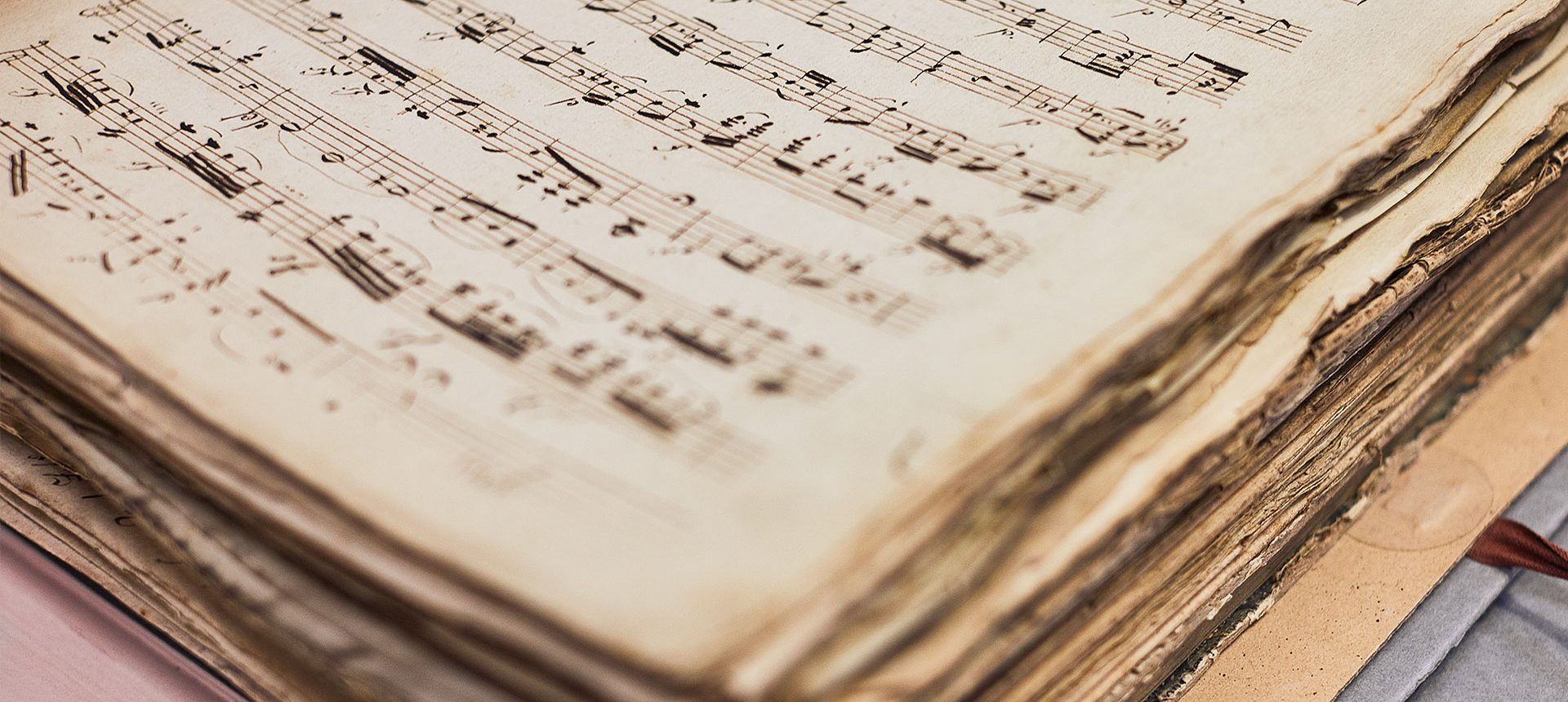
Here you can find almost anything about all the concerts Gothenburg Symphony has played over the years, both in the Concert Hall and on tour.
Search for conductors, soloists and other artists that has played together with us. Or search for composers and music that we have played. And filter on specific seasons. Guesting orchestras and ensembles are also included in the archive.
The result is presented by season.
The Gothenburg Symphony was formed in 1905 and today consists of 109 musicians. The orchestra's base is Gothenburg Concert Hall at Götaplatsen that has gathered music lovers since 1935. Since the 2019-2020 season, Barbara Hannigan is Principal guest conductor. We are also a proud partner of Barbara Hannigan's Equilibrium mentoring program focusing on young singers at the start of their careers. The title Principal Guest Conductor is shared by Pekka Kuusisto from 2025.
Wilhelm Stenhammar was the orchestra's chief conductor from 1907 to 1922. He gave the orchestra a strong Nordic profile and invited colleagues Carl Nielsen and Jean Sibelius to the orchestra. Under the direction of conductor Neeme Järvi from 1982-2004, the orchestra made a series of international tours as well as a hundred disc recordings and established themselves among Europe's leading orchestras. In 1996, the Swedish Riksdag appointed the Gothenburg Symphony as Sweden's National Orchestra.
In recent decades, the orchestra has had prominent chief conductors such as Santtu-Matias Rouvali, Mario Venzago and Gustavo Dudamel, following Kent Nagano as Principal Guest conductor. Anna-Karin Larsson is CEO and artistic director, Gustavo Dudamel honorary conductor and Neeme Järvi chief conductor emeritus. The orchestra's owner is the Västra Götaland Region.
The Gothenburg Symphony works regularly with conductors such as Herbert Blomstedt, Joana Carneiro, Jukka-Pekka Saraste, Christian Zacharias and Anja Bihlmaier.
Beethoven composed over 700 works during his 45-year career. One of the most beloved is his only violin concerto—a work with an unusually dramatic backstory. Legend has it that the concerto was not completed until just before its premiere in Vienna on December 23, 1806. Consequently, the soloist Franz Clement—to whom the work is dedicated—reportedly had to play parts of the music directly from the manuscript. At the premiere, he even inserted an improvised cadenza of his own, which he is said to have played with his violin held upside down.
For its time, the concerto was bold in several respects: it was unusually long, featured a larger orchestra than previous concertos, and included a virtuosic, demanding solo part. It is perhaps not surprising that it took fifty years for the work to become a staple of the concert repertoire.
Musically, Beethoven blends the Classical style with something new and Romantic. The lengthy orchestral introduction presents and develops the musical material before the violin enters. Soloist and orchestra then interact and evolve together throughout the concerto; they share themes, respond to one another, and take turns leading and following.
The violin concerto is cherished by many because it is not merely a display of virtuosity, but a living musical dialogue.
The Gothenburg Symphony was formed in 1905 and today consists of 109 musicians. The orchestra's base is Gothenburg Concert Hall at Götaplatsen that has gathered music lovers since 1935. Since the 2019-2020 season, Barbara Hannigan is Principal guest conductor. We are also a proud partner of Barbara Hannigan's Equilibrium mentoring program focusing on young singers at the start of their careers. The title Principal Guest Conductor is shared by Pekka Kuusisto from 2025.
Wilhelm Stenhammar was the orchestra's chief conductor from 1907 to 1922. He gave the orchestra a strong Nordic profile and invited colleagues Carl Nielsen and Jean Sibelius to the orchestra. Under the direction of conductor Neeme Järvi from 1982-2004, the orchestra made a series of international tours as well as a hundred disc recordings and established themselves among Europe's leading orchestras. In 1996, the Swedish Riksdag appointed the Gothenburg Symphony as Sweden's National Orchestra.
In recent decades, the orchestra has had prominent chief conductors such as Santtu-Matias Rouvali, Mario Venzago and Gustavo Dudamel, following Kent Nagano as Principal Guest conductor. Anna-Karin Larsson is CEO and artistic director, Gustavo Dudamel honorary conductor and Neeme Järvi chief conductor emeritus. The orchestra's owner is the Västra Götaland Region.
The Gothenburg Symphony works regularly with conductors such as Herbert Blomstedt, Joana Carneiro, Jukka-Pekka Saraste, Christian Zacharias and Anja Bihlmaier.
Wolfgang Amadeus Mozart (1756-1791)
Eine kleine Nachtmusik
Allegro
Romanze: Andante
Menuetto e Trio
Rondo: Allegro
One might wonder if there is a more beautifully crafted and polished gem than Eine kleine Nachtmusik - so appealing, so perfect. Nachtmusik is German for "serenade", and when it was composed, Mozart had already composed twelve serenades. Compared to the earlier serenades, it truly lives up to its name - a little one. It becomes a miniature, a simple, classically pure and easily accessible trifle, in terms of scope. The earlier serenades could be 45 minutes long. A serenade should also be intended to be played outdoors, but that does not work at all with Eine kleine Nachtmusik with its lovely and intimate string music.
Mozart included Eine kleine Nachtmusik in his own catalogue of compositions in Vienna on August 10, 1787, and listed it as having five movements. There was another minuet - but this movement disappeared early in the work's history and has never been found. It has also not been possible to find out why Mozart wrote this lovely entertainment music. In any case, it does not seem to have been a commission, but that he wrote music out of his own interest.
It has been surprising that the mature master of cosmopolitan Vienna interrupted the demanding work of orchestrating the exciting nighttime moods of the opera Don Giovanni in favor of this delicacy. Was it the contrast he needed? Was the inspiration pressing?
The Gothenburg Symphony was formed in 1905 and today consists of 109 musicians. The orchestra's base is Gothenburg Concert Hall at Götaplatsen that has gathered music lovers since 1935. Since the 2019-2020 season, Barbara Hannigan is Principal guest conductor. We are also a proud partner of Barbara Hannigan's Equilibrium mentoring program focusing on young singers at the start of their careers. The title Principal Guest Conductor is shared by Pekka Kuusisto from 2025.
Wilhelm Stenhammar was the orchestra's chief conductor from 1907 to 1922. He gave the orchestra a strong Nordic profile and invited colleagues Carl Nielsen and Jean Sibelius to the orchestra. Under the direction of conductor Neeme Järvi from 1982-2004, the orchestra made a series of international tours as well as a hundred disc recordings and established themselves among Europe's leading orchestras. In 1996, the Swedish Riksdag appointed the Gothenburg Symphony as Sweden's National Orchestra.
In recent decades, the orchestra has had prominent chief conductors such as Santtu-Matias Rouvali, Mario Venzago and Gustavo Dudamel, following Kent Nagano as Principal Guest conductor. Anna-Karin Larsson is CEO and artistic director, Gustavo Dudamel honorary conductor and Neeme Järvi chief conductor emeritus. The orchestra's owner is the Västra Götaland Region.
The Gothenburg Symphony works regularly with conductors such as Herbert Blomstedt, Joana Carneiro, Jukka-Pekka Saraste, Christian Zacharias and Anja Bihlmaier.
Felix Mendelssohn (1809-1847)
Violin Concerto E minor
Allegro molto appassionato
Andante
Allegretto non troppo. Allegro molto vivace
Felix Mendelssohn came from a German-Jewish family and as a composer strove to reconcile issues of spirituality and religious tolerance within society, and within himself. The Violin Concerto in E minor was written for the soloist Ferdinand David. However, the wait was six years before the premiere could take place in Leipzig on March 13, 1845 with David and the Gewandhaus Orchestra. New was the transition to the second movement without a break, as well as the fact that the soloist took up the opening theme, not the orchestra, and that a solo cadenza came already in the introduction - something that Sibelius and Tchaikovsky would also follow. The success was immediate. But in Nazi Germany, Mendelssohn's greatness was denied and his name was erased from public life.
The Gothenburg Symphony was formed in 1905 and today consists of 109 musicians. The orchestra's base is Gothenburg Concert Hall at Götaplatsen that has gathered music lovers since 1935. Since the 2019-2020 season, Barbara Hannigan is Principal guest conductor. We are also a proud partner of Barbara Hannigan's Equilibrium mentoring program focusing on young singers at the start of their careers. The title Principal Guest Conductor is shared by Pekka Kuusisto from 2025.
Wilhelm Stenhammar was the orchestra's chief conductor from 1907 to 1922. He gave the orchestra a strong Nordic profile and invited colleagues Carl Nielsen and Jean Sibelius to the orchestra. Under the direction of conductor Neeme Järvi from 1982-2004, the orchestra made a series of international tours as well as a hundred disc recordings and established themselves among Europe's leading orchestras. In 1996, the Swedish Riksdag appointed the Gothenburg Symphony as Sweden's National Orchestra.
In recent decades, the orchestra has had prominent chief conductors such as Santtu-Matias Rouvali, Mario Venzago and Gustavo Dudamel, following Kent Nagano as Principal Guest conductor. Anna-Karin Larsson is CEO and artistic director, Gustavo Dudamel honorary conductor and Neeme Järvi chief conductor emeritus. The orchestra's owner is the Västra Götaland Region.
The Gothenburg Symphony works regularly with conductors such as Herbert Blomstedt, Joana Carneiro, Jukka-Pekka Saraste, Christian Zacharias and Anja Bihlmaier.
Bartók had written a violin concerto as early as 1907, though it remained unpublished during his lifetime. Thirty years later, the violinist Zoltán Székely asked him for a new concerto. At first, Bartók was reluctant; he had envisioned a large-scale set of variations instead. He had already begun work in May 1937, before pausing to compose the Sonata for Two Pianos and Percussion. He also interrupted his work in the autumn of 1938 to write Contrasts—for clarinet, violin, and piano—which had been commissioned by Benny Goodman. Bartók was a controversial figure at the time; he forbade the rebroadcasting of his radio concerts in Italy and Germany. In a private letter, he claimed that Hungary was drawing closer to the "gangster and murderer regimes" of those states. He planned to emigrate, "away from the vicinity of this tainted country."
Yet the music is devoid of any trace of despondency. Like the great classical masters Beethoven and Mozart, he was able to rise above the mundane—evident in the two outer movements, which possess a youthful vitality; the third movement is even set in 3/4 time and features variations with a folk-song character. Variations also define the exquisite middle movement: the first variation actually employs the timpani as a melodic instrument, while the next boasts a rich array of sonorities from the harp, woodwinds, and celesta, gradually giving way to an increasingly prominent role for the soloist. Ultimately, the music takes on an almost dance-like quality. As is often the case in troubled times, the music fulfilled a greater purpose: instilling resilience, hope, and the courage to live. By the time of the premiere in Amsterdam in 1939—featuring Székely and the Concertgebouw Orchestra—Bartók was already en route to the United States. The emigration took place in October 1940.
Participants
The Gothenburg Symphony was formed in 1905 and today consists of 109 musicians. The orchestra's base is Gothenburg Concert Hall at Götaplatsen that has gathered music lovers since 1935. Since the 2019-2020 season, Barbara Hannigan is Principal guest conductor. We are also a proud partner of Barbara Hannigan's Equilibrium mentoring program focusing on young singers at the start of their careers. The title Principal Guest Conductor is shared by Pekka Kuusisto from 2025.
Wilhelm Stenhammar was the orchestra's chief conductor from 1907 to 1922. He gave the orchestra a strong Nordic profile and invited colleagues Carl Nielsen and Jean Sibelius to the orchestra. Under the direction of conductor Neeme Järvi from 1982-2004, the orchestra made a series of international tours as well as a hundred disc recordings and established themselves among Europe's leading orchestras. In 1996, the Swedish Riksdag appointed the Gothenburg Symphony as Sweden's National Orchestra.
In recent decades, the orchestra has had prominent chief conductors such as Santtu-Matias Rouvali, Mario Venzago and Gustavo Dudamel, following Kent Nagano as Principal Guest conductor. Anna-Karin Larsson is CEO and artistic director, Gustavo Dudamel honorary conductor and Neeme Järvi chief conductor emeritus. The orchestra's owner is the Västra Götaland Region.
The Gothenburg Symphony works regularly with conductors such as Herbert Blomstedt, Joana Carneiro, Jukka-Pekka Saraste, Christian Zacharias and Anja Bihlmaier.
Herbert Blomstedt, born in 1927, continues to be one of the world's most sought-after conductors. He has been a regular and much appreciated guest conductor with the Gothenburg Symphony since 1954 and is also named an honorary symphony conductor. His work as a conductor is inextricably linked to his religious and human ethos, and his interpretations combine great fidelity to the score and analytical precision. In the more than sixty years of his career, he has acquired the unrestricted respect of the musical world.
Born in the USA to Swedish parents and educated in Uppsala, New York, Darmstadt and Basel, Herbert Blomstedt made his debut as a conductor in 1954 with the Stockholm Philharmonic Orchestra and was subsequently chief conductor of the Oslo Philharmonic, the Swedish and Danish Radio symphony orchestras and the Staatskapelle Dresden. During his career, Herbert Blomstedt has been chief conductor of the Gewandhaus Orchestra in Leipzig, the NDR Orchestra in Hamburg and the San Francisco Symphony Orchestra. He has appeared with all the major orchestras, including the Berlin Philharmonic, the Boston and Chicago Symphony Orchestras, the Concertgebouw Orchestra, the New York Philharmonic, the Bavarian Radio Symphony Orchestra and the Vienna Philharmonic. Herbert Blomstedt's discography includes hundreds of recordings. Among his later releases are Stenhammar's Serenade and Symphony No. 2 with the Gothenburg Symphony (BIS).
Herbert Blomstedt holds several Honorary Doctorates and is an elected member of the Royal Swedish Music Academy. He continues to be at the helm of all leading international orchestras with enormous presence, verve and artistic drive.
The Gothenburg Symphony was formed in 1905 and today consists of 109 musicians. The orchestra's base is Gothenburg Concert Hall at Götaplatsen that has gathered music lovers since 1935. Since the 2019-2020 season, Barbara Hannigan is Principal guest conductor. We are also a proud partner of Barbara Hannigan's Equilibrium mentoring program focusing on young singers at the start of their careers. The title Principal Guest Conductor is shared by Pekka Kuusisto from 2025.
Wilhelm Stenhammar was the orchestra's chief conductor from 1907 to 1922. He gave the orchestra a strong Nordic profile and invited colleagues Carl Nielsen and Jean Sibelius to the orchestra. Under the direction of conductor Neeme Järvi from 1982-2004, the orchestra made a series of international tours as well as a hundred disc recordings and established themselves among Europe's leading orchestras. In 1996, the Swedish Riksdag appointed the Gothenburg Symphony as Sweden's National Orchestra.
In recent decades, the orchestra has had prominent chief conductors such as Santtu-Matias Rouvali, Mario Venzago and Gustavo Dudamel, following Kent Nagano as Principal Guest conductor. Anna-Karin Larsson is CEO and artistic director, Gustavo Dudamel honorary conductor and Neeme Järvi chief conductor emeritus. The orchestra's owner is the Västra Götaland Region.
The Gothenburg Symphony works regularly with conductors such as Herbert Blomstedt, Joana Carneiro, Jukka-Pekka Saraste, Christian Zacharias and Anja Bihlmaier.
Haydn Variations Op 56
Like Beethoven, Brahms was very interested in the variation form and stands out as one of the foremost composers in this area. The theme for the Haydn variations is a chorale called St Antoni, followed by eight variations and a grand finale. A good friend of Brahms, Karl Ferdinand Pohl, had brought some unknown music to Brahms in 1870, including some scores or divertimenti for wind orchestra. One partita contained the Antonius Chorale, which Brahms fell in love with and noted in his sketchbook. At first it was believed to have been composed by Haydn, but researchers increasingly believe that it was possibly one of Haydn's students, probably Ignatz Pleyel, who composed the partita. The theme is based on a hymn that pilgrims used to sing on St. Anthony's Day.
The Brahms work is available in two versions, one for two pianos and one for orchestra. Brahms entered the orchestral version in his catalog first, but it was the piano version that first appeared in print. The duo version was first performed by Brahms himself and Clara Schumann. The orchestral version was first performed in November 1873 by the Vienna Philharmonic under Brahms.
The Gothenburg Symphony was formed in 1905 and today consists of 109 musicians. The orchestra's base is Gothenburg Concert Hall at Götaplatsen that has gathered music lovers since 1935. Since the 2019-2020 season, Barbara Hannigan is Principal guest conductor. We are also a proud partner of Barbara Hannigan's Equilibrium mentoring program focusing on young singers at the start of their careers. The title Principal Guest Conductor is shared by Pekka Kuusisto from 2025.
Wilhelm Stenhammar was the orchestra's chief conductor from 1907 to 1922. He gave the orchestra a strong Nordic profile and invited colleagues Carl Nielsen and Jean Sibelius to the orchestra. Under the direction of conductor Neeme Järvi from 1982-2004, the orchestra made a series of international tours as well as a hundred disc recordings and established themselves among Europe's leading orchestras. In 1996, the Swedish Riksdag appointed the Gothenburg Symphony as Sweden's National Orchestra.
In recent decades, the orchestra has had prominent chief conductors such as Santtu-Matias Rouvali, Mario Venzago and Gustavo Dudamel, following Kent Nagano as Principal Guest conductor. Anna-Karin Larsson is CEO and artistic director, Gustavo Dudamel honorary conductor and Neeme Järvi chief conductor emeritus. The orchestra's owner is the Västra Götaland Region.
The Gothenburg Symphony works regularly with conductors such as Herbert Blomstedt, Joana Carneiro, Jukka-Pekka Saraste, Christian Zacharias and Anja Bihlmaier.
Zoltán Kodály (1882-1967)
Galántai táncok
Ancient Hungarian peasant music, still unchanged in the villages, began to be recorded by Zoltán Kodály and Bartók around 1905. Both composers were captivated by the unique Romani verbunkos music. In the small Slovak town of Galánta, fifty kilometers from Bratislava, next to the train line between Vienna and Budapest, there was a famous Romani music chapel that gave Kodály his earliest taste for orchestral sound.
Dances from Galánta were written in 1933 for the 80th anniversary of the Budapest Philharmonic. The instrumentation for double flutes (plus piccolo), oboes, A-clarinets, bassoons, plus four horns, timpani, snare drum, glockenspiel, triangle and strings imitated such a verbunkos band with a solo clarinet in the lead role as the Romani tárogáto. The story goes that the Galánta pieces were originally composed during Hungary's struggle for independence under Turkish occupation. Verbunkos music began to be published in sheet music in the late 18th century, not least in Vienna, where both Mozart and Schubert were strongly influenced by it. Kodály uses the slow verbunkos introduction as a rondo theme in the following four dances as well as in the great final coda. It alone takes up more than half the length of the piece.
As a respected professor at the Budapest Academy of Music and president of the Hungarian Academy of Sciences, and later an honorary doctor in Oxford and Berlin, Kodály would promote the importance of spontaneous folk music. This liberal orientation also permeated key earlier works such as the Háry János Suite of 1927 and the Dances from Marosszék of 1933, both of which, along with the Galánta Dances, were his most frequently performed works.
The Gothenburg Symphony was formed in 1905 and today consists of 109 musicians. The orchestra's base is Gothenburg Concert Hall at Götaplatsen that has gathered music lovers since 1935. Since the 2019-2020 season, Barbara Hannigan is Principal guest conductor. We are also a proud partner of Barbara Hannigan's Equilibrium mentoring program focusing on young singers at the start of their careers. The title Principal Guest Conductor is shared by Pekka Kuusisto from 2025.
Wilhelm Stenhammar was the orchestra's chief conductor from 1907 to 1922. He gave the orchestra a strong Nordic profile and invited colleagues Carl Nielsen and Jean Sibelius to the orchestra. Under the direction of conductor Neeme Järvi from 1982-2004, the orchestra made a series of international tours as well as a hundred disc recordings and established themselves among Europe's leading orchestras. In 1996, the Swedish Riksdag appointed the Gothenburg Symphony as Sweden's National Orchestra.
In recent decades, the orchestra has had prominent chief conductors such as Santtu-Matias Rouvali, Mario Venzago and Gustavo Dudamel, following Kent Nagano as Principal Guest conductor. Anna-Karin Larsson is CEO and artistic director, Gustavo Dudamel honorary conductor and Neeme Järvi chief conductor emeritus. The orchestra's owner is the Västra Götaland Region.
The Gothenburg Symphony works regularly with conductors such as Herbert Blomstedt, Joana Carneiro, Jukka-Pekka Saraste, Christian Zacharias and Anja Bihlmaier.
Wolfgang Amadeus Mozart (1756-1791)
Eine kleine Nachtmusik
Allegro
Romanze: Andante
Menuetto e Trio
Rondo: Allegro
One might wonder if there is a more beautifully crafted and polished gem than Eine kleine Nachtmusik - so appealing, so perfect. Nachtmusik is German for "serenade", and when it was composed, Mozart had already composed twelve serenades. Compared to the earlier serenades, it truly lives up to its name - a little one. It becomes a miniature, a simple, classically pure and easily accessible trifle, in terms of scope. The earlier serenades could be 45 minutes long. A serenade should also be intended to be played outdoors, but that does not work at all with Eine kleine Nachtmusik with its lovely and intimate string music.
Mozart included Eine kleine Nachtmusik in his own catalogue of compositions in Vienna on August 10, 1787, and listed it as having five movements. There was another minuet - but this movement disappeared early in the work's history and has never been found. It has also not been possible to find out why Mozart wrote this lovely entertainment music. In any case, it does not seem to have been a commission, but that he wrote music out of his own interest.
It has been surprising that the mature master of cosmopolitan Vienna interrupted the demanding work of orchestrating the exciting nighttime moods of the opera Don Giovanni in favor of this delicacy. Was it the contrast he needed? Was the inspiration pressing?
The Gothenburg Symphony was formed in 1905 and today consists of 109 musicians. The orchestra's base is Gothenburg Concert Hall at Götaplatsen that has gathered music lovers since 1935. Since the 2019-2020 season, Barbara Hannigan is Principal guest conductor. We are also a proud partner of Barbara Hannigan's Equilibrium mentoring program focusing on young singers at the start of their careers. The title Principal Guest Conductor is shared by Pekka Kuusisto from 2025.
Wilhelm Stenhammar was the orchestra's chief conductor from 1907 to 1922. He gave the orchestra a strong Nordic profile and invited colleagues Carl Nielsen and Jean Sibelius to the orchestra. Under the direction of conductor Neeme Järvi from 1982-2004, the orchestra made a series of international tours as well as a hundred disc recordings and established themselves among Europe's leading orchestras. In 1996, the Swedish Riksdag appointed the Gothenburg Symphony as Sweden's National Orchestra.
In recent decades, the orchestra has had prominent chief conductors such as Santtu-Matias Rouvali, Mario Venzago and Gustavo Dudamel, following Kent Nagano as Principal Guest conductor. Anna-Karin Larsson is CEO and artistic director, Gustavo Dudamel honorary conductor and Neeme Järvi chief conductor emeritus. The orchestra's owner is the Västra Götaland Region.
The Gothenburg Symphony works regularly with conductors such as Herbert Blomstedt, Joana Carneiro, Jukka-Pekka Saraste, Christian Zacharias and Anja Bihlmaier.
The Gothenburg Symphony was formed in 1905 and today consists of 109 musicians. The orchestra's base is Gothenburg Concert Hall at Götaplatsen that has gathered music lovers since 1935. Since the 2019-2020 season, Barbara Hannigan is Principal guest conductor. We are also a proud partner of Barbara Hannigan's Equilibrium mentoring program focusing on young singers at the start of their careers. The title Principal Guest Conductor is shared by Pekka Kuusisto from 2025.
Wilhelm Stenhammar was the orchestra's chief conductor from 1907 to 1922. He gave the orchestra a strong Nordic profile and invited colleagues Carl Nielsen and Jean Sibelius to the orchestra. Under the direction of conductor Neeme Järvi from 1982-2004, the orchestra made a series of international tours as well as a hundred disc recordings and established themselves among Europe's leading orchestras. In 1996, the Swedish Riksdag appointed the Gothenburg Symphony as Sweden's National Orchestra.
In recent decades, the orchestra has had prominent chief conductors such as Santtu-Matias Rouvali, Mario Venzago and Gustavo Dudamel, following Kent Nagano as Principal Guest conductor. Anna-Karin Larsson is CEO and artistic director, Gustavo Dudamel honorary conductor and Neeme Järvi chief conductor emeritus. The orchestra's owner is the Västra Götaland Region.
The Gothenburg Symphony works regularly with conductors such as Herbert Blomstedt, Joana Carneiro, Jukka-Pekka Saraste, Christian Zacharias and Anja Bihlmaier.
Beethoven really had to struggle with his music. He worked meticulously on every detail, and the work is still extant in his sketchbooks. Even the seemingly obvious opening of the Fifth Symphony, the knocking on the door of fate that immediately seizes the listener and which seems to be such an unshakable thought, undergoes a series of transformations in the sketches that are difficult to understand in retrospect.
The energetic scherzo transition in the finale has undergone countless phases of development. The sketches also show that Beethoven originally did not at all envision a finale in a triumphant major, but in a minor key. Beethoven's Fifth is certainly worthy of all the admiring attention it receives. It is the result of the tribulations of a hard-working genius.
The Gothenburg Symphony was formed in 1905 and today consists of 109 musicians. The orchestra's base is Gothenburg Concert Hall at Götaplatsen that has gathered music lovers since 1935. Since the 2019-2020 season, Barbara Hannigan is Principal guest conductor. We are also a proud partner of Barbara Hannigan's Equilibrium mentoring program focusing on young singers at the start of their careers. The title Principal Guest Conductor is shared by Pekka Kuusisto from 2025.
Wilhelm Stenhammar was the orchestra's chief conductor from 1907 to 1922. He gave the orchestra a strong Nordic profile and invited colleagues Carl Nielsen and Jean Sibelius to the orchestra. Under the direction of conductor Neeme Järvi from 1982-2004, the orchestra made a series of international tours as well as a hundred disc recordings and established themselves among Europe's leading orchestras. In 1996, the Swedish Riksdag appointed the Gothenburg Symphony as Sweden's National Orchestra.
In recent decades, the orchestra has had prominent chief conductors such as Santtu-Matias Rouvali, Mario Venzago and Gustavo Dudamel, following Kent Nagano as Principal Guest conductor. Anna-Karin Larsson is CEO and artistic director, Gustavo Dudamel honorary conductor and Neeme Järvi chief conductor emeritus. The orchestra's owner is the Västra Götaland Region.
The Gothenburg Symphony works regularly with conductors such as Herbert Blomstedt, Joana Carneiro, Jukka-Pekka Saraste, Christian Zacharias and Anja Bihlmaier.
Maurice Ravel (1875-1937)
Suite No 2 from Daphnis et Chloé
It is difficult to capture this orchestral suite in a few words, which after more than 100 years strikes an audience with enormous richness of color and virtuosity. A music that is only remarkable at the time of its creation. 1913 is the year that Stravinsky's Rite of Spring is played for the first time, and Anton Webern's 6 orchestral works are performed in Vienna. Two concerts whose musical revolution was for a long time overshadowed by the scuffles that arose during the concerts.
Ravel's suite was already embraced during the composer's lifetime, but its musical revolution in harmony and orchestration is no lesser. This suite, which is part of a ballet set to the Greek tale of Daphnis and Chloé, to which Diaghilev's famous dance company danced, bears all the characteristics that made Ravel's music immortal.
The examples are countless, but the level of subtle genius is present already in the opening of the work, when the sun rises in the impressionistic orchestral scree. Not least listen to how this is embodied in the string section. The timbre, which is like a fund for the moving wind motifs, is in fact the sunrise's most sonorous transformation; how the strings in a slow procession during the opening bars raise the chords, from desk to desk, from section to section, and in that way - sifted through the sound of the strings - sweetly let the overtones from the strings go from the dark to the clear.
Esaias Järnegard
The Gothenburg Symphony was formed in 1905 and today consists of 109 musicians. The orchestra's base is Gothenburg Concert Hall at Götaplatsen that has gathered music lovers since 1935. Since the 2019-2020 season, Barbara Hannigan is Principal guest conductor. We are also a proud partner of Barbara Hannigan's Equilibrium mentoring program focusing on young singers at the start of their careers. The title Principal Guest Conductor is shared by Pekka Kuusisto from 2025.
Wilhelm Stenhammar was the orchestra's chief conductor from 1907 to 1922. He gave the orchestra a strong Nordic profile and invited colleagues Carl Nielsen and Jean Sibelius to the orchestra. Under the direction of conductor Neeme Järvi from 1982-2004, the orchestra made a series of international tours as well as a hundred disc recordings and established themselves among Europe's leading orchestras. In 1996, the Swedish Riksdag appointed the Gothenburg Symphony as Sweden's National Orchestra.
In recent decades, the orchestra has had prominent chief conductors such as Santtu-Matias Rouvali, Mario Venzago and Gustavo Dudamel, following Kent Nagano as Principal Guest conductor. Anna-Karin Larsson is CEO and artistic director, Gustavo Dudamel honorary conductor and Neeme Järvi chief conductor emeritus. The orchestra's owner is the Västra Götaland Region.
The Gothenburg Symphony works regularly with conductors such as Herbert Blomstedt, Joana Carneiro, Jukka-Pekka Saraste, Christian Zacharias and Anja Bihlmaier.