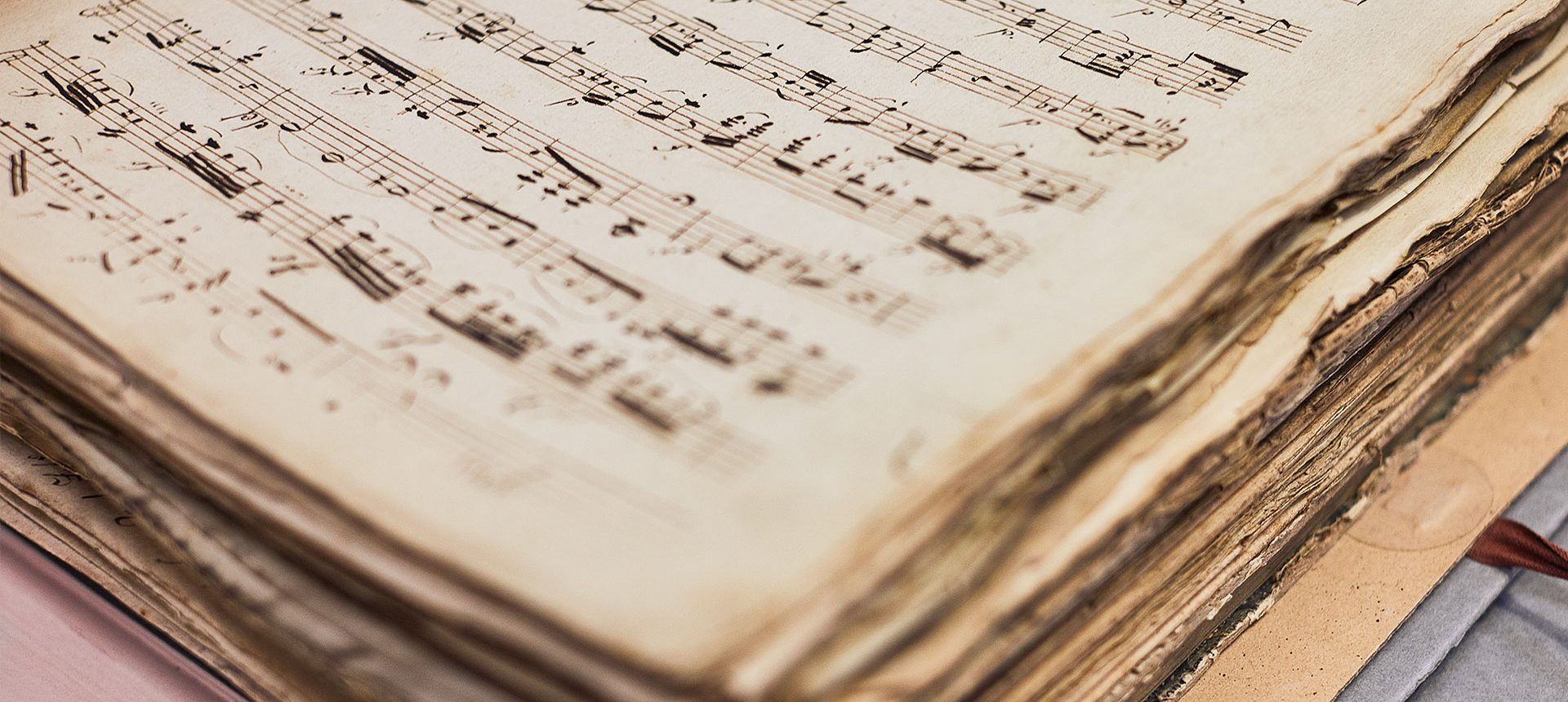
Here you can find almost anything about all the concerts Gothenburg Symphony has played over the years, both in the Concert Hall and on tour.
Search for conductors, soloists and other artists that has played together with us. Or search for composers and music that we have played. And filter on specific seasons. Guesting orchestras and ensembles are also included in the archive.
The result is presented by season.
1. Selig sind, die da Leid tragen
2. Denn alles Fleisch, es ist wie Gras
3. Herr, lehre doch mich
4. Wie lieblich sind deine Wohnungen
5. Ihr habt nun Traurigkeit
6. Denn wir haben hier keine bleibende Statt
7. Selig sind die Toten
A requiem is typically a musical setting of the traditional Latin text of the Catholic Mass for the Dead. Johannes Brahms, however, broke with these conventions, drawing inspiration from various sources. He had contemplated the work for some time before beginning to write his Mass for the Dead in 1860; the first two movements were completed the following year. The funeral march in the main section of the second movement—which bears a resemblance to a sarabande—originated in a lost sonata in D minor for two pianos that he had been working on as early as 1854. Brahms might well have been content with just these two movements, but when his mother died on February 2, 1865, at the age of 76, he felt compelled to add more music. Consequently, during the spring and summer of 1865, he completed no fewer than four additional movements—those designated as numbers 3, 4, 6, and 7 in the finished work.
The first two movements premiered in Vienna on December 1, 1867, but the predominantly Catholic audience failed to grasp the work. On Good Friday (April 10), 1868, all the movements composed up to that point were performed at Bremen Cathedral to such acclaim that the performance was repeated a few weeks later. Both Brahms’s father and Robert Schumann’s widow, Clara, were in attendance. Brahms conducted the performance in Bremen himself, yet he remained highly critical of the work; a month later, he added the slow soprano aria that now constitutes the fifth movement. Thus, his most extensive composition was finally completed, and its extremely self-critical creator was reasonably satisfied.
In February 1869, the complete work was premiered in Leipzig by Carl Reinecke, in the form we know today. Before the year was out, it had already been performed in some twenty cities across Germany and Switzerland. It was the first time Brahms had written a major work for soloists, choir, and orchestra. This piece paved the way for a long series of similar works. The fact that Brahms did not use the standard Latin text for the Requiem—or even a translation of it—stems from his background as a Protestant and the fact that he was not particularly religious. The work is based on biblical texts from both the Old and New Testaments—using Luther’s German translation—as well as the Apocrypha; the composer selected these passages with great care, thereby infusing the work with a personal process of mourning that possesses universal human significance. It became a monumental work, yet at the same time one that was deeply personal and heartfelt.
Lars-Erik Larsson (1908-1986)
Pastoral Suite
Overture - Romance - Scherzo
Lars-Erik Larsson made his debut in Stockholm at the age of 20 and became one of Sweden's most popular composers. The Pastoral Suite was composed in the autumn of 1938 for the programme "Moments of the Day" on Swedish Radio, where Larsson was conductor. He originally wrote six movements, three of which have been retained in the suite. The overture has a slow introduction and a subsequent longer allegro in the composer's typical easygoing, rhythmically varied style. Then the romance, the most frequently performed movement, which is singable with great melodic beauty. Finally, a lively and graceful scherzo. The suite is scored for double woodwinds, two horns, two trumpets, timpani and strings, while the middle movement is for strings only.
The Gothenburg Symphony was formed in 1905 and today consists of 109 musicians. The orchestra's base is Gothenburg Concert Hall at Götaplatsen that has gathered music lovers since 1935. Since the 2019-2020 season, Barbara Hannigan is Principal guest conductor. We are also a proud partner of Barbara Hannigan's Equilibrium mentoring program focusing on young singers at the start of their careers. The title Principal Guest Conductor is shared by Pekka Kuusisto from 2025.
Wilhelm Stenhammar was the orchestra's chief conductor from 1907 to 1922. He gave the orchestra a strong Nordic profile and invited colleagues Carl Nielsen and Jean Sibelius to the orchestra. Under the direction of conductor Neeme Järvi from 1982-2004, the orchestra made a series of international tours as well as a hundred disc recordings and established themselves among Europe's leading orchestras. In 1996, the Swedish Riksdag appointed the Gothenburg Symphony as Sweden's National Orchestra.
In recent decades, the orchestra has had prominent chief conductors such as Santtu-Matias Rouvali, Mario Venzago and Gustavo Dudamel, following Kent Nagano as Principal Guest conductor. Anna-Karin Larsson is CEO and artistic director, Gustavo Dudamel honorary conductor and Neeme Järvi chief conductor emeritus. The orchestra's owner is the Västra Götaland Region.
The Gothenburg Symphony works regularly with conductors such as Herbert Blomstedt, Joana Carneiro, Jukka-Pekka Saraste, Christian Zacharias and Anja Bihlmaier.
The choir was founded in 1917 by cousins Elsa and Wilhelm Stenhammar. Elsa Stenhammar was one of the driving forces in turn-of-the-century choir life in Gothenburg and became the choir's first rehearser. On December 8, 1917, the choir debuted in Beethoven's Choir Fantasy with Wilhelm Stenhammar as soloist at the grand piano. As the country's oldest symphonic choir, they were able to celebrate their 100th anniversary in 2017 with a big celebratory concert where Mozart and Brahms as well as Stenhammar, Elfrida Andrée and Björn & Benny were on the program.
The Gothenburg Symphony Choir is a non-profit association that is linked to the Gothenburg Symphony. The choir participates in concerts and performances under both the orchestra's and its own auspices. The music is mixed and the repertoire extensive. The Gothenburg Symphony Choir has participated in concerts in, among other places, the Royal Albert Hall and Canterbury Cathedral in England, as well as participated with the Gothenburg Symphony in the annual music festival in the Canary Islands and on a tour to China.
Tobias Ringborg is equally successful in opera houses as on concert stages as both a conductor and a violinist. His career began in 1994 when he won the prestigious Soloist Prize and received a soloist diploma from the Royal Academy of Music. He has a lifelong passion for opera and made his debut as an opera conductor at Folkoperan in 2001 with Verdi's La Traviata. In 2002 he joined Malmö Opera and made his debut at the Royal Opera in Stockholm in 2001 with La Bohème. He has also conducted at the Norwegian Opera in Oslo, the Royal Danish Opera in Denmark, Oper Leipzig, Scottish Opera and the English Opera North.
Tobias Ringborg has explored the symphonic repertoire with leading orchestras in the Nordic countries, as well as in Auckland, in Victoria (Canada) and with the Scottish Chamber Orchestra. In 2005 he made his London debut with the English Chamber Orchestra at the Barbican, both as a soloist and conductor. The years 2012-2015 Ringborg was chief conductor of Dalasinfoniettan.
In the 2024-2025 season he conducted Puccini's La Rondine at the Victorian Opera in Melbourne, La Bohème at the Aalborg Opera Festival, Madama Butterfly at the Gothenburg Opera and The Barber of Seville at the Royal Swedish Opera. In addition, a gala evening at the Royal Swedish Opera at the opening of the Riksdag, Verdi's Requiem in the Faroe Islands and Moses Pergaments The Jewish Song at Stockholm Concert Hall.
The 2025-2026 season includes The Marriage of Figaro and Turandot at the Royal Swedish Opera, Così fan tutte with the Swedish Chamber Orchestra, and concerts with the Royal Philharmonic Orchestra, Uppsala Chamber Orchestra, and the orchestras in Aachen and Nuremberg.
Katie Thomas is a choral conductor from Wales and since 2023 the choirmaster of the Gothenburg Symphony Orchestra. Previous engagements include nine years as a voice coach for the BBC Chorus, assignments as a guest choirmaster and conductor with the BBC Singers, MDR Rundfunkchor, National Youth Choirs of Great Britain and the Junior Royal College of Music, as well as a guest lecturer in choral conducting and director of the chamber choir at the University of Music and Performing Arts in Gothenburg. She has been a teacher of choral conducting techniques at the Association of British Choral Directors and a judge at choral festivals worldwide within the organization Interkultur.
As a professional soprano, Katie Thomas has been engaged with the UK's leading choirs, such as the Monteverdi Choir under the direction of Sir John Eliot Gardiner, Polyphony and the Academy of Ancient Music. She has appeared in major concert venues in Europe and the USA, including the Concertgebouw Amsterdam, the Musikverein Vienna and Carnegie Hall in New York. Together with London Voices, she has recorded several soundtracks for films and video games, often at the renowned Abbey Road Studios, as well as concerts for both television and radio. Katie Thomas is a graduate of Cardiff University and the Royal Academy of Music in London. In 2020, she was appointed an Associate of the Royal Academy of Music (ARAM) in the United Kingdom for outstanding contributions to professional music and significant achievements in conducting and choral music.
The Gothenburg Symphony was formed in 1905 and today consists of 109 musicians. The orchestra's base is Gothenburg Concert Hall at Götaplatsen that has gathered music lovers since 1935. Since the 2019-2020 season, Barbara Hannigan is Principal guest conductor. We are also a proud partner of Barbara Hannigan's Equilibrium mentoring program focusing on young singers at the start of their careers. The title Principal Guest Conductor is shared by Pekka Kuusisto from 2025.
Wilhelm Stenhammar was the orchestra's chief conductor from 1907 to 1922. He gave the orchestra a strong Nordic profile and invited colleagues Carl Nielsen and Jean Sibelius to the orchestra. Under the direction of conductor Neeme Järvi from 1982-2004, the orchestra made a series of international tours as well as a hundred disc recordings and established themselves among Europe's leading orchestras. In 1996, the Swedish Riksdag appointed the Gothenburg Symphony as Sweden's National Orchestra.
In recent decades, the orchestra has had prominent chief conductors such as Santtu-Matias Rouvali, Mario Venzago and Gustavo Dudamel, following Kent Nagano as Principal Guest conductor. Anna-Karin Larsson is CEO and artistic director, Gustavo Dudamel honorary conductor and Neeme Järvi chief conductor emeritus. The orchestra's owner is the Västra Götaland Region.
The Gothenburg Symphony works regularly with conductors such as Herbert Blomstedt, Joana Carneiro, Jukka-Pekka Saraste, Christian Zacharias and Anja Bihlmaier.
The choir was founded in 1917 by cousins Elsa and Wilhelm Stenhammar. Elsa Stenhammar was one of the driving forces in turn-of-the-century choir life in Gothenburg and became the choir's first rehearser. On December 8, 1917, the choir debuted in Beethoven's Choir Fantasy with Wilhelm Stenhammar as soloist at the grand piano. As the country's oldest symphonic choir, they were able to celebrate their 100th anniversary in 2017 with a big celebratory concert where Mozart and Brahms as well as Stenhammar, Elfrida Andrée and Björn & Benny were on the program.
The Gothenburg Symphony Choir is a non-profit association that is linked to the Gothenburg Symphony. The choir participates in concerts and performances under both the orchestra's and its own auspices. The music is mixed and the repertoire extensive. The Gothenburg Symphony Choir has participated in concerts in, among other places, the Royal Albert Hall and Canterbury Cathedral in England, as well as participated with the Gothenburg Symphony in the annual music festival in the Canary Islands and on a tour to China.
Katie Thomas is a choral conductor from Wales and since 2023 the choirmaster of the Gothenburg Symphony Orchestra. Previous engagements include nine years as a voice coach for the BBC Chorus, assignments as a guest choirmaster and conductor with the BBC Singers, MDR Rundfunkchor, National Youth Choirs of Great Britain and the Junior Royal College of Music, as well as a guest lecturer in choral conducting and director of the chamber choir at the University of Music and Performing Arts in Gothenburg. She has been a teacher of choral conducting techniques at the Association of British Choral Directors and a judge at choral festivals worldwide within the organization Interkultur.
As a professional soprano, Katie Thomas has been engaged with the UK's leading choirs, such as the Monteverdi Choir under the direction of Sir John Eliot Gardiner, Polyphony and the Academy of Ancient Music. She has appeared in major concert venues in Europe and the USA, including the Concertgebouw Amsterdam, the Musikverein Vienna and Carnegie Hall in New York. Together with London Voices, she has recorded several soundtracks for films and video games, often at the renowned Abbey Road Studios, as well as concerts for both television and radio. Katie Thomas is a graduate of Cardiff University and the Royal Academy of Music in London. In 2020, she was appointed an Associate of the Royal Academy of Music (ARAM) in the United Kingdom for outstanding contributions to professional music and significant achievements in conducting and choral music.
The Gothenburg Symphony was formed in 1905 and today consists of 109 musicians. The orchestra's base is Gothenburg Concert Hall at Götaplatsen that has gathered music lovers since 1935. Since the 2019-2020 season, Barbara Hannigan is Principal guest conductor. We are also a proud partner of Barbara Hannigan's Equilibrium mentoring program focusing on young singers at the start of their careers. The title Principal Guest Conductor is shared by Pekka Kuusisto from 2025.
Wilhelm Stenhammar was the orchestra's chief conductor from 1907 to 1922. He gave the orchestra a strong Nordic profile and invited colleagues Carl Nielsen and Jean Sibelius to the orchestra. Under the direction of conductor Neeme Järvi from 1982-2004, the orchestra made a series of international tours as well as a hundred disc recordings and established themselves among Europe's leading orchestras. In 1996, the Swedish Riksdag appointed the Gothenburg Symphony as Sweden's National Orchestra.
In recent decades, the orchestra has had prominent chief conductors such as Santtu-Matias Rouvali, Mario Venzago and Gustavo Dudamel, following Kent Nagano as Principal Guest conductor. Anna-Karin Larsson is CEO and artistic director, Gustavo Dudamel honorary conductor and Neeme Järvi chief conductor emeritus. The orchestra's owner is the Västra Götaland Region.
The Gothenburg Symphony works regularly with conductors such as Herbert Blomstedt, Joana Carneiro, Jukka-Pekka Saraste, Christian Zacharias and Anja Bihlmaier.
Swedish conductor Johannes Gustavsson works regularly with all major Nordic orchestras, being in demand as an interpreter of extensive symphonic and operatic repertoire. He established close relationships with orchestras such as the Royal Stockholm Philharmonic, Swedish Radio Symphony, Gothenburg Symphony Orchestra, Oslo Philharmonic, the Norwegian Radio Orchestra, Helsinki Philharmonic Orchestra, the Royal Swedish Opera, and the Gothenburg Opera. The soloists he often performs with include Janine Jansen, Peter Jablonski, Martin Fröst, Nina Stemme, Vikingur Olafsson, Olli Mustonen, Isbelle van Keulen, Torleif Thedeen, Guy Braunstein, and many others.
He has a over 20 year partnership with the Gothenburg Symphony Orchestra, which to date includes almost 40 concerts and countless days in the recording studio.
He has held senior conducting posts at the Ostrobothnian Chamber Orchestra, the Västerås Sinfonietta, the Nordic Chamber Orchestra, and was chief conductor at the Wermland Opera and at the Oulu Symphony Orchestra until 2021. As a champion of new music, he is dedicated to ensuring that works of his contemporaries are heard in concert halls, and to date he has premiered over 50 orchestral works written in the 21st century. Since 2023 he is Artistic director of Jönköping's Sinfonietta.
His recordings includes world premiere of Valborg Aulin’s Tableaux Parisiens for Nilento Records, and Anders Eliasson’s Double Concerto and Sinfonia per Archi with the Swedish Radio Symphony Orchestra for the CPO label. He has recorded for Dacapo with the Danish National Symphony Orchestra, for Ondine with the Iceland Symphony Orchestra (works by Jón Nordal) andthe Oulu Symphony Orchestra (works by Uuno Klami and Einar Englung), to name a few.
He was prizewinner at the Solti Conducting Competition in Frankfurt and the Toscanini Competition in Parma, and the first artist to be awarded both the Swedish Conductor’s Prize and the Herbert Blomstedt Award. Originally trained as a violist, his strong passion for conducting led him to study conducting at the Norwegian Academy of Music with Ole Kristian Ruud and Olav Anton Thommessen, and with the great Finnish conductor Jorma Panula.
Conductor and soprano Barbara Hannigan is Principal guest conductor of the Gothenburg Symphony Orchestra since 2019, embodying music with an unparalleled dramatic sensibility. She moves freely between the multiple roles of conductor, singer and curator. Over more than three decades, she has forged artistic partnerships with extraordinary musicians, directors and choreographers, including Romeo Castellucci, Claus Guth, Vladimir Jurowski, Katie Mitchell, Simon Rattle, Esa-Pekka Salonen, Kirill Petrenko, Sasha Waltz, and Krzysztof Warlikowski. The late conductor and pianist Reinbert de Leeuw has been an extraordinary influence and inspiration on her development as a musician.
In the 2026-2027 season, Hannigan begins her tenure as Chief Conductor and Artistic Director of the Iceland Symphony Orchestra, where her spirit of discovery will shape an artistic vision rooted in excellence, openness and collaboration, while forging new connections between Iceland and the wider international music community.
Balancing her work as both conductor and soprano, Hannigan maintains long-standing relationships with her colleagues in the orchestral, operatic and chamber music realms. She has maintained multi-year associations with London Symphony Orchestra (as Associate Artist), l'Orchestre de Chambre de Lausanne (as Principal Guest Conductor), and performs regularly with the Munich Philharmonic, Swedish Radio Symphony Orchestra, Swedish Chamber Orchestra, Orchestre Philharmonique de Radio France, and Danish Radio Symphony Orchestra. She makes her Rotterdam Philharmonic Orchestra conducting debut, performing as part of the joint project between the orchestra and Scapino Ballet entitled La Mer, in which she will sing, conduct and also dance with the artists of this world-renowned dance company. She continues to tour her unique production of Poulenc’s La Voix Humaine, after its most recent successes with New York Philharmonic and Czech Philharmonic Orchestras, bringing the work this season to Berlin with the Deutsches Symphonie-Orchester Berlin. Her recital tour with her most important musical partner, pianist Bertrand Chamayou (works by Messiaen, Scriabin and Zorn) continues in the 2026/27 season with performances throughout Europe.
Her awards and honours include the Governor General's Performing Arts Award (2026), the 2025 Polar Music Prize, 2025 Musical America Artist of the Year, "Accademico Onorario (Honorary Academician) (2025) at Accademia di Santa Cecilia, the Order of Canada (2016), Officier des Arts et des Lettres in France (2022), Gramophone Magazine’s 2022 Artist of the Year, Germany's Faust Award (2015), Sweden's Rolf Schock Prize for Musical Arts (2018), and Denmark’s Léonie Sonning Music Prize (2021).
Barbara Hannigan resides in Finistère, on the northwest coast of France, looking over an inlet which leads directly across the Atlantic to where she grew up in Waverley, Nova Scotia.
Tomas von Brömssen is one of our most popular actors. He has been a prominent figure on the Gothenburg theatre scene since the 1970s and is known from countless film and television productions. Through television series such as Albert & Herbert and Saltön, he has won a place in the hearts of the Swedish people. In 1995 he received a Guldbagge for his role in Bo Widerberg's Lust och fägring stor. In the same year he was named Gothenburger of the Year.
Tomas von Brömssen is also a musician, including in the orchestra Majornas Tredje Rote. At Gothenburg City Theatre he has appeared in Påklädaren, Pygmalion and Karl Gerhard, and in Gisslan 1994 at Backa Teater, all directed by Eva Bergman. In 2022 he had great success with the performance Kontrabasen.
Antonín Dvorák (1841-1904)
Symphony No. 8 Op 88
A few years before Antonín Dvorák left for America, the Eighth Symphony grew during long walks in the woods and fields. The Eighth Symphony is the result of a conscious search for peace and harmony. When the storm sometimes roars for the sake of contrast, it only blows away the dry leaves and brings fresh air with it. It is a happily smiling music, a simple, folk fiddler's music that deviates from the strict symphonic traditions.
The first movement begins with a sonorous cello theme that then returns twice during the movement; in the introduction to the development and in the recapitulation. The movement closely follows the sonata form despite the great changes in emotion. The slow movement is an adagio in C minor that is built up from a string of beautiful episodes. Then follows a graceful and elastic waltz before the finale once again presents a short introduction consisting of a trumpet solo. This solo also recurs a few times, including as a pianissimo accompaniment to solo flute and played by trumpets and horns. An outward-looking coda concludes the symphony.
On 2 February 1890, this G major symphony was premiered with the composer himself conducting the National Theatre Orchestra in Prague, and he also conducted performances in London and Frankfurt shortly afterwards. The symphony would soon triumph around the world, and alongside the Ninth Symphony (From the New World), written in America, it became the most beloved of his symphonies. The symphony was dedicated to the "Bohemian Franz Joseph Academy for the Promotion of Art and Literature", in thanks for Dvorák becoming its honorary member.
The Gothenburg Symphony was formed in 1905 and today consists of 109 musicians. The orchestra's base is Gothenburg Concert Hall at Götaplatsen that has gathered music lovers since 1935. Since the 2019-2020 season, Barbara Hannigan is Principal guest conductor. We are also a proud partner of Barbara Hannigan's Equilibrium mentoring program focusing on young singers at the start of their careers. The title Principal Guest Conductor is shared by Pekka Kuusisto from 2025.
Wilhelm Stenhammar was the orchestra's chief conductor from 1907 to 1922. He gave the orchestra a strong Nordic profile and invited colleagues Carl Nielsen and Jean Sibelius to the orchestra. Under the direction of conductor Neeme Järvi from 1982-2004, the orchestra made a series of international tours as well as a hundred disc recordings and established themselves among Europe's leading orchestras. In 1996, the Swedish Riksdag appointed the Gothenburg Symphony as Sweden's National Orchestra.
In recent decades, the orchestra has had prominent chief conductors such as Santtu-Matias Rouvali, Mario Venzago and Gustavo Dudamel, following Kent Nagano as Principal Guest conductor. Anna-Karin Larsson is CEO and artistic director, Gustavo Dudamel honorary conductor and Neeme Järvi chief conductor emeritus. The orchestra's owner is the Västra Götaland Region.
The Gothenburg Symphony works regularly with conductors such as Herbert Blomstedt, Joana Carneiro, Jukka-Pekka Saraste, Christian Zacharias and Anja Bihlmaier.
The choir was founded in 1917 by cousins Elsa and Wilhelm Stenhammar. Elsa Stenhammar was one of the driving forces in turn-of-the-century choir life in Gothenburg and became the choir's first rehearser. On December 8, 1917, the choir debuted in Beethoven's Choir Fantasy with Wilhelm Stenhammar as soloist at the grand piano. As the country's oldest symphonic choir, they were able to celebrate their 100th anniversary in 2017 with a big celebratory concert where Mozart and Brahms as well as Stenhammar, Elfrida Andrée and Björn & Benny were on the program.
The Gothenburg Symphony Choir is a non-profit association that is linked to the Gothenburg Symphony. The choir participates in concerts and performances under both the orchestra's and its own auspices. The music is mixed and the repertoire extensive. The Gothenburg Symphony Choir has participated in concerts in, among other places, the Royal Albert Hall and Canterbury Cathedral in England, as well as participated with the Gothenburg Symphony in the annual music festival in the Canary Islands and on a tour to China.
The Gothenburg Symphony was formed in 1905 and today consists of 109 musicians. The orchestra's base is Gothenburg Concert Hall at Götaplatsen that has gathered music lovers since 1935. Since the 2019-2020 season, Barbara Hannigan is Principal guest conductor. We are also a proud partner of Barbara Hannigan's Equilibrium mentoring program focusing on young singers at the start of their careers. The title Principal Guest Conductor is shared by Pekka Kuusisto from 2025.
Wilhelm Stenhammar was the orchestra's chief conductor from 1907 to 1922. He gave the orchestra a strong Nordic profile and invited colleagues Carl Nielsen and Jean Sibelius to the orchestra. Under the direction of conductor Neeme Järvi from 1982-2004, the orchestra made a series of international tours as well as a hundred disc recordings and established themselves among Europe's leading orchestras. In 1996, the Swedish Riksdag appointed the Gothenburg Symphony as Sweden's National Orchestra.
In recent decades, the orchestra has had prominent chief conductors such as Santtu-Matias Rouvali, Mario Venzago and Gustavo Dudamel, following Kent Nagano as Principal Guest conductor. Anna-Karin Larsson is CEO and artistic director, Gustavo Dudamel honorary conductor and Neeme Järvi chief conductor emeritus. The orchestra's owner is the Västra Götaland Region.
The Gothenburg Symphony works regularly with conductors such as Herbert Blomstedt, Joana Carneiro, Jukka-Pekka Saraste, Christian Zacharias and Anja Bihlmaier.
Kent Nagano is considered one of today’s outstanding conductors for both operatic and orchestral repertoire. He will be the next Chief conductor and Artistic Director of the Orquesta y Coro Nacionales de España (OCNE) in Madrid starting in September 2026 and is the newly appointed Principal Artistic Partner of Filarmonica Toscanini. In addition, he is committed together with Jan Vogler as Artistic Director of the Ring project “The Wagner Cycles” of Dresdner Musikfestspiele with Dresdner Festspielorchester and Concerto Köln alongside Jan Vogler. He has been Honorary Conductor of the Deutsches Symphonie-Orchester Berlin since 2006, Concerto Köln since 2019, the Orchestre symphonique de Montréal since 2021 and the Philharmonisches Staatsorchester Hamburg since 2023 and is as patron of the Herrenchiemsee Festival.
As a much sought-after guest conductor, Kent Nagano regularly works with leading international orchestras worldwide, 2025-2026 season highlights included several projects with the Deutsches Symphonie-Orchester Berlin, the Munich Philharmonic Orchestra, Maggio Musicale, the Tonhalle Orchestra Zurich, Opera de Paris, and the Philharmonia Orchestra amongst others.
The choir was founded in 1917 by cousins Elsa and Wilhelm Stenhammar. Elsa Stenhammar was one of the driving forces in turn-of-the-century choir life in Gothenburg and became the choir's first rehearser. On December 8, 1917, the choir debuted in Beethoven's Choir Fantasy with Wilhelm Stenhammar as soloist at the grand piano. As the country's oldest symphonic choir, they were able to celebrate their 100th anniversary in 2017 with a big celebratory concert where Mozart and Brahms as well as Stenhammar, Elfrida Andrée and Björn & Benny were on the program.
The Gothenburg Symphony Choir is a non-profit association that is linked to the Gothenburg Symphony. The choir participates in concerts and performances under both the orchestra's and its own auspices. The music is mixed and the repertoire extensive. The Gothenburg Symphony Choir has participated in concerts in, among other places, the Royal Albert Hall and Canterbury Cathedral in England, as well as participated with the Gothenburg Symphony in the annual music festival in the Canary Islands and on a tour to China.
The Gothenburg Symphony was formed in 1905 and today consists of 109 musicians. The orchestra's base is Gothenburg Concert Hall at Götaplatsen that has gathered music lovers since 1935. Since the 2019-2020 season, Barbara Hannigan is Principal guest conductor. We are also a proud partner of Barbara Hannigan's Equilibrium mentoring program focusing on young singers at the start of their careers. The title Principal Guest Conductor is shared by Pekka Kuusisto from 2025.
Wilhelm Stenhammar was the orchestra's chief conductor from 1907 to 1922. He gave the orchestra a strong Nordic profile and invited colleagues Carl Nielsen and Jean Sibelius to the orchestra. Under the direction of conductor Neeme Järvi from 1982-2004, the orchestra made a series of international tours as well as a hundred disc recordings and established themselves among Europe's leading orchestras. In 1996, the Swedish Riksdag appointed the Gothenburg Symphony as Sweden's National Orchestra.
In recent decades, the orchestra has had prominent chief conductors such as Santtu-Matias Rouvali, Mario Venzago and Gustavo Dudamel, following Kent Nagano as Principal Guest conductor. Anna-Karin Larsson is CEO and artistic director, Gustavo Dudamel honorary conductor and Neeme Järvi chief conductor emeritus. The orchestra's owner is the Västra Götaland Region.
The Gothenburg Symphony works regularly with conductors such as Herbert Blomstedt, Joana Carneiro, Jukka-Pekka Saraste, Christian Zacharias and Anja Bihlmaier.