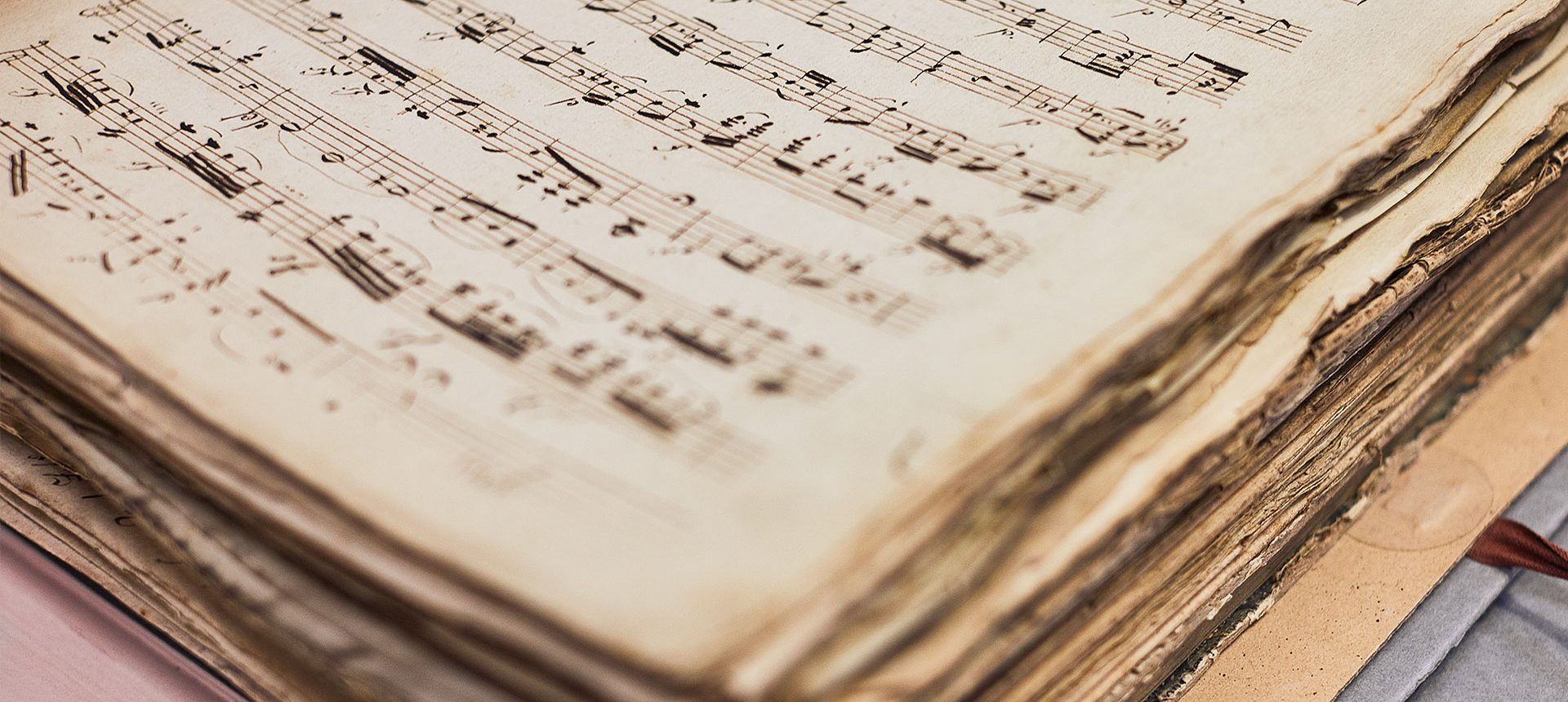
Here you can find almost anything about all the concerts Gothenburg Symphony has played over the years, both in the Concert Hall and on tour.
Search for conductors, soloists and other artists that has played together with us. Or search for composers and music that we have played. And filter on specific seasons. Guesting orchestras and ensembles are also included in the archive.
The result is presented by season.
The Gothenburg Symphony was formed in 1905 and today consists of 109 musicians. The orchestra's base is Gothenburg Concert Hall at Götaplatsen that has gathered music lovers since 1935. Since the 2019-2020 season, Barbara Hannigan is Principal guest conductor. We are also a proud partner of Barbara Hannigan's Equilibrium mentoring program focusing on young singers at the start of their careers. The title Principal Guest Conductor is shared by Pekka Kuusisto from 2025.
Wilhelm Stenhammar was the orchestra's chief conductor from 1907 to 1922. He gave the orchestra a strong Nordic profile and invited colleagues Carl Nielsen and Jean Sibelius to the orchestra. Under the direction of conductor Neeme Järvi from 1982-2004, the orchestra made a series of international tours as well as a hundred disc recordings and established themselves among Europe's leading orchestras. In 1996, the Swedish Riksdag appointed the Gothenburg Symphony as Sweden's National Orchestra.
In recent decades, the orchestra has had prominent chief conductors such as Santtu-Matias Rouvali, Mario Venzago and Gustavo Dudamel, following Kent Nagano as Principal Guest conductor. Anna-Karin Larsson is CEO and artistic director, Gustavo Dudamel honorary conductor and Neeme Järvi chief conductor emeritus. The orchestra's owner is the Västra Götaland Region.
The Gothenburg Symphony works regularly with conductors such as Herbert Blomstedt, Joana Carneiro, Jukka-Pekka Saraste, Christian Zacharias and Anja Bihlmaier.
Swedish conductor Johannes Gustavsson works regularly with all major Nordic orchestras, being in demand as an interpreter of extensive symphonic and operatic repertoire. He established close relationships with orchestras such as the Royal Stockholm Philharmonic, Swedish Radio Symphony, Gothenburg Symphony Orchestra, Oslo Philharmonic, the Norwegian Radio Orchestra, Helsinki Philharmonic Orchestra, the Royal Swedish Opera, and the Gothenburg Opera. The soloists he often performs with include Janine Jansen, Peter Jablonski, Martin Fröst, Nina Stemme, Vikingur Olafsson, Olli Mustonen, Isbelle van Keulen, Torleif Thedeen, Guy Braunstein, and many others.
He has a over 20 year partnership with the Gothenburg Symphony Orchestra, which to date includes almost 40 concerts and countless days in the recording studio.
He has held senior conducting posts at the Ostrobothnian Chamber Orchestra, the Västerås Sinfonietta, the Nordic Chamber Orchestra, and was chief conductor at the Wermland Opera and at the Oulu Symphony Orchestra until 2021. As a champion of new music, he is dedicated to ensuring that works of his contemporaries are heard in concert halls, and to date he has premiered over 50 orchestral works written in the 21st century. Since 2023 he is Artistic director of Jönköping's Sinfonietta.
His recordings includes world premiere of Valborg Aulin’s Tableaux Parisiens for Nilento Records, and Anders Eliasson’s Double Concerto and Sinfonia per Archi with the Swedish Radio Symphony Orchestra for the CPO label. He has recorded for Dacapo with the Danish National Symphony Orchestra, for Ondine with the Iceland Symphony Orchestra (works by Jón Nordal) andthe Oulu Symphony Orchestra (works by Uuno Klami and Einar Englung), to name a few.
He was prizewinner at the Solti Conducting Competition in Frankfurt and the Toscanini Competition in Parma, and the first artist to be awarded both the Swedish Conductor’s Prize and the Herbert Blomstedt Award. Originally trained as a violist, his strong passion for conducting led him to study conducting at the Norwegian Academy of Music with Ole Kristian Ruud and Olav Anton Thommessen, and with the great Finnish conductor Jorma Panula.
Trombonist Nils Landgren is one of Sweden’s most well known soloists and a grand name on the international stage. He began playing drums at the age of six, before finally discovering the trombone at age 13.
In the 70’s he toured with the most successful Swedish pop star of that time, Björn Skifs’ “Blue Swede”, who got to number 1 in the US pop charts with “Hooked on a feeling”. He has played with stars like Thad Jones, ABBA, The Crusaders, Eddie Harris, Bernard “Pretty” Purdie, Wyclef Jean and Herbie Hancock.
1998 Nils started his long collaboration with the NDR Bigband in Hamburg, and in 2001 Nils was appointed Artistic Director for the prestigious Jazzfest Berlin. He has also been Artistic Director of Bohuslän Bigband in Gothenburg.
This year he celebrates his 70’s birthday with the album Love of My Life and brings it on tour in Europe.
2025-10-17 20:00 Lugano Arte e Cultura
Göteborgs Symfoniker
Programme
Wilhelm Stenhammar (1871-1927)
Excelsior!
Many have said that Stenhammar's Excelsior! is strongly influenced by Wagner, but there is undeniably much here that would prove to be genuine Stenhammar. The title can be interpreted as "rushing and striving", and the lecture description of the main theme is "passionately agitated". The score is dated Berlin 4 September 1896. It is known that Stenhammar saw a performance of Goethe's Faust in the German capital at this time and that he had purchased Goethe's collected works. The books have been preserved and it can be seen that the volume with Faust was read extensively. Although he clearly had Faust as a literary model, the drama has only helped to create the atmosphere. If any part of Faust has been the direct inspiration, it is the conversation between Faust and his valet Wagner immediately after the parts Prologue in Heaven and Night.
The overture was dedicated to the Berlin Philharmonic, which may seem presumptuous for a 25-year-old composer who had written his very first orchestral work. When Stenhammar himself brought the work to his debut concert as conductor with the Royal Court Orchestra in Stockholm on 16 October 1897, it was a great success.
Camille Saint-Saëns (1835–1921)
Cello Concerto No. 1
Like Mozart and Mendelssohn, Camille Saint-Saëns was a precocious child prodigy. By the age of 10, he could play all of Beethoven's piano sonatas from memory. During his long life, he composed in most genres: symphonies, chamber music, opera and choral works. He is perhaps best known for Carnival of the Animals and Cello Concerto No. 1 – called "the perfect cello concerto" by Shostakovich.
No frills. No long orchestral introduction. With a dramatic orchestral chord followed by the soloist's fiery entrance, the listener is thrown straight into a musical whirlwind – as if the cello had suddenly acquired a voice that could no longer be contained. Through the concerto's three movements, Saint-Saëns lets the cello show its full range: from lyrical warmth to virtuoso brilliance, from glowing temperament to heartfelt reflection. The music demands total presence from both soloist and audience. There is certainly time for rest and recovery, but absolutely no break – the three movements are composed in one long, continuous flow. The sudden attack of the opening retains its romantic shock effect until the final triumphant gathering of power.
The premiere of the cello concerto took place in Paris in 1873 – since then considered by many to be one of the greatest.
Jean Sibelius (1865-1957)
Symphony No. 6 Op 104
Allegro molto moderato
Allegretto moderato
Poco vivace
Allegro molto
As early as 1915, Sibelius had begun work on what would become the Sixth and Seventh Symphonies, but it was not an easy journey. In February 1920, work on the Sixth Symphony seems to have come to a halt. He writes in his diary:
"I am getting older and youth brings new ideals and interests people in them. Shall the evening of my life find me listless and resigned, quietly awaiting death?"
His question seems frighteningly prophetic. After the Seventh Symphony and Tapiola (1926), a 30-year musical silence awaited the Finn in Ainola. It was fundamentally about being true to himself, and Sibelius found that his voice was no longer relevant.
But in the 1920s, a lively glow still remained. The Fifth Symphony was a success in the United States (with Stokowski in Philadelphia and Stransky in New York). Sibelius also received a well-paid offer to become a teacher at the prestigious Eastman-Rochester School, but after many turns he turned it down: "To leave composing now would be suicide."
In the autumn of 1922, work on the Sixth Symphony gained new momentum and by January 1923 most of it was finished. The premiere took place in Helsinki on 19 February 1923. Just a week later, the symphony received its Swedish premiere in Stockholm, and on 10 April Sibelius took the symphony to Gothenburg. Julius Rabe wrote in Göteborgs Handels och Sjöfartstidning:
"Yesterday's Sibelius concert was without a doubt the greatest day of this now-passing musical year. It had both a powerful inner significance and an outer festivity. And there was in the audience a willingness to receive and let themselves be carried away, which gives a concert such an invaluable addition of atmosphere and resonance, which welds together the thousand-strong crowd of the public into a humbly listening congregation, where the individuals disappear and merge into a collective personality."
Hugo Alfvén (1872-1960)
Suite from The Prodigal Son
With a music that can be said to be characterized by the musical aftermath of Romanticism, the composer and conductor Hugo Alfvén left his mark on Swedish musical life during the first half of the 20th century.
The ballet The Prodigal Son, or more precisely: the orchestral suite from it, would become Alfvén's last major composition. The ballet depicts the biblical story of the son who leaves his father, squanders his inheritance, but who then returns in repentance and through reconciliation is given a picture of what is genuinely human.
The music can be said to reflect this inner journey – we travel from the lyrical to the dramatic. From the youthful to the thoughtful of age. In between we hear evidence of Alfvén's soft spot for folk melody and the rhythmic danceable. Several of the melodies are also found in the many songs that Alfvén had arranged and composed for choir Orphei Drängar, which he over many years turned into the notorious male choir it still is today.
Participants
The Gothenburg Symphony was formed in 1905 and today consists of 109 musicians. The orchestra's base is Gothenburg Concert Hall at Götaplatsen that has gathered music lovers since 1935. Since the 2019-2020 season, Barbara Hannigan is Principal guest conductor. We are also a proud partner of Barbara Hannigan's Equilibrium mentoring program focusing on young singers at the start of their careers. The title Principal Guest Conductor is shared by Pekka Kuusisto from 2025.
Wilhelm Stenhammar was the orchestra's chief conductor from 1907 to 1922. He gave the orchestra a strong Nordic profile and invited colleagues Carl Nielsen and Jean Sibelius to the orchestra. Under the direction of conductor Neeme Järvi from 1982-2004, the orchestra made a series of international tours as well as a hundred disc recordings and established themselves among Europe's leading orchestras. In 1996, the Swedish Riksdag appointed the Gothenburg Symphony as Sweden's National Orchestra.
In recent decades, the orchestra has had prominent chief conductors such as Santtu-Matias Rouvali, Mario Venzago and Gustavo Dudamel, following Kent Nagano as Principal Guest conductor. Anna-Karin Larsson is CEO and artistic director, Gustavo Dudamel honorary conductor and Neeme Järvi chief conductor emeritus. The orchestra's owner is the Västra Götaland Region.
The Gothenburg Symphony works regularly with conductors such as Herbert Blomstedt, Joana Carneiro, Jukka-Pekka Saraste, Christian Zacharias and Anja Bihlmaier.
Conductor Laureate of Minnesota Orchestra, where he held the Music Directorship for 19 years, Osmo Vänskä is recognised for his compelling interpretations of repertoire of all ages and an energetic presence on the podium. He was Music Director of Seoul Philharmonic Orchestra from 2020 to 2023 and has long-standing relationships with many orchestras worldwide. With Minnesota Orchestra he undertook five major European tours, as well as an historic trip to Cuba in 2015. They also made a ground-breaking tour to South Africa in 2018 and made an acclaimed return to the BBC Proms the same year.
This season he appears with Gothenburg Symphony, Symphonieorchester des Bayerischen Rundfunks, Oslo Philharmonic, Bergen and Helsinki Philharmonic orchestras, Antwerp and Iceland symphonies as well as City of Birmingham Symphony Orchestra. He also returns to his long-time partner Minnesota Orchestra and to the Tokyo Metropolitan Symphony Orchestra and Tokyo Symphony Orchestra.
Vänskä studied conducting at Finland’s Sibelius Academy and was awarded first prize in the 1982 Besançon Competition. He began his career as a clarinetist, occupying the co-principal chair of Helsinki Philharmonic Orchestra.
Truls Mørk is an acclaimed cellist and performs with the most prominent orchestras including the Orchestre de Paris, Berliner Philharmoniker, Vienna Philharmonic, Concertgebouw Orchestra, Munich Philharmonic, Philharmonia and London Philharmonic and Gewandhausorchester Leipzig. In North America, he has appeared with the New York Philharmonic, Philadelphia Orchestra, Cleveland Orchestra, Boston Symphony Orchestra and Los Angeles Philharmonic. Conducting collaborations include Esa-Pekka Salonen, David Zinman, Manfred Honeck, Gustavo Dudamel, Sir Simon Rattle, Kent Nagano, Yannick Nézet-Séguin and Christoph Eschenbach, among others.
In the 2024-2025 season, Mørk returned to the Rotterdam, London and Bergen Philharmonic Orchestras, RAI Turin, Orchestre Phiharmonique de Radio France and the ORF Vienna Radio Symphony Orchestra.
Truls Mørk is a great advocate for contemporary music and has given over 30 world premieres. He has performed Esa-Pekka Salonen's Cello Concerto with a number of prominent orchestras, Victoria Borisova-Olla's Cello Concerto Oh Giselle Remember Me, Rautavaara's Towards the Horizon, Pavel Haas's Cello Concerto with the Vienna Philharmonic and Jonathan Nott, Penderecki's Concerto for Three Cellos with the Hafliði Symphony Orchestra and Charles Hallgrímsson's Cello Concerto commissioned by the Oslo Philharmonic, Iceland Symphony and the Scottish Chamber Orchestra.
He last visited the Gothenburg Symphony in season 2016-2017 when he was Artist in Residence.
2025-10-15 19:00 Stora salen
Göteborgs Symfoniker
Programme
Wilhelm Stenhammar (1871-1927)
Excelsior!
Many have said that Stenhammar's Excelsior! is strongly influenced by Wagner, but there is undeniably much here that would prove to be genuine Stenhammar. The title can be interpreted as "rushing and striving", and the lecture description of the main theme is "passionately agitated". The score is dated Berlin 4 September 1896. It is known that Stenhammar saw a performance of Goethe's Faust in the German capital at this time and that he had purchased Goethe's collected works. The books have been preserved and it can be seen that the volume with Faust was read extensively. Although he clearly had Faust as a literary model, the drama has only helped to create the atmosphere. If any part of Faust has been the direct inspiration, it is the conversation between Faust and his valet Wagner immediately after the parts Prologue in Heaven and Night.
The overture was dedicated to the Berlin Philharmonic, which may seem presumptuous for a 25-year-old composer who had written his very first orchestral work. When Stenhammar himself brought the work to his debut concert as conductor with the Royal Court Orchestra in Stockholm on 16 October 1897, it was a great success.
Camille Saint-Saëns (1835–1921)
Cello Concerto No. 1
Like Mozart and Mendelssohn, Camille Saint-Saëns was a precocious child prodigy. By the age of 10, he could play all of Beethoven's piano sonatas from memory. During his long life, he composed in most genres: symphonies, chamber music, opera and choral works. He is perhaps best known for Carnival of the Animals and Cello Concerto No. 1 – called "the perfect cello concerto" by Shostakovich.
No frills. No long orchestral introduction. With a dramatic orchestral chord followed by the soloist's fiery entrance, the listener is thrown straight into a musical whirlwind – as if the cello had suddenly acquired a voice that could no longer be contained. Through the concerto's three movements, Saint-Saëns lets the cello show its full range: from lyrical warmth to virtuoso brilliance, from glowing temperament to heartfelt reflection. The music demands total presence from both soloist and audience. There is certainly time for rest and recovery, but absolutely no break – the three movements are composed in one long, continuous flow. The sudden attack of the opening retains its romantic shock effect until the final triumphant gathering of power.
The premiere of the cello concerto took place in Paris in 1873 – since then considered by many to be one of the greatest.
Jean Sibelius (1865-1957)
Symphony No. 6 Op 104
Allegro molto moderato
Allegretto moderato
Poco vivace
Allegro molto
As early as 1915, Sibelius had begun work on what would become the Sixth and Seventh Symphonies, but it was not an easy journey. In February 1920, work on the Sixth Symphony seems to have come to a halt. He writes in his diary:
"I am getting older and youth brings new ideals and interests people in them. Shall the evening of my life find me listless and resigned, quietly awaiting death?"
His question seems frighteningly prophetic. After the Seventh Symphony and Tapiola (1926), a 30-year musical silence awaited the Finn in Ainola. It was fundamentally about being true to himself, and Sibelius found that his voice was no longer relevant.
But in the 1920s, a lively glow still remained. The Fifth Symphony was a success in the United States (with Stokowski in Philadelphia and Stransky in New York). Sibelius also received a well-paid offer to become a teacher at the prestigious Eastman-Rochester School, but after many turns he turned it down: "To leave composing now would be suicide."
In the autumn of 1922, work on the Sixth Symphony gained new momentum and by January 1923 most of it was finished. The premiere took place in Helsinki on 19 February 1923. Just a week later, the symphony received its Swedish premiere in Stockholm, and on 10 April Sibelius took the symphony to Gothenburg. Julius Rabe wrote in Göteborgs Handels och Sjöfartstidning:
"Yesterday's Sibelius concert was without a doubt the greatest day of this now-passing musical year. It had both a powerful inner significance and an outer festivity. And there was in the audience a willingness to receive and let themselves be carried away, which gives a concert such an invaluable addition of atmosphere and resonance, which welds together the thousand-strong crowd of the public into a humbly listening congregation, where the individuals disappear and merge into a collective personality."
Hugo Alfvén (1872-1960)
Suite from The Prodigal Son
With a music that can be said to be characterized by the musical aftermath of Romanticism, the composer and conductor Hugo Alfvén left his mark on Swedish musical life during the first half of the 20th century.
The ballet The Prodigal Son, or more precisely: the orchestral suite from it, would become Alfvén's last major composition. The ballet depicts the biblical story of the son who leaves his father, squanders his inheritance, but who then returns in repentance and through reconciliation is given a picture of what is genuinely human.
The music can be said to reflect this inner journey – we travel from the lyrical to the dramatic. From the youthful to the thoughtful of age. In between we hear evidence of Alfvén's soft spot for folk melody and the rhythmic danceable. Several of the melodies are also found in the many songs that Alfvén had arranged and composed for choir Orphei Drängar, which he over many years turned into the notorious male choir it still is today.
Participants
The Gothenburg Symphony was formed in 1905 and today consists of 109 musicians. The orchestra's base is Gothenburg Concert Hall at Götaplatsen that has gathered music lovers since 1935. Since the 2019-2020 season, Barbara Hannigan is Principal guest conductor. We are also a proud partner of Barbara Hannigan's Equilibrium mentoring program focusing on young singers at the start of their careers. The title Principal Guest Conductor is shared by Pekka Kuusisto from 2025.
Wilhelm Stenhammar was the orchestra's chief conductor from 1907 to 1922. He gave the orchestra a strong Nordic profile and invited colleagues Carl Nielsen and Jean Sibelius to the orchestra. Under the direction of conductor Neeme Järvi from 1982-2004, the orchestra made a series of international tours as well as a hundred disc recordings and established themselves among Europe's leading orchestras. In 1996, the Swedish Riksdag appointed the Gothenburg Symphony as Sweden's National Orchestra.
In recent decades, the orchestra has had prominent chief conductors such as Santtu-Matias Rouvali, Mario Venzago and Gustavo Dudamel, following Kent Nagano as Principal Guest conductor. Anna-Karin Larsson is CEO and artistic director, Gustavo Dudamel honorary conductor and Neeme Järvi chief conductor emeritus. The orchestra's owner is the Västra Götaland Region.
The Gothenburg Symphony works regularly with conductors such as Herbert Blomstedt, Joana Carneiro, Jukka-Pekka Saraste, Christian Zacharias and Anja Bihlmaier.
Conductor Laureate of Minnesota Orchestra, where he held the Music Directorship for 19 years, Osmo Vänskä is recognised for his compelling interpretations of repertoire of all ages and an energetic presence on the podium. He was Music Director of Seoul Philharmonic Orchestra from 2020 to 2023 and has long-standing relationships with many orchestras worldwide. With Minnesota Orchestra he undertook five major European tours, as well as an historic trip to Cuba in 2015. They also made a ground-breaking tour to South Africa in 2018 and made an acclaimed return to the BBC Proms the same year.
This season he appears with Gothenburg Symphony, Symphonieorchester des Bayerischen Rundfunks, Oslo Philharmonic, Bergen and Helsinki Philharmonic orchestras, Antwerp and Iceland symphonies as well as City of Birmingham Symphony Orchestra. He also returns to his long-time partner Minnesota Orchestra and to the Tokyo Metropolitan Symphony Orchestra and Tokyo Symphony Orchestra.
Vänskä studied conducting at Finland’s Sibelius Academy and was awarded first prize in the 1982 Besançon Competition. He began his career as a clarinetist, occupying the co-principal chair of Helsinki Philharmonic Orchestra.
Truls Mørk is an acclaimed cellist and performs with the most prominent orchestras including the Orchestre de Paris, Berliner Philharmoniker, Vienna Philharmonic, Concertgebouw Orchestra, Munich Philharmonic, Philharmonia and London Philharmonic and Gewandhausorchester Leipzig. In North America, he has appeared with the New York Philharmonic, Philadelphia Orchestra, Cleveland Orchestra, Boston Symphony Orchestra and Los Angeles Philharmonic. Conducting collaborations include Esa-Pekka Salonen, David Zinman, Manfred Honeck, Gustavo Dudamel, Sir Simon Rattle, Kent Nagano, Yannick Nézet-Séguin and Christoph Eschenbach, among others.
In the 2024-2025 season, Mørk returned to the Rotterdam, London and Bergen Philharmonic Orchestras, RAI Turin, Orchestre Phiharmonique de Radio France and the ORF Vienna Radio Symphony Orchestra.
Truls Mørk is a great advocate for contemporary music and has given over 30 world premieres. He has performed Esa-Pekka Salonen's Cello Concerto with a number of prominent orchestras, Victoria Borisova-Olla's Cello Concerto Oh Giselle Remember Me, Rautavaara's Towards the Horizon, Pavel Haas's Cello Concerto with the Vienna Philharmonic and Jonathan Nott, Penderecki's Concerto for Three Cellos with the Hafliði Symphony Orchestra and Charles Hallgrímsson's Cello Concerto commissioned by the Oslo Philharmonic, Iceland Symphony and the Scottish Chamber Orchestra.
He last visited the Gothenburg Symphony in season 2016-2017 when he was Artist in Residence.
2025-05-25 11:00 Dresden Kulturpalast
Göteborgs Symfoniker
Programme
Frédéric Chopin (1810–1849)
Piano Concerto No. 1
Allegro maestoso
Romanze - Largetto
Rondo – Vivace
Chopin's piano concerto in E minor was published in 1833, and "the second" in F minor in 1836 (although he had already composed it at age 19). Both reflect his fondness for Bellini's operas, especially Norma, whose ornaments he adapted and personified. The main theme is introduced by the orchestra at considerable length, adding to the tension. Once the piano enters, glowing lyrical ornaments follow. Chopin was sometimes criticized for focusing more on the strength of the piano than on the qualities of the orchestra, but this probably contributed to his success with audiences.
The second movement is slow and caressing. Chopin wrote under the composition: "I am using muted strings - I wonder how they will sound?" He described the largetto as having "a romantic, calm and rather melancholic character ... a kind of moonlight dream on a beautiful spring night." The main theme of the rondo in E major has been likened to a polka or krakowiac (also a dance). Chopin modulates to A major, and before the refreshing final clip, he moves into E flat, then B flat in the section's return.
The Piano Concerto in E minor was first performed in Warsaw in 1830 with Chopin as soloist, shortly before he left his homeland for Paris and never returned.
Peter Tchaikovsky (1840-1893)
Symphony No. 6 Pathetique Op 74
Adagio;Allegro non troppo - Allegro con grazia - Allegro molto vivace - Finale:Adagio lamentoso
Few symphonies contain as many outbursts of emotion and sudden mood swings as Tchaikovsky's Sixth, with the telling title Pathétique ("passionate suffering"). It reflects his manic-depressive personality, he suffered throughout his life from crises and often struggled with illness and depression. Tchaikovsky's death in Saint Petersburg, just nine days after he conducted the premiere, also gave the work a tragic aura right from the start. It was even said that the music deliberately foreshadowed his own death, which occurred after he drank cholera-tainted water. Even today, musicologists disagree whether it was an accident or a forced suicide, to avoid public scandal as a homosexual.
Is the sixth symphony really a self-composed requiem? This theory is fueled by the "dark" key of B minor, which stands for great passion and tragedy, and by the unusual structure. The main motif that runs throughout the work consists of a plaintive, descending second interval. The gloomy character of the symphony is clear already in the first movement, with its slow, dark introduction. The second movement is reminiscent of Don José's flower aria from Bizet's opera Carmen, which Tchaikovsky greatly admired. Towards the end of the movement there is a chorale-like funeral march, and even a quote from the Russian Orthodox funeral liturgy. The second movement provides some lightening, and Tchaikovsky wrote it in an elegant 5/4 time signature, which is a fairly common time signature in Russian folk music. The "limping" character makes the movement almost humorous, despite the loving waltz or minuet-like style.
In the third movement he returns to the march as idea, but it begins as an cheerful scherzo that gradually unfolds in its full life-affirming power. The fourth movement is the most famous in the symphony, and is partly reminiscent of a mournful requiem. The main theme is characterized by sighing motifs, and at the end the music fades into a low string chord in B minor.
Tchaikovsky considered the symphony to be his most important, most personal composition, but the premiere was received cautiously.
Participants
The Gothenburg Symphony was formed in 1905 and today consists of 109 musicians. The orchestra's base is Gothenburg Concert Hall at Götaplatsen that has gathered music lovers since 1935. Since the 2019-2020 season, Barbara Hannigan is Principal guest conductor. We are also a proud partner of Barbara Hannigan's Equilibrium mentoring program focusing on young singers at the start of their careers. The title Principal Guest Conductor is shared by Pekka Kuusisto from 2025.
Wilhelm Stenhammar was the orchestra's chief conductor from 1907 to 1922. He gave the orchestra a strong Nordic profile and invited colleagues Carl Nielsen and Jean Sibelius to the orchestra. Under the direction of conductor Neeme Järvi from 1982-2004, the orchestra made a series of international tours as well as a hundred disc recordings and established themselves among Europe's leading orchestras. In 1996, the Swedish Riksdag appointed the Gothenburg Symphony as Sweden's National Orchestra.
In recent decades, the orchestra has had prominent chief conductors such as Santtu-Matias Rouvali, Mario Venzago and Gustavo Dudamel, following Kent Nagano as Principal Guest conductor. Anna-Karin Larsson is CEO and artistic director, Gustavo Dudamel honorary conductor and Neeme Järvi chief conductor emeritus. The orchestra's owner is the Västra Götaland Region.
The Gothenburg Symphony works regularly with conductors such as Herbert Blomstedt, Joana Carneiro, Jukka-Pekka Saraste, Christian Zacharias and Anja Bihlmaier.
Seong-Jin Cho gained attention in 2015 when he won the International Chopin Competition in Warsaw. In 2016 he signed an exclusive contract with Deutsche Grammophon and in 2023 he was awarded the prestigious Samsung Ho-Am Prize in the Arts. Cho collaborates with the world's leading orchestras including the Berlin Philharmonic, the Vienna Philharmonic, the London Symphony Orchestra, the Orchester de Paris, the New York Philharmonic and the Philadelphia Orchestra. He works with conductors such as Myung-Whun Chung, Gustavo Dudamel, Andris Nelsons, Yannick Nézet-Séguin, Gianandrea Noseda, Sir Simon Rattle, Santtu-Matias Rouvali, Esa-Pekka Salonen and Lahav Shani.
In the 2024/25 season Seong-Jin Cho takes up the mantle of Artist in Residence with the Berliner Philharmoniker. He notably returns to London’s BBC Proms, to the Philadelphia Orchestra to open their season with Yannick Nézet-Séguin, to New York Philharmonic and Chicago Symphony Orchestra with Santtu-Matias Rouvali, and to The Cleveland Orchestra under Franz Welser-Möst. Cho embarks on several international tours, including his notable return to Wiener Philharmoniker with Andris Nelsons in Korea and to Symphonieorchester des Bayerischen Rundfunks with Sir Simon Rattle in Korea, Japan, and Taiwan, following a performance of Brahms Piano Concerto. No. 2 in Munich.
Born in 1994 in Seoul, Seong-Jin Cho gave his first public solo concert aged 11. In 2009, he became the youngest ever winner of Japan's Hamamatsu International Piano Competition. Seong-Jin Cho is now based in Berlin. He visited Sweden in the spring of 2024 and performed with the Swedish Royal Philharmonic at a guest concert in Gothenburg.
2025-05-23 20:00 Prag Rudolfinum Dvorak hall
Göteborgs Symfoniker
Programme
Bedrich Smetana (1824-1884)
Haakon Jarl Op 16
The Czech national composer Bedrich Smetana, who celebrated his 200th birthday last year, had close ties to Gothenburg. Between 1856 and 1861 he worked in the city as a conductor, pianist and teacher. He developed the city's musical life, founded a music school and composed several works, including three symphonic poems – Wallenstein's Camp, Rickard III and Haakon Jarl, which was the last work Smetana wrote before returning to Prague.
After a trip to Weimar, where Smetana was fascinated by the way Franz Liszt transformed literary works into music, Smetana decided to broaden his library with works that would suit a Scandinavian audience. Haakon Jarl is based on a tragedy by the Danish playwright Adam Oehlenschläger. The story takes place in Viking-age Norway, where the ruler, also known as Håkon Sigurdsson, fights against the advance of Christianity.
Smetana's Haakon Jarl offers drama from the first note. Dark, doom-laden themes reflect Haakon's ruthless rule, while bright hymn-like melodies depict the budding faith in a new era. There is much emotion and theatricality as a Nordic legend comes to life in Smetana's romantic tone.
Jörgen Wade
Frédéric Chopin (1810–1849)
Piano Concerto No. 1
Allegro maestoso
Romanze - Largetto
Rondo – Vivace
Chopin's piano concerto in E minor was published in 1833, and "the second" in F minor in 1836 (although he had already composed it at age 19). Both reflect his fondness for Bellini's operas, especially Norma, whose ornaments he adapted and personified. The main theme is introduced by the orchestra at considerable length, adding to the tension. Once the piano enters, glowing lyrical ornaments follow. Chopin was sometimes criticized for focusing more on the strength of the piano than on the qualities of the orchestra, but this probably contributed to his success with audiences.
The second movement is slow and caressing. Chopin wrote under the composition: "I am using muted strings - I wonder how they will sound?" He described the largetto as having "a romantic, calm and rather melancholic character ... a kind of moonlight dream on a beautiful spring night." The main theme of the rondo in E major has been likened to a polka or krakowiac (also a dance). Chopin modulates to A major, and before the refreshing final clip, he moves into E flat, then B flat in the section's return.
The Piano Concerto in E minor was first performed in Warsaw in 1830 with Chopin as soloist, shortly before he left his homeland for Paris and never returned.
Bela Bartók (1881-1945)
Concerto for Orchestra
Introduzione
Gioco delle coppie
Elegia
Intermezzo interrotto
Finale
When this music was written in 1943, Bela Bartók had two years left to live. He had come to the United States fleeing a Europe at war and clawed his way through a few lean years in New York. The honorary doctorate at Harvard provided no income. In addition, he became increasingly ill, what previously appeared to be tuberculosis turned out to be leukemia. But he continued to compose as always. Work was his life - and pleasure too, if you will. Like a child, he rested by doing other things.
He was first and foremost a music ethnologist, that is, a recorder and collector of folk music. And it was among other things this immeasurable library, more than 13,000 melodies, he was so keen to save the Second World War. Countless trips in Hungary, Romania, Bulgaria, Slovakia and Turkey were made with a phonograph as a memory aid. In between, he composed, on top of that a whole lot of teaching as income and change, and of course an extensive activity as a concert pianist in many countries. In addition, he was interested in collecting plants, beetles, learning new languages. Palestrina's music was always on the piano and he never traveled without his thumbed score of Stravinsky's The Rite of Spring under his arm. Is there a diagnosis for this? we would ask today.
The music Bela Bartók wrote was highly influenced by all the music he saw and heard on his collecting trips, but in the later works you can also hear how fascinated he was by the Baroque masters. The concerto for orchestra was commissioned by the Sergei Koussevitsky Music Foundation. Bartók himself has described the music as a journey from austerity via an ominous song to a life-affirming ending. Like Mozart, he composed incredibly quickly, he couldn't get an idea out of his head until the next one appeared. With such a cacophony within, it is no wonder that throughout his life he sought out quiet places.
Bartok himself saw the collection of folk music as his greatest and most important deed for more than one reason: "My own idea is the brotherhood of peoples, brotherhood despite all wars and conflicts. I try - as best I can - to serve that idea in my music: therefore I reject no influences, whether Slovak, Romanian, Arabic, or from other sources." (Bartók, 1931)
KATARINA A KARLSSON
The Gothenburg Symphony was formed in 1905 and today consists of 109 musicians. The orchestra's base is Gothenburg Concert Hall at Götaplatsen that has gathered music lovers since 1935. Since the 2019-2020 season, Barbara Hannigan is Principal guest conductor. We are also a proud partner of Barbara Hannigan's Equilibrium mentoring program focusing on young singers at the start of their careers. The title Principal Guest Conductor is shared by Pekka Kuusisto from 2025.
Wilhelm Stenhammar was the orchestra's chief conductor from 1907 to 1922. He gave the orchestra a strong Nordic profile and invited colleagues Carl Nielsen and Jean Sibelius to the orchestra. Under the direction of conductor Neeme Järvi from 1982-2004, the orchestra made a series of international tours as well as a hundred disc recordings and established themselves among Europe's leading orchestras. In 1996, the Swedish Riksdag appointed the Gothenburg Symphony as Sweden's National Orchestra.
In recent decades, the orchestra has had prominent chief conductors such as Santtu-Matias Rouvali, Mario Venzago and Gustavo Dudamel, following Kent Nagano as Principal Guest conductor. Anna-Karin Larsson is CEO and artistic director, Gustavo Dudamel honorary conductor and Neeme Järvi chief conductor emeritus. The orchestra's owner is the Västra Götaland Region.
The Gothenburg Symphony works regularly with conductors such as Herbert Blomstedt, Joana Carneiro, Jukka-Pekka Saraste, Christian Zacharias and Anja Bihlmaier.
The Canadian pianist Jan Lisiecki has been on the world's biggest stages for almost two decades. This season he returns to the Boston Symphony, London Philharmonic, Munich Philharmonic, Pittsburgh Symphony and Seattle Symphony. He leads the Academy of St Martin in the Fields on tour and is Artist in Residence at the Toronto Symphony Orchestra. He performs his acclaimed solo program at La Scala in Milan, Théâtre des Champs-Élysées in Paris, San Francisco's Herbst Theatre, BOZAR Brussels and Klavier-Festival Ruhr. A duo program WITH Mozart, Beethoven and Schumann together with Julia Fischer takes him to arenas all over Europe and the USA.
Jan Lisiecki got an exclusive recording contract with Deutsche Grammophon at the age of 15. His nine albums have been awarded the JUNO Award, ECHO Klassik, Gramophone Critics' Choice, Diapason d'Or and Edison Klassiek. At the age of 18, he received both the Leonard Bernstein Award and Gramophone's Young Artist Award. He visited the Gothenburg Symphony Orchestra for the first time as a 16-year-old. This time he accompanies the orchestra on tour to Stockholm, Prague and Stuttgart.
2025-05-21 19:30 Stuttgart, Kultur- und Kongresszentrum Liederhalle
Göteborgs Symfoniker
Programme
Frédéric Chopin (1810–1849)
Piano Concerto No. 1
Allegro maestoso
Romanze - Largetto
Rondo – Vivace
Chopin's piano concerto in E minor was published in 1833, and "the second" in F minor in 1836 (although he had already composed it at age 19). Both reflect his fondness for Bellini's operas, especially Norma, whose ornaments he adapted and personified. The main theme is introduced by the orchestra at considerable length, adding to the tension. Once the piano enters, glowing lyrical ornaments follow. Chopin was sometimes criticized for focusing more on the strength of the piano than on the qualities of the orchestra, but this probably contributed to his success with audiences.
The second movement is slow and caressing. Chopin wrote under the composition: "I am using muted strings - I wonder how they will sound?" He described the largetto as having "a romantic, calm and rather melancholic character ... a kind of moonlight dream on a beautiful spring night." The main theme of the rondo in E major has been likened to a polka or krakowiac (also a dance). Chopin modulates to A major, and before the refreshing final clip, he moves into E flat, then B flat in the section's return.
The Piano Concerto in E minor was first performed in Warsaw in 1830 with Chopin as soloist, shortly before he left his homeland for Paris and never returned.
Peter Tchaikovsky (1840-1893)
Symphony No. 6 Pathetique Op 74
Adagio;Allegro non troppo - Allegro con grazia - Allegro molto vivace - Finale:Adagio lamentoso
Few symphonies contain as many outbursts of emotion and sudden mood swings as Tchaikovsky's Sixth, with the telling title Pathétique ("passionate suffering"). It reflects his manic-depressive personality, he suffered throughout his life from crises and often struggled with illness and depression. Tchaikovsky's death in Saint Petersburg, just nine days after he conducted the premiere, also gave the work a tragic aura right from the start. It was even said that the music deliberately foreshadowed his own death, which occurred after he drank cholera-tainted water. Even today, musicologists disagree whether it was an accident or a forced suicide, to avoid public scandal as a homosexual.
Is the sixth symphony really a self-composed requiem? This theory is fueled by the "dark" key of B minor, which stands for great passion and tragedy, and by the unusual structure. The main motif that runs throughout the work consists of a plaintive, descending second interval. The gloomy character of the symphony is clear already in the first movement, with its slow, dark introduction. The second movement is reminiscent of Don José's flower aria from Bizet's opera Carmen, which Tchaikovsky greatly admired. Towards the end of the movement there is a chorale-like funeral march, and even a quote from the Russian Orthodox funeral liturgy. The second movement provides some lightening, and Tchaikovsky wrote it in an elegant 5/4 time signature, which is a fairly common time signature in Russian folk music. The "limping" character makes the movement almost humorous, despite the loving waltz or minuet-like style.
In the third movement he returns to the march as idea, but it begins as an cheerful scherzo that gradually unfolds in its full life-affirming power. The fourth movement is the most famous in the symphony, and is partly reminiscent of a mournful requiem. The main theme is characterized by sighing motifs, and at the end the music fades into a low string chord in B minor.
Tchaikovsky considered the symphony to be his most important, most personal composition, but the premiere was received cautiously.
Participants
The Gothenburg Symphony was formed in 1905 and today consists of 109 musicians. The orchestra's base is Gothenburg Concert Hall at Götaplatsen that has gathered music lovers since 1935. Since the 2019-2020 season, Barbara Hannigan is Principal guest conductor. We are also a proud partner of Barbara Hannigan's Equilibrium mentoring program focusing on young singers at the start of their careers. The title Principal Guest Conductor is shared by Pekka Kuusisto from 2025.
Wilhelm Stenhammar was the orchestra's chief conductor from 1907 to 1922. He gave the orchestra a strong Nordic profile and invited colleagues Carl Nielsen and Jean Sibelius to the orchestra. Under the direction of conductor Neeme Järvi from 1982-2004, the orchestra made a series of international tours as well as a hundred disc recordings and established themselves among Europe's leading orchestras. In 1996, the Swedish Riksdag appointed the Gothenburg Symphony as Sweden's National Orchestra.
In recent decades, the orchestra has had prominent chief conductors such as Santtu-Matias Rouvali, Mario Venzago and Gustavo Dudamel, following Kent Nagano as Principal Guest conductor. Anna-Karin Larsson is CEO and artistic director, Gustavo Dudamel honorary conductor and Neeme Järvi chief conductor emeritus. The orchestra's owner is the Västra Götaland Region.
The Gothenburg Symphony works regularly with conductors such as Herbert Blomstedt, Joana Carneiro, Jukka-Pekka Saraste, Christian Zacharias and Anja Bihlmaier.
The Canadian pianist Jan Lisiecki has been on the world's biggest stages for almost two decades. This season he returns to the Boston Symphony, London Philharmonic, Munich Philharmonic, Pittsburgh Symphony and Seattle Symphony. He leads the Academy of St Martin in the Fields on tour and is Artist in Residence at the Toronto Symphony Orchestra. He performs his acclaimed solo program at La Scala in Milan, Théâtre des Champs-Élysées in Paris, San Francisco's Herbst Theatre, BOZAR Brussels and Klavier-Festival Ruhr. A duo program WITH Mozart, Beethoven and Schumann together with Julia Fischer takes him to arenas all over Europe and the USA.
Jan Lisiecki got an exclusive recording contract with Deutsche Grammophon at the age of 15. His nine albums have been awarded the JUNO Award, ECHO Klassik, Gramophone Critics' Choice, Diapason d'Or and Edison Klassiek. At the age of 18, he received both the Leonard Bernstein Award and Gramophone's Young Artist Award. He visited the Gothenburg Symphony Orchestra for the first time as a 16-year-old. This time he accompanies the orchestra on tour to Stockholm, Prague and Stuttgart.
2025-05-17 15:00 Sthlms konserthus
Göteborgs Symfoniker
Programme
Frédéric Chopin (1810–1849)
Piano Concerto No. 1
Allegro maestoso
Romanze - Largetto
Rondo – Vivace
Chopin's piano concerto in E minor was published in 1833, and "the second" in F minor in 1836 (although he had already composed it at age 19). Both reflect his fondness for Bellini's operas, especially Norma, whose ornaments he adapted and personified. The main theme is introduced by the orchestra at considerable length, adding to the tension. Once the piano enters, glowing lyrical ornaments follow. Chopin was sometimes criticized for focusing more on the strength of the piano than on the qualities of the orchestra, but this probably contributed to his success with audiences.
The second movement is slow and caressing. Chopin wrote under the composition: "I am using muted strings - I wonder how they will sound?" He described the largetto as having "a romantic, calm and rather melancholic character ... a kind of moonlight dream on a beautiful spring night." The main theme of the rondo in E major has been likened to a polka or krakowiac (also a dance). Chopin modulates to A major, and before the refreshing final clip, he moves into E flat, then B flat in the section's return.
The Piano Concerto in E minor was first performed in Warsaw in 1830 with Chopin as soloist, shortly before he left his homeland for Paris and never returned.
Peter Tchaikovsky (1840-1893)
Symphony No. 6 Pathetique Op 74
Adagio;Allegro non troppo - Allegro con grazia - Allegro molto vivace - Finale:Adagio lamentoso
Few symphonies contain as many outbursts of emotion and sudden mood swings as Tchaikovsky's Sixth, with the telling title Pathétique ("passionate suffering"). It reflects his manic-depressive personality, he suffered throughout his life from crises and often struggled with illness and depression. Tchaikovsky's death in Saint Petersburg, just nine days after he conducted the premiere, also gave the work a tragic aura right from the start. It was even said that the music deliberately foreshadowed his own death, which occurred after he drank cholera-tainted water. Even today, musicologists disagree whether it was an accident or a forced suicide, to avoid public scandal as a homosexual.
Is the sixth symphony really a self-composed requiem? This theory is fueled by the "dark" key of B minor, which stands for great passion and tragedy, and by the unusual structure. The main motif that runs throughout the work consists of a plaintive, descending second interval. The gloomy character of the symphony is clear already in the first movement, with its slow, dark introduction. The second movement is reminiscent of Don José's flower aria from Bizet's opera Carmen, which Tchaikovsky greatly admired. Towards the end of the movement there is a chorale-like funeral march, and even a quote from the Russian Orthodox funeral liturgy. The second movement provides some lightening, and Tchaikovsky wrote it in an elegant 5/4 time signature, which is a fairly common time signature in Russian folk music. The "limping" character makes the movement almost humorous, despite the loving waltz or minuet-like style.
In the third movement he returns to the march as idea, but it begins as an cheerful scherzo that gradually unfolds in its full life-affirming power. The fourth movement is the most famous in the symphony, and is partly reminiscent of a mournful requiem. The main theme is characterized by sighing motifs, and at the end the music fades into a low string chord in B minor.
Tchaikovsky considered the symphony to be his most important, most personal composition, but the premiere was received cautiously.
Participants
The Gothenburg Symphony was formed in 1905 and today consists of 109 musicians. The orchestra's base is Gothenburg Concert Hall at Götaplatsen that has gathered music lovers since 1935. Since the 2019-2020 season, Barbara Hannigan is Principal guest conductor. We are also a proud partner of Barbara Hannigan's Equilibrium mentoring program focusing on young singers at the start of their careers. The title Principal Guest Conductor is shared by Pekka Kuusisto from 2025.
Wilhelm Stenhammar was the orchestra's chief conductor from 1907 to 1922. He gave the orchestra a strong Nordic profile and invited colleagues Carl Nielsen and Jean Sibelius to the orchestra. Under the direction of conductor Neeme Järvi from 1982-2004, the orchestra made a series of international tours as well as a hundred disc recordings and established themselves among Europe's leading orchestras. In 1996, the Swedish Riksdag appointed the Gothenburg Symphony as Sweden's National Orchestra.
In recent decades, the orchestra has had prominent chief conductors such as Santtu-Matias Rouvali, Mario Venzago and Gustavo Dudamel, following Kent Nagano as Principal Guest conductor. Anna-Karin Larsson is CEO and artistic director, Gustavo Dudamel honorary conductor and Neeme Järvi chief conductor emeritus. The orchestra's owner is the Västra Götaland Region.
The Gothenburg Symphony works regularly with conductors such as Herbert Blomstedt, Joana Carneiro, Jukka-Pekka Saraste, Christian Zacharias and Anja Bihlmaier.
The Canadian pianist Jan Lisiecki has been on the world's biggest stages for almost two decades. This season he returns to the Boston Symphony, London Philharmonic, Munich Philharmonic, Pittsburgh Symphony and Seattle Symphony. He leads the Academy of St Martin in the Fields on tour and is Artist in Residence at the Toronto Symphony Orchestra. He performs his acclaimed solo program at La Scala in Milan, Théâtre des Champs-Élysées in Paris, San Francisco's Herbst Theatre, BOZAR Brussels and Klavier-Festival Ruhr. A duo program WITH Mozart, Beethoven and Schumann together with Julia Fischer takes him to arenas all over Europe and the USA.
Jan Lisiecki got an exclusive recording contract with Deutsche Grammophon at the age of 15. His nine albums have been awarded the JUNO Award, ECHO Klassik, Gramophone Critics' Choice, Diapason d'Or and Edison Klassiek. At the age of 18, he received both the Leonard Bernstein Award and Gramophone's Young Artist Award. He visited the Gothenburg Symphony Orchestra for the first time as a 16-year-old. This time he accompanies the orchestra on tour to Stockholm, Prague and Stuttgart.
The Gothenburg Symphony was formed in 1905 and today consists of 109 musicians. The orchestra's base is Gothenburg Concert Hall at Götaplatsen that has gathered music lovers since 1935. Since the 2019-2020 season, Barbara Hannigan is Principal guest conductor. We are also a proud partner of Barbara Hannigan's Equilibrium mentoring program focusing on young singers at the start of their careers. The title Principal Guest Conductor is shared by Pekka Kuusisto from 2025.
Wilhelm Stenhammar was the orchestra's chief conductor from 1907 to 1922. He gave the orchestra a strong Nordic profile and invited colleagues Carl Nielsen and Jean Sibelius to the orchestra. Under the direction of conductor Neeme Järvi from 1982-2004, the orchestra made a series of international tours as well as a hundred disc recordings and established themselves among Europe's leading orchestras. In 1996, the Swedish Riksdag appointed the Gothenburg Symphony as Sweden's National Orchestra.
In recent decades, the orchestra has had prominent chief conductors such as Santtu-Matias Rouvali, Mario Venzago and Gustavo Dudamel, following Kent Nagano as Principal Guest conductor. Anna-Karin Larsson is CEO and artistic director, Gustavo Dudamel honorary conductor and Neeme Järvi chief conductor emeritus. The orchestra's owner is the Västra Götaland Region.
The Gothenburg Symphony works regularly with conductors such as Herbert Blomstedt, Joana Carneiro, Jukka-Pekka Saraste, Christian Zacharias and Anja Bihlmaier.
The violinist Ava Bahari was Artist in Residence at Gothenburg Symphony Orchestra for 2024-2026. She gave her first solo concert at age eight in the Gothenburg Concert Hall. In 2026, her first album with the Gothenburg Symphony Orchestra was released with a recording of the Sibelius Violin Concerto (Alpha Classics).
In 2025/26, Bahari performed Mendelssohn’s Violin Concerto with Joshua Weilerstein, Hindemith’s Violin Concerto, and Brahms’ Concerto for Violin and Cello in Gothenburg. Elsewhere in 25/26, she made debut appearances with Orchestre de Paris, Hamburger Symphoniker, Tampere Philharmonic Orchestra, Stavanger Symphony Orchestra and Macedonian Philharmonic Orchestra, among others, and returned to Royal Stockholm Philharmonic Orchestra for their season-closing concerts. With the Swedish Chamber Orchestra she gave the world premiere of Annamaria Kowalsky’s Violin Concerto, commissioned specifically for Bahari.
Ava Bahari is selected as an ECHO Rising Star for 2026/27, and she has received numerous awards, including top prizes at the Premio Paganini Competition in Genova (2021), Concours International Tibor Varga in Sion (2021) and Aurora Music Competition in Stockholm (2019). She studied Bachelor and Master at the Hochschule für Musik Hanns Eisler Berlin under the guidance of Prof. Kolja Blacher and has also received music and culture scholarships from among others Sten A Olsson's Foundation for Research and Culture.
She plays a 1694 Stradivarius Ovcharov on generous loan from Anders Sveaas Almennyttige Fond.
The Gothenburg Symphony was formed in 1905 and today consists of 109 musicians. The orchestra's base is Gothenburg Concert Hall at Götaplatsen that has gathered music lovers since 1935. Since the 2019-2020 season, Barbara Hannigan is Principal guest conductor. We are also a proud partner of Barbara Hannigan's Equilibrium mentoring program focusing on young singers at the start of their careers. The title Principal Guest Conductor is shared by Pekka Kuusisto from 2025.
Wilhelm Stenhammar was the orchestra's chief conductor from 1907 to 1922. He gave the orchestra a strong Nordic profile and invited colleagues Carl Nielsen and Jean Sibelius to the orchestra. Under the direction of conductor Neeme Järvi from 1982-2004, the orchestra made a series of international tours as well as a hundred disc recordings and established themselves among Europe's leading orchestras. In 1996, the Swedish Riksdag appointed the Gothenburg Symphony as Sweden's National Orchestra.
In recent decades, the orchestra has had prominent chief conductors such as Santtu-Matias Rouvali, Mario Venzago and Gustavo Dudamel, following Kent Nagano as Principal Guest conductor. Anna-Karin Larsson is CEO and artistic director, Gustavo Dudamel honorary conductor and Neeme Järvi chief conductor emeritus. The orchestra's owner is the Västra Götaland Region.
The Gothenburg Symphony works regularly with conductors such as Herbert Blomstedt, Joana Carneiro, Jukka-Pekka Saraste, Christian Zacharias and Anja Bihlmaier.
Peter Tchaikovsky (1840-1893)
Symphony No. 6 Pathetique Op 74
Adagio;Allegro non troppo - Allegro con grazia - Allegro molto vivace - Finale:Adagio lamentoso
Few symphonies contain as many outbursts of emotion and sudden mood swings as Tchaikovsky's Sixth, with the telling title Pathétique ("passionate suffering"). It reflects his manic-depressive personality, he suffered throughout his life from crises and often struggled with illness and depression. Tchaikovsky's death in Saint Petersburg, just nine days after he conducted the premiere, also gave the work a tragic aura right from the start. It was even said that the music deliberately foreshadowed his own death, which occurred after he drank cholera-tainted water. Even today, musicologists disagree whether it was an accident or a forced suicide, to avoid public scandal as a homosexual.
Is the sixth symphony really a self-composed requiem? This theory is fueled by the "dark" key of B minor, which stands for great passion and tragedy, and by the unusual structure. The main motif that runs throughout the work consists of a plaintive, descending second interval. The gloomy character of the symphony is clear already in the first movement, with its slow, dark introduction. The second movement is reminiscent of Don José's flower aria from Bizet's opera Carmen, which Tchaikovsky greatly admired. Towards the end of the movement there is a chorale-like funeral march, and even a quote from the Russian Orthodox funeral liturgy. The second movement provides some lightening, and Tchaikovsky wrote it in an elegant 5/4 time signature, which is a fairly common time signature in Russian folk music. The "limping" character makes the movement almost humorous, despite the loving waltz or minuet-like style.
In the third movement he returns to the march as idea, but it begins as an cheerful scherzo that gradually unfolds in its full life-affirming power. The fourth movement is the most famous in the symphony, and is partly reminiscent of a mournful requiem. The main theme is characterized by sighing motifs, and at the end the music fades into a low string chord in B minor.
Tchaikovsky considered the symphony to be his most important, most personal composition, but the premiere was received cautiously.
Participants
The Gothenburg Symphony was formed in 1905 and today consists of 109 musicians. The orchestra's base is Gothenburg Concert Hall at Götaplatsen that has gathered music lovers since 1935. Since the 2019-2020 season, Barbara Hannigan is Principal guest conductor. We are also a proud partner of Barbara Hannigan's Equilibrium mentoring program focusing on young singers at the start of their careers. The title Principal Guest Conductor is shared by Pekka Kuusisto from 2025.
Wilhelm Stenhammar was the orchestra's chief conductor from 1907 to 1922. He gave the orchestra a strong Nordic profile and invited colleagues Carl Nielsen and Jean Sibelius to the orchestra. Under the direction of conductor Neeme Järvi from 1982-2004, the orchestra made a series of international tours as well as a hundred disc recordings and established themselves among Europe's leading orchestras. In 1996, the Swedish Riksdag appointed the Gothenburg Symphony as Sweden's National Orchestra.
In recent decades, the orchestra has had prominent chief conductors such as Santtu-Matias Rouvali, Mario Venzago and Gustavo Dudamel, following Kent Nagano as Principal Guest conductor. Anna-Karin Larsson is CEO and artistic director, Gustavo Dudamel honorary conductor and Neeme Järvi chief conductor emeritus. The orchestra's owner is the Västra Götaland Region.
The Gothenburg Symphony works regularly with conductors such as Herbert Blomstedt, Joana Carneiro, Jukka-Pekka Saraste, Christian Zacharias and Anja Bihlmaier.
The Gothenburg Symphony Vocal Ensemble (GSVE) was formed in 2016 and consists of 12 professional singers. The ensemble works both as part of the Gothenburg Symphony Choir in major symphonic works performed together with the Gothenburg Symphony, and as an independent ensemble under the direction of Katie Thomas.
GSVE is a group of experienced and versatile singers, who perform varied programs and explore a wide repertoire, from medieval music to newly commissioned works. The ensemble has previously collaborated with, among others, the Helsingborg Symphony Orchestra and the Barockakademin Göteborgs Symfoniker and performs regular vocal programs both in Gothenburg's Concert Hall and around the Västra Götaland region.
The Gothenburg Symphony was formed in 1905 and today consists of 109 musicians. The orchestra's base is Gothenburg Concert Hall at Götaplatsen that has gathered music lovers since 1935. Since the 2019-2020 season, Barbara Hannigan is Principal guest conductor. We are also a proud partner of Barbara Hannigan's Equilibrium mentoring program focusing on young singers at the start of their careers. The title Principal Guest Conductor is shared by Pekka Kuusisto from 2025.
Wilhelm Stenhammar was the orchestra's chief conductor from 1907 to 1922. He gave the orchestra a strong Nordic profile and invited colleagues Carl Nielsen and Jean Sibelius to the orchestra. Under the direction of conductor Neeme Järvi from 1982-2004, the orchestra made a series of international tours as well as a hundred disc recordings and established themselves among Europe's leading orchestras. In 1996, the Swedish Riksdag appointed the Gothenburg Symphony as Sweden's National Orchestra.
In recent decades, the orchestra has had prominent chief conductors such as Santtu-Matias Rouvali, Mario Venzago and Gustavo Dudamel, following Kent Nagano as Principal Guest conductor. Anna-Karin Larsson is CEO and artistic director, Gustavo Dudamel honorary conductor and Neeme Järvi chief conductor emeritus. The orchestra's owner is the Västra Götaland Region.
The Gothenburg Symphony works regularly with conductors such as Herbert Blomstedt, Joana Carneiro, Jukka-Pekka Saraste, Christian Zacharias and Anja Bihlmaier.
Swedish conductor Johannes Gustavsson works regularly with all major Nordic orchestras, being in demand as an interpreter of extensive symphonic and operatic repertoire. He established close relationships with orchestras such as the Royal Stockholm Philharmonic, Swedish Radio Symphony, Gothenburg Symphony Orchestra, Oslo Philharmonic, the Norwegian Radio Orchestra, Helsinki Philharmonic Orchestra, the Royal Swedish Opera, and the Gothenburg Opera. The soloists he often performs with include Janine Jansen, Peter Jablonski, Martin Fröst, Nina Stemme, Vikingur Olafsson, Olli Mustonen, Isbelle van Keulen, Torleif Thedeen, Guy Braunstein, and many others.
He has a over 20 year partnership with the Gothenburg Symphony Orchestra, which to date includes almost 40 concerts and countless days in the recording studio.
He has held senior conducting posts at the Ostrobothnian Chamber Orchestra, the Västerås Sinfonietta, the Nordic Chamber Orchestra, and was chief conductor at the Wermland Opera and at the Oulu Symphony Orchestra until 2021. As a champion of new music, he is dedicated to ensuring that works of his contemporaries are heard in concert halls, and to date he has premiered over 50 orchestral works written in the 21st century. Since 2023 he is Artistic director of Jönköping's Sinfonietta.
His recordings includes world premiere of Valborg Aulin’s Tableaux Parisiens for Nilento Records, and Anders Eliasson’s Double Concerto and Sinfonia per Archi with the Swedish Radio Symphony Orchestra for the CPO label. He has recorded for Dacapo with the Danish National Symphony Orchestra, for Ondine with the Iceland Symphony Orchestra (works by Jón Nordal) andthe Oulu Symphony Orchestra (works by Uuno Klami and Einar Englung), to name a few.
He was prizewinner at the Solti Conducting Competition in Frankfurt and the Toscanini Competition in Parma, and the first artist to be awarded both the Swedish Conductor’s Prize and the Herbert Blomstedt Award. Originally trained as a violist, his strong passion for conducting led him to study conducting at the Norwegian Academy of Music with Ole Kristian Ruud and Olav Anton Thommessen, and with the great Finnish conductor Jorma Panula.
Conductor and soprano Barbara Hannigan is Principal guest conductor of the Gothenburg Symphony Orchestra since 2019, embodying music with an unparalleled dramatic sensibility. She moves freely between the multiple roles of conductor, singer and curator. Over more than three decades, she has forged artistic partnerships with extraordinary musicians, directors and choreographers, including Romeo Castellucci, Claus Guth, Vladimir Jurowski, Katie Mitchell, Simon Rattle, Esa-Pekka Salonen, Kirill Petrenko, Sasha Waltz, and Krzysztof Warlikowski. The late conductor and pianist Reinbert de Leeuw has been an extraordinary influence and inspiration on her development as a musician.
In the 2026-2027 season, Hannigan begins her tenure as Chief Conductor and Artistic Director of the Iceland Symphony Orchestra, where her spirit of discovery will shape an artistic vision rooted in excellence, openness and collaboration, while forging new connections between Iceland and the wider international music community.
Balancing her work as both conductor and soprano, Hannigan maintains long-standing relationships with her colleagues in the orchestral, operatic and chamber music realms. She has maintained multi-year associations with London Symphony Orchestra (as Associate Artist), l'Orchestre de Chambre de Lausanne (as Principal Guest Conductor), and performs regularly with the Munich Philharmonic, Swedish Radio Symphony Orchestra, Swedish Chamber Orchestra, Orchestre Philharmonique de Radio France, and Danish Radio Symphony Orchestra. She makes her Rotterdam Philharmonic Orchestra conducting debut, performing as part of the joint project between the orchestra and Scapino Ballet entitled La Mer, in which she will sing, conduct and also dance with the artists of this world-renowned dance company. She continues to tour her unique production of Poulenc’s La Voix Humaine, after its most recent successes with New York Philharmonic and Czech Philharmonic Orchestras, bringing the work this season to Berlin with the Deutsches Symphonie-Orchester Berlin. Her recital tour with her most important musical partner, pianist Bertrand Chamayou (works by Messiaen, Scriabin and Zorn) continues in the 2026/27 season with performances throughout Europe.
Her awards and honours include the Governor General's Performing Arts Award (2026), the 2025 Polar Music Prize, 2025 Musical America Artist of the Year, "Accademico Onorario (Honorary Academician) (2025) at Accademia di Santa Cecilia, the Order of Canada (2016), Officier des Arts et des Lettres in France (2022), Gramophone Magazine’s 2022 Artist of the Year, Germany's Faust Award (2015), Sweden's Rolf Schock Prize for Musical Arts (2018), and Denmark’s Léonie Sonning Music Prize (2021).
Barbara Hannigan resides in Finistère, on the northwest coast of France, looking over an inlet which leads directly across the Atlantic to where she grew up in Waverley, Nova Scotia.
Tomas von Brömssen is one of our most popular actors. He has been a prominent figure on the Gothenburg theatre scene since the 1970s and is known from countless film and television productions. Through television series such as Albert & Herbert and Saltön, he has won a place in the hearts of the Swedish people. In 1995 he received a Guldbagge for his role in Bo Widerberg's Lust och fägring stor. In the same year he was named Gothenburger of the Year.
Tomas von Brömssen is also a musician, including in the orchestra Majornas Tredje Rote. At Gothenburg City Theatre he has appeared in Påklädaren, Pygmalion and Karl Gerhard, and in Gisslan 1994 at Backa Teater, all directed by Eva Bergman. In 2022 he had great success with the performance Kontrabasen.
The Gothenburg Symphony was formed in 1905 and today consists of 109 musicians. The orchestra's base is Gothenburg Concert Hall at Götaplatsen that has gathered music lovers since 1935. Since the 2019-2020 season, Barbara Hannigan is Principal guest conductor. We are also a proud partner of Barbara Hannigan's Equilibrium mentoring program focusing on young singers at the start of their careers. The title Principal Guest Conductor is shared by Pekka Kuusisto from 2025.
Wilhelm Stenhammar was the orchestra's chief conductor from 1907 to 1922. He gave the orchestra a strong Nordic profile and invited colleagues Carl Nielsen and Jean Sibelius to the orchestra. Under the direction of conductor Neeme Järvi from 1982-2004, the orchestra made a series of international tours as well as a hundred disc recordings and established themselves among Europe's leading orchestras. In 1996, the Swedish Riksdag appointed the Gothenburg Symphony as Sweden's National Orchestra.
In recent decades, the orchestra has had prominent chief conductors such as Santtu-Matias Rouvali, Mario Venzago and Gustavo Dudamel, following Kent Nagano as Principal Guest conductor. Anna-Karin Larsson is CEO and artistic director, Gustavo Dudamel honorary conductor and Neeme Järvi chief conductor emeritus. The orchestra's owner is the Västra Götaland Region.
The Gothenburg Symphony works regularly with conductors such as Herbert Blomstedt, Joana Carneiro, Jukka-Pekka Saraste, Christian Zacharias and Anja Bihlmaier.
The Gothenburg Symphony Vocal Ensemble (GSVE) was formed in 2016 and consists of 12 professional singers. The ensemble works both as part of the Gothenburg Symphony Choir in major symphonic works performed together with the Gothenburg Symphony, and as an independent ensemble under the direction of Katie Thomas.
GSVE is a group of experienced and versatile singers, who perform varied programs and explore a wide repertoire, from medieval music to newly commissioned works. The ensemble has previously collaborated with, among others, the Helsingborg Symphony Orchestra and the Barockakademin Göteborgs Symfoniker and performs regular vocal programs both in Gothenburg's Concert Hall and around the Västra Götaland region.
In 1874, a major memorial exhibition of works by the artist and architect Victor Hartmann was held in St. Petersburg. The composer Mussorgsky, one of his closest friends, was so deeply moved by the paintings that he went home and composed his piano suite Pictures at an Exhibition. Unfortunately, the music was not published until five years after the composer's death, and it did not achieve true popularity until Ravel orchestrated it in 1922.
The suite consists, in effect, of musical depictions of paintings—some of which still survive today. It begins with a "Promenade," a melody that recurs in various forms between the movements, guiding the viewer from one painting to the next. The Promenade has been interpreted as a portrait of the portly composer himself, waddling through the exhibition. "Gnomus" depicts a nutcracker—a toy figure that cracks nuts with its jaws. *The Old Castle* portrays a medieval Italian castle with a singing troubadour standing before it. In Tuileries, we encounter children and their nannies playing in the Parisian park. "Bydlo" is an old Polish cart with enormous wheels, drawn by oxen.
"Ballet of the Unhatched Chicks" is a small sketch for a ballet; *Samuel Goldenberg and Schmuyle* depicts two Polish Jews—one rich, the other poor. In the marketplace at Limoges, we encounter French women passionately trying to haggle. In *Catacombs*, the artist himself is depicted holding a lantern at the entrance to the Paris catacombs. Baba Yaga was a witch from Russian folklore who lived in a hut—here rendered as a table clock. The finale is *The Great Gate of Kiev*, an unrealized architectural project for a triumphal arch. The music builds into a monumental tribute to the deceased friend.
Hearing this grandiose music, one might easily get the impression that the artworks themselves were masterpieces. In reality, however, they consist of rather simple sketches and small paintings. It was memories and emotions that inspired Mussorgsky—he likely even had one of Hartmann’s paintings hanging on his own wall.
Stig Jacobsson
Participants
The Gothenburg Symphony was formed in 1905 and today consists of 109 musicians. The orchestra's base is Gothenburg Concert Hall at Götaplatsen that has gathered music lovers since 1935. Since the 2019-2020 season, Barbara Hannigan is Principal guest conductor. We are also a proud partner of Barbara Hannigan's Equilibrium mentoring program focusing on young singers at the start of their careers. The title Principal Guest Conductor is shared by Pekka Kuusisto from 2025.
Wilhelm Stenhammar was the orchestra's chief conductor from 1907 to 1922. He gave the orchestra a strong Nordic profile and invited colleagues Carl Nielsen and Jean Sibelius to the orchestra. Under the direction of conductor Neeme Järvi from 1982-2004, the orchestra made a series of international tours as well as a hundred disc recordings and established themselves among Europe's leading orchestras. In 1996, the Swedish Riksdag appointed the Gothenburg Symphony as Sweden's National Orchestra.
In recent decades, the orchestra has had prominent chief conductors such as Santtu-Matias Rouvali, Mario Venzago and Gustavo Dudamel, following Kent Nagano as Principal Guest conductor. Anna-Karin Larsson is CEO and artistic director, Gustavo Dudamel honorary conductor and Neeme Järvi chief conductor emeritus. The orchestra's owner is the Västra Götaland Region.
The Gothenburg Symphony works regularly with conductors such as Herbert Blomstedt, Joana Carneiro, Jukka-Pekka Saraste, Christian Zacharias and Anja Bihlmaier.
Bartók had written a violin concerto as early as 1907, though it remained unpublished during his lifetime. Thirty years later, the violinist Zoltán Székely asked him for a new concerto. At first, Bartók was reluctant; he had envisioned a large-scale set of variations instead. He had already begun work in May 1937, before pausing to compose the Sonata for Two Pianos and Percussion. He also interrupted his work in the autumn of 1938 to write Contrasts—for clarinet, violin, and piano—which had been commissioned by Benny Goodman. Bartók was a controversial figure at the time; he forbade the rebroadcasting of his radio concerts in Italy and Germany. In a private letter, he claimed that Hungary was drawing closer to the "gangster and murderer regimes" of those states. He planned to emigrate, "away from the vicinity of this tainted country."
Yet the music is devoid of any trace of despondency. Like the great classical masters Beethoven and Mozart, he was able to rise above the mundane—evident in the two outer movements, which possess a youthful vitality; the third movement is even set in 3/4 time and features variations with a folk-song character. Variations also define the exquisite middle movement: the first variation actually employs the timpani as a melodic instrument, while the next boasts a rich array of sonorities from the harp, woodwinds, and celesta, gradually giving way to an increasingly prominent role for the soloist. Ultimately, the music takes on an almost dance-like quality. As is often the case in troubled times, the music fulfilled a greater purpose: instilling resilience, hope, and the courage to live. By the time of the premiere in Amsterdam in 1939—featuring Székely and the Concertgebouw Orchestra—Bartók was already en route to the United States. The emigration took place in October 1940.
Beethoven's Third Symphony from 1803 shook the foundations of classical music. After the Viennese Classical First and the more experimental Second Symphony, Beethoven found a musical language totally of his own with the Third.
It is expansive, large, and does not shy away from new and unexpected effects (the most obvious are probably the dissonances in the opening of the first movement). Never before had any symphony had such an extensive and musically elaborate opening movement, which is at the same time completely romantic in expression. The self-confidence and perfection of the symphony are striking - like a shiny locomotive speeding through a landscape where only oxcarts had previously passed. It turned out in retrospect that the symphony was far ahead of its time. Much of Brahms' symphony music can, for example, be traced back to the Eroica, which says something about its epoch-making influence.
The funeral march in movement 2 (which is said to have been composed a few years earlier for a noble Englishman) is unique, a variation movement with a previously unimagined weight and emotional strength. Beethoven single-handedly expanded the dynamics of musical expression, making other symphonies from the same period seem puny by comparison. But it also meant that many listeners found the music bizarre, incomprehensible, and frightening.
Participants
The Gothenburg Symphony was formed in 1905 and today consists of 109 musicians. The orchestra's base is Gothenburg Concert Hall at Götaplatsen that has gathered music lovers since 1935. Since the 2019-2020 season, Barbara Hannigan is Principal guest conductor. We are also a proud partner of Barbara Hannigan's Equilibrium mentoring program focusing on young singers at the start of their careers. The title Principal Guest Conductor is shared by Pekka Kuusisto from 2025.
Wilhelm Stenhammar was the orchestra's chief conductor from 1907 to 1922. He gave the orchestra a strong Nordic profile and invited colleagues Carl Nielsen and Jean Sibelius to the orchestra. Under the direction of conductor Neeme Järvi from 1982-2004, the orchestra made a series of international tours as well as a hundred disc recordings and established themselves among Europe's leading orchestras. In 1996, the Swedish Riksdag appointed the Gothenburg Symphony as Sweden's National Orchestra.
In recent decades, the orchestra has had prominent chief conductors such as Santtu-Matias Rouvali, Mario Venzago and Gustavo Dudamel, following Kent Nagano as Principal Guest conductor. Anna-Karin Larsson is CEO and artistic director, Gustavo Dudamel honorary conductor and Neeme Järvi chief conductor emeritus. The orchestra's owner is the Västra Götaland Region.
The Gothenburg Symphony works regularly with conductors such as Herbert Blomstedt, Joana Carneiro, Jukka-Pekka Saraste, Christian Zacharias and Anja Bihlmaier.
Trombonist Nils Landgren is one of Sweden’s most well known soloists and a grand name on the international stage. He began playing drums at the age of six, before finally discovering the trombone at age 13.
In the 70’s he toured with the most successful Swedish pop star of that time, Björn Skifs’ “Blue Swede”, who got to number 1 in the US pop charts with “Hooked on a feeling”. He has played with stars like Thad Jones, ABBA, The Crusaders, Eddie Harris, Bernard “Pretty” Purdie, Wyclef Jean and Herbie Hancock.
1998 Nils started his long collaboration with the NDR Bigband in Hamburg, and in 2001 Nils was appointed Artistic Director for the prestigious Jazzfest Berlin. He has also been Artistic Director of Bohuslän Bigband in Gothenburg.
This year he celebrates his 70’s birthday with the album Love of My Life and brings it on tour in Europe.
Richard Strauss’s symphonic poem Till Eulenspiegels lustige Streiche is one of the great masterpieces of the orchestral repertoire. Until this point the composer had been known as a scholarly and rather serious young master, but after the premiere of Till in Cologne on 5 November 1895, it became clear that he also possessed a sparkling sense of humour.
Formally the work resembles a rondo, inviting us to follow the various escapades of the title character. Till Eulenspiegel, a famous trickster who had appeared in literature since the Middle Ages, is introduced in unmistakably fairy-tale fashion: the violins begin the piece with a dreamy phrase that seems to sing, “Once upon a time...”.
We then encounter Till as an itinerant preacher, see him fall in love, watch as he is brought to trial and sentenced to death, and finally witness his hanging. No name was inscribed on his gravestone, but an image of an owl and a mirror got to illustrate an old proverb: “Man sees his own faults as little as an owl recognizes his ugliness in looking into a mirror.” Hence the name Eulenspiegel (The Owl’s Mirror).
The Gothenburg Symphony was formed in 1905 and today consists of 109 musicians. The orchestra's base is Gothenburg Concert Hall at Götaplatsen that has gathered music lovers since 1935. Since the 2019-2020 season, Barbara Hannigan is Principal guest conductor. We are also a proud partner of Barbara Hannigan's Equilibrium mentoring program focusing on young singers at the start of their careers. The title Principal Guest Conductor is shared by Pekka Kuusisto from 2025.
Wilhelm Stenhammar was the orchestra's chief conductor from 1907 to 1922. He gave the orchestra a strong Nordic profile and invited colleagues Carl Nielsen and Jean Sibelius to the orchestra. Under the direction of conductor Neeme Järvi from 1982-2004, the orchestra made a series of international tours as well as a hundred disc recordings and established themselves among Europe's leading orchestras. In 1996, the Swedish Riksdag appointed the Gothenburg Symphony as Sweden's National Orchestra.
In recent decades, the orchestra has had prominent chief conductors such as Santtu-Matias Rouvali, Mario Venzago and Gustavo Dudamel, following Kent Nagano as Principal Guest conductor. Anna-Karin Larsson is CEO and artistic director, Gustavo Dudamel honorary conductor and Neeme Järvi chief conductor emeritus. The orchestra's owner is the Västra Götaland Region.
The Gothenburg Symphony works regularly with conductors such as Herbert Blomstedt, Joana Carneiro, Jukka-Pekka Saraste, Christian Zacharias and Anja Bihlmaier.