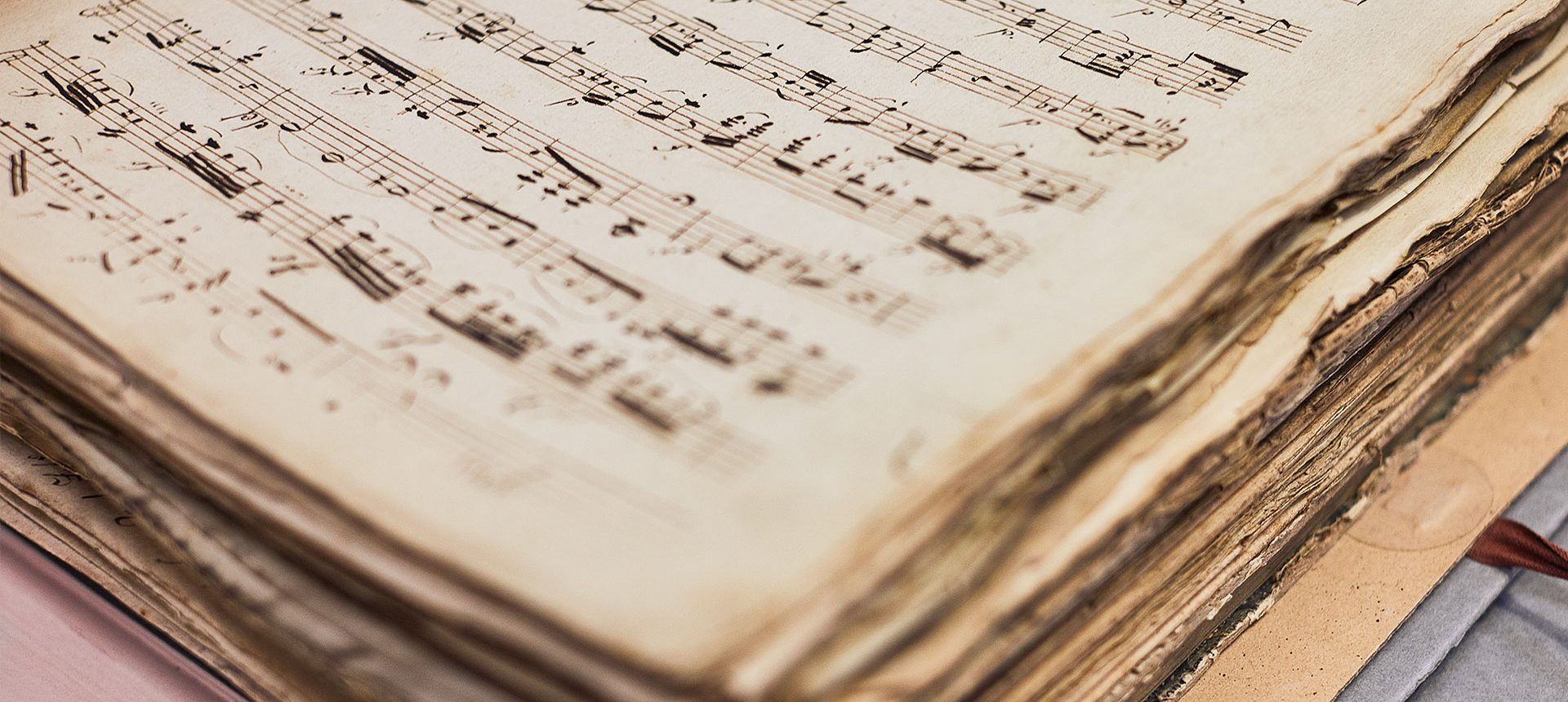
Here you can find almost anything about all the concerts Gothenburg Symphony has played over the years, both in the Concert Hall and on tour.
Search for conductors, soloists and other artists that has played together with us. Or search for composers and music that we have played. And filter on specific seasons. Guesting orchestras and ensembles are also included in the archive.
The result is presented by season.
The Gothenburg Symphony was formed in 1905 and today consists of 109 musicians. The orchestra's base is Gothenburg Concert Hall at Götaplatsen that has gathered music lovers since 1935. Since the 2019-2020 season, Barbara Hannigan is Principal guest conductor. We are also a proud partner of Barbara Hannigan's Equilibrium mentoring program focusing on young singers at the start of their careers. The title Principal Guest Conductor is shared by Pekka Kuusisto from 2025.
Wilhelm Stenhammar was the orchestra's chief conductor from 1907 to 1922. He gave the orchestra a strong Nordic profile and invited colleagues Carl Nielsen and Jean Sibelius to the orchestra. Under the direction of conductor Neeme Järvi from 1982-2004, the orchestra made a series of international tours as well as a hundred disc recordings and established themselves among Europe's leading orchestras. In 1996, the Swedish Riksdag appointed the Gothenburg Symphony as Sweden's National Orchestra.
In recent decades, the orchestra has had prominent chief conductors such as Santtu-Matias Rouvali, Mario Venzago and Gustavo Dudamel, following Kent Nagano as Principal Guest conductor. Anna-Karin Larsson is CEO and artistic director, Gustavo Dudamel honorary conductor and Neeme Järvi chief conductor emeritus. The orchestra's owner is the Västra Götaland Region.
The Gothenburg Symphony works regularly with conductors such as Herbert Blomstedt, Joana Carneiro, Jukka-Pekka Saraste, Christian Zacharias and Anja Bihlmaier.
Conductor and soprano Barbara Hannigan is Principal guest conductor of the Gothenburg Symphony Orchestra since 2019, embodying music with an unparalleled dramatic sensibility. She moves freely between the multiple roles of conductor, singer and curator. Over more than three decades, she has forged artistic partnerships with extraordinary musicians, directors and choreographers, including Romeo Castellucci, Claus Guth, Vladimir Jurowski, Katie Mitchell, Simon Rattle, Esa-Pekka Salonen, Kirill Petrenko, Sasha Waltz, and Krzysztof Warlikowski. The late conductor and pianist Reinbert de Leeuw has been an extraordinary influence and inspiration on her development as a musician.
In the 2026-2027 season, Hannigan begins her tenure as Chief Conductor and Artistic Director of the Iceland Symphony Orchestra, where her spirit of discovery will shape an artistic vision rooted in excellence, openness and collaboration, while forging new connections between Iceland and the wider international music community.
Balancing her work as both conductor and soprano, Hannigan maintains long-standing relationships with her colleagues in the orchestral, operatic and chamber music realms. She has maintained multi-year associations with London Symphony Orchestra (as Associate Artist), l'Orchestre de Chambre de Lausanne (as Principal Guest Conductor), and performs regularly with the Munich Philharmonic, Swedish Radio Symphony Orchestra, Swedish Chamber Orchestra, Orchestre Philharmonique de Radio France, and Danish Radio Symphony Orchestra. She makes her Rotterdam Philharmonic Orchestra conducting debut, performing as part of the joint project between the orchestra and Scapino Ballet entitled La Mer, in which she will sing, conduct and also dance with the artists of this world-renowned dance company. She continues to tour her unique production of Poulenc’s La Voix Humaine, after its most recent successes with New York Philharmonic and Czech Philharmonic Orchestras, bringing the work this season to Berlin with the Deutsches Symphonie-Orchester Berlin. Her recital tour with her most important musical partner, pianist Bertrand Chamayou (works by Messiaen, Scriabin and Zorn) continues in the 2026/27 season with performances throughout Europe.
Her awards and honours include the Governor General's Performing Arts Award (2026), the 2025 Polar Music Prize, 2025 Musical America Artist of the Year, "Accademico Onorario (Honorary Academician) (2025) at Accademia di Santa Cecilia, the Order of Canada (2016), Officier des Arts et des Lettres in France (2022), Gramophone Magazine’s 2022 Artist of the Year, Germany's Faust Award (2015), Sweden's Rolf Schock Prize for Musical Arts (2018), and Denmark’s Léonie Sonning Music Prize (2021).
Barbara Hannigan resides in Finistère, on the northwest coast of France, looking over an inlet which leads directly across the Atlantic to where she grew up in Waverley, Nova Scotia.
Gustav Mahler (1860-1911)
Symphony No. 1, Titan (original version)
The first symphony was premiered in Budapest with the composer as conductor. The music attracted violent criticism, because this was something that was not expected. Mahler had made a name for himself as a brilliant opera conductor but as a composer he was virtually unknown, and now he came up with an ambitious, stylistically variegated and strangely personal symphony. Few works by Mahler have since undergone so many revisions - right up until 1898. When the first version was found in the 1960s, it was clear that the differences were large. The Andante that constituted the second movement, Blumine, was cut already in the 1890s.
The opening is compelling: it begins with an unforgettable feeling of space and stillness. Perhaps Mahler was thinking of when he was left alone in the forest by his father with the promise not to move until his father returned - and it took many hours. Gradually, thematic fragments emerge: horn calls, trumpet fanfares, birdsong. The movement here played as no 3 was first called "Full Sails" and reflects a longing for nature and lively, Austrian-inspired peasant dances.
"Mourning march à la Callot" he called the next movement, and the etching intended by the artist shows the dead hunter being carried on a stretcher by the animals of the forest. It is a parodic picture and a highly parodic piece of music, which is based on the well-known children's song Frère Jacques in an ironic, grotesque and bitter minor version.
The finale is the despair of a wounded heart. He borrowed the title of the movement from Dante: "From inferno to paradise". Music may seem to start in hell, and Mahler was probably a long way to paradise. But he didn't get there yet, he did so only in the second symphony - and it was started immediately after the first.
Participants
The Gothenburg Symphony was formed in 1905 and today consists of 109 musicians. The orchestra's base is Gothenburg Concert Hall at Götaplatsen that has gathered music lovers since 1935. Since the 2019-2020 season, Barbara Hannigan is Principal guest conductor. We are also a proud partner of Barbara Hannigan's Equilibrium mentoring program focusing on young singers at the start of their careers. The title Principal Guest Conductor is shared by Pekka Kuusisto from 2025.
Wilhelm Stenhammar was the orchestra's chief conductor from 1907 to 1922. He gave the orchestra a strong Nordic profile and invited colleagues Carl Nielsen and Jean Sibelius to the orchestra. Under the direction of conductor Neeme Järvi from 1982-2004, the orchestra made a series of international tours as well as a hundred disc recordings and established themselves among Europe's leading orchestras. In 1996, the Swedish Riksdag appointed the Gothenburg Symphony as Sweden's National Orchestra.
In recent decades, the orchestra has had prominent chief conductors such as Santtu-Matias Rouvali, Mario Venzago and Gustavo Dudamel, following Kent Nagano as Principal Guest conductor. Anna-Karin Larsson is CEO and artistic director, Gustavo Dudamel honorary conductor and Neeme Järvi chief conductor emeritus. The orchestra's owner is the Västra Götaland Region.
The Gothenburg Symphony works regularly with conductors such as Herbert Blomstedt, Joana Carneiro, Jukka-Pekka Saraste, Christian Zacharias and Anja Bihlmaier.
Herbert Blomstedt, born in 1927, continues to be one of the world's most sought-after conductors. He has been a regular and much appreciated guest conductor with the Gothenburg Symphony since 1954 and is also named an honorary symphony conductor. His work as a conductor is inextricably linked to his religious and human ethos, and his interpretations combine great fidelity to the score and analytical precision. In the more than sixty years of his career, he has acquired the unrestricted respect of the musical world.
Born in the USA to Swedish parents and educated in Uppsala, New York, Darmstadt and Basel, Herbert Blomstedt made his debut as a conductor in 1954 with the Stockholm Philharmonic Orchestra and was subsequently chief conductor of the Oslo Philharmonic, the Swedish and Danish Radio symphony orchestras and the Staatskapelle Dresden. During his career, Herbert Blomstedt has been chief conductor of the Gewandhaus Orchestra in Leipzig, the NDR Orchestra in Hamburg and the San Francisco Symphony Orchestra. He has appeared with all the major orchestras, including the Berlin Philharmonic, the Boston and Chicago Symphony Orchestras, the Concertgebouw Orchestra, the New York Philharmonic, the Bavarian Radio Symphony Orchestra and the Vienna Philharmonic. Herbert Blomstedt's discography includes hundreds of recordings. Among his later releases are Stenhammar's Serenade and Symphony No. 2 with the Gothenburg Symphony (BIS).
Herbert Blomstedt holds several Honorary Doctorates and is an elected member of the Royal Swedish Music Academy. He continues to be at the helm of all leading international orchestras with enormous presence, verve and artistic drive.
The Gothenburg Symphony was formed in 1905 and today consists of 109 musicians. The orchestra's base is Gothenburg Concert Hall at Götaplatsen that has gathered music lovers since 1935. Since the 2019-2020 season, Barbara Hannigan is Principal guest conductor. We are also a proud partner of Barbara Hannigan's Equilibrium mentoring program focusing on young singers at the start of their careers. The title Principal Guest Conductor is shared by Pekka Kuusisto from 2025.
Wilhelm Stenhammar was the orchestra's chief conductor from 1907 to 1922. He gave the orchestra a strong Nordic profile and invited colleagues Carl Nielsen and Jean Sibelius to the orchestra. Under the direction of conductor Neeme Järvi from 1982-2004, the orchestra made a series of international tours as well as a hundred disc recordings and established themselves among Europe's leading orchestras. In 1996, the Swedish Riksdag appointed the Gothenburg Symphony as Sweden's National Orchestra.
In recent decades, the orchestra has had prominent chief conductors such as Santtu-Matias Rouvali, Mario Venzago and Gustavo Dudamel, following Kent Nagano as Principal Guest conductor. Anna-Karin Larsson is CEO and artistic director, Gustavo Dudamel honorary conductor and Neeme Järvi chief conductor emeritus. The orchestra's owner is the Västra Götaland Region.
The Gothenburg Symphony works regularly with conductors such as Herbert Blomstedt, Joana Carneiro, Jukka-Pekka Saraste, Christian Zacharias and Anja Bihlmaier.
Lars-Erik Larsson (1908-1986)
Pastoral Suite
Overture - Romance - Scherzo
Lars-Erik Larsson made his debut in Stockholm at the age of 20 and became one of Sweden's most popular composers. The Pastoral Suite was composed in the autumn of 1938 for the programme "Moments of the Day" on Swedish Radio, where Larsson was conductor. He originally wrote six movements, three of which have been retained in the suite. The overture has a slow introduction and a subsequent longer allegro in the composer's typical easygoing, rhythmically varied style. Then the romance, the most frequently performed movement, which is singable with great melodic beauty. Finally, a lively and graceful scherzo. The suite is scored for double woodwinds, two horns, two trumpets, timpani and strings, while the middle movement is for strings only.
The Gothenburg Symphony was formed in 1905 and today consists of 109 musicians. The orchestra's base is Gothenburg Concert Hall at Götaplatsen that has gathered music lovers since 1935. Since the 2019-2020 season, Barbara Hannigan is Principal guest conductor. We are also a proud partner of Barbara Hannigan's Equilibrium mentoring program focusing on young singers at the start of their careers. The title Principal Guest Conductor is shared by Pekka Kuusisto from 2025.
Wilhelm Stenhammar was the orchestra's chief conductor from 1907 to 1922. He gave the orchestra a strong Nordic profile and invited colleagues Carl Nielsen and Jean Sibelius to the orchestra. Under the direction of conductor Neeme Järvi from 1982-2004, the orchestra made a series of international tours as well as a hundred disc recordings and established themselves among Europe's leading orchestras. In 1996, the Swedish Riksdag appointed the Gothenburg Symphony as Sweden's National Orchestra.
In recent decades, the orchestra has had prominent chief conductors such as Santtu-Matias Rouvali, Mario Venzago and Gustavo Dudamel, following Kent Nagano as Principal Guest conductor. Anna-Karin Larsson is CEO and artistic director, Gustavo Dudamel honorary conductor and Neeme Järvi chief conductor emeritus. The orchestra's owner is the Västra Götaland Region.
The Gothenburg Symphony works regularly with conductors such as Herbert Blomstedt, Joana Carneiro, Jukka-Pekka Saraste, Christian Zacharias and Anja Bihlmaier.
The Estonian-born conductor Neeme Järvi is the Gothenburg Symphony Orchestra's Principal Conductor Emeritus. He conducts many of the world's most prominent orchestras and works with soloists of the highest class. During his long career, he has made over 450 disc recordings. Under Neeme Järvi's direction from 1982-2004, the Gothenburg Symphony made a series of international tours and made around a hundred disc recordings and established itself among Europe's leading orchestras.
Neeme Järvi became chief conductor of the Residentie Orkest in 2005, artistic director of the Estonian National Symphony Orchestra in 2009 and music director of the New Jersey Symphony Orchestra in 2005. He has also been artistic director of the Orchester de la Suisse Romande. He holds the titles of Music Director Emeritus of the Detroit Symphony Orchestra and Conductor Laureate of the Royal Scottish National Orchestra.
Throughout his career, Neeme Järvi has been honored with international honors and awards. In Estonia, these include an honorary doctorate at the Estonian Academy of Music in Tallinn, and the Order of the National Coat of Arms from the President of the Republic of Estonia. He has also received the Commander of the Order of the North Star from King Karl XVI Gustaf.
He most recently guested with the Gothenburg Symphony Orchestra in 2024 at the Hasselblad Concert, which was also recorded for GSOplay and Swedish Radio.
The Gothenburg Symphony was formed in 1905 and today consists of 109 musicians. The orchestra's base is Gothenburg Concert Hall at Götaplatsen that has gathered music lovers since 1935. Since the 2019-2020 season, Barbara Hannigan is Principal guest conductor. We are also a proud partner of Barbara Hannigan's Equilibrium mentoring program focusing on young singers at the start of their careers. The title Principal Guest Conductor is shared by Pekka Kuusisto from 2025.
Wilhelm Stenhammar was the orchestra's chief conductor from 1907 to 1922. He gave the orchestra a strong Nordic profile and invited colleagues Carl Nielsen and Jean Sibelius to the orchestra. Under the direction of conductor Neeme Järvi from 1982-2004, the orchestra made a series of international tours as well as a hundred disc recordings and established themselves among Europe's leading orchestras. In 1996, the Swedish Riksdag appointed the Gothenburg Symphony as Sweden's National Orchestra.
In recent decades, the orchestra has had prominent chief conductors such as Santtu-Matias Rouvali, Mario Venzago and Gustavo Dudamel, following Kent Nagano as Principal Guest conductor. Anna-Karin Larsson is CEO and artistic director, Gustavo Dudamel honorary conductor and Neeme Järvi chief conductor emeritus. The orchestra's owner is the Västra Götaland Region.
The Gothenburg Symphony works regularly with conductors such as Herbert Blomstedt, Joana Carneiro, Jukka-Pekka Saraste, Christian Zacharias and Anja Bihlmaier.
Mahler’s Fourth Symphony marked a fresh direction in his symphonic writing. It is more concise than Symphony 2 and 3, and the orchestral forces are noticeably reduced. Gone, too, are the programmatic headings Mahler had previously used for each movement, even though he initially worked from a sketch of guiding ideas. The result is often described as a “happier” and more “playful” symphony, almost chamber-like at times, alive with melodies and dance rhythms. Echoes of the Viennese Classics – Haydn above all – mingle with Austrian Ländler and lilting waltz motifs.
The symphony traces a disquieting journey from earthly life towards a heavenly existence beyond death. In the opening movement, sleigh bells and paradisiacal motifs appear alongside march rhythms and a touch of Viennese charm in the strings and winds. The second movement, a scherzo, introduces a ghostly dance of death through a violin solo played with the strings tuned a whole tone higher than usual. Mahler wanted it to sound “like a fiddler – friend Hein (a medieval name for Death) striking up a tune!” The winds add to the eerie atmosphere with unsettling waltz rhythms.
Then comes the third movement, Ruhevoll: a serene and deeply moving set of variations. Mahler described it as containing “divinely joyful and profoundly sorrowful melodies”. It is an adagio in the truest Mahlerian sense. Near the end a powerful orchestral outburst dissolves into “heavenly” sonorities in the strings and harp. The gates of paradise begin to open. “When humankind, now filled with wonder, asks what all this means, the child answers with the fourth movement: This is heavenly life!” the composer explained.
And this heavenly life is brimming with joy, song, dance, music-making – and above all food and drink. The text of the finale comes from the folk poetry collection Des Knaben Wunderhorn, “Das himmlische Leben”, and is set for soprano.
"Only once have I succeeded in fully realizing my intentions, in Boléro."
Maurice Ravel composed Boléro (1928) as a bold experiment in rhythm, timbre, and endurance. Originally written as ballet music for the Russian ballerina Ida Rubinstein, the work is based on an almost ascetic musical material - an unchanging rhythm of the snare drum together with two simple melodies repeated without thematic development. What changes instead is the color, density, and dynamics of the orchestra. Over a sustained ostinatory rhythm, the melody wanders through the orchestra's instruments, one by one, in a slow and relentless rise toward a monumental climax.
Ravel himself emphasized the monotonous and almost mechanical character of the work, describing it as a pure study in orchestration rather than an expression of drama or narrative. It is precisely this consistent limitation that gives the music its hypnotic, almost trance-like effect. Boléro immediately attracted great attention upon its premiere in Paris, and achieved worldwide success within months. It became Ravel's most famous work, remains one of the most frequently performed classical pieces in the world, and is considered one of the most iconic and powerful orchestral experiences of the 20th century.
The Gothenburg Symphony was formed in 1905 and today consists of 109 musicians. The orchestra's base is Gothenburg Concert Hall at Götaplatsen that has gathered music lovers since 1935. Since the 2019-2020 season, Barbara Hannigan is Principal guest conductor. We are also a proud partner of Barbara Hannigan's Equilibrium mentoring program focusing on young singers at the start of their careers. The title Principal Guest Conductor is shared by Pekka Kuusisto from 2025.
Wilhelm Stenhammar was the orchestra's chief conductor from 1907 to 1922. He gave the orchestra a strong Nordic profile and invited colleagues Carl Nielsen and Jean Sibelius to the orchestra. Under the direction of conductor Neeme Järvi from 1982-2004, the orchestra made a series of international tours as well as a hundred disc recordings and established themselves among Europe's leading orchestras. In 1996, the Swedish Riksdag appointed the Gothenburg Symphony as Sweden's National Orchestra.
In recent decades, the orchestra has had prominent chief conductors such as Santtu-Matias Rouvali, Mario Venzago and Gustavo Dudamel, following Kent Nagano as Principal Guest conductor. Anna-Karin Larsson is CEO and artistic director, Gustavo Dudamel honorary conductor and Neeme Järvi chief conductor emeritus. The orchestra's owner is the Västra Götaland Region.
The Gothenburg Symphony works regularly with conductors such as Herbert Blomstedt, Joana Carneiro, Jukka-Pekka Saraste, Christian Zacharias and Anja Bihlmaier.
Zoltán Kodály (1882-1967)
Galántai táncok
Ancient Hungarian peasant music, still unchanged in the villages, began to be recorded by Zoltán Kodály and Bartók around 1905. Both composers were captivated by the unique Romani verbunkos music. In the small Slovak town of Galánta, fifty kilometers from Bratislava, next to the train line between Vienna and Budapest, there was a famous Romani music chapel that gave Kodály his earliest taste for orchestral sound.
Dances from Galánta were written in 1933 for the 80th anniversary of the Budapest Philharmonic. The instrumentation for double flutes (plus piccolo), oboes, A-clarinets, bassoons, plus four horns, timpani, snare drum, glockenspiel, triangle and strings imitated such a verbunkos band with a solo clarinet in the lead role as the Romani tárogáto. The story goes that the Galánta pieces were originally composed during Hungary's struggle for independence under Turkish occupation. Verbunkos music began to be published in sheet music in the late 18th century, not least in Vienna, where both Mozart and Schubert were strongly influenced by it. Kodály uses the slow verbunkos introduction as a rondo theme in the following four dances as well as in the great final coda. It alone takes up more than half the length of the piece.
As a respected professor at the Budapest Academy of Music and president of the Hungarian Academy of Sciences, and later an honorary doctor in Oxford and Berlin, Kodály would promote the importance of spontaneous folk music. This liberal orientation also permeated key earlier works such as the Háry János Suite of 1927 and the Dances from Marosszék of 1933, both of which, along with the Galánta Dances, were his most frequently performed works.
The Gothenburg Symphony was formed in 1905 and today consists of 109 musicians. The orchestra's base is Gothenburg Concert Hall at Götaplatsen that has gathered music lovers since 1935. Since the 2019-2020 season, Barbara Hannigan is Principal guest conductor. We are also a proud partner of Barbara Hannigan's Equilibrium mentoring program focusing on young singers at the start of their careers. The title Principal Guest Conductor is shared by Pekka Kuusisto from 2025.
Wilhelm Stenhammar was the orchestra's chief conductor from 1907 to 1922. He gave the orchestra a strong Nordic profile and invited colleagues Carl Nielsen and Jean Sibelius to the orchestra. Under the direction of conductor Neeme Järvi from 1982-2004, the orchestra made a series of international tours as well as a hundred disc recordings and established themselves among Europe's leading orchestras. In 1996, the Swedish Riksdag appointed the Gothenburg Symphony as Sweden's National Orchestra.
In recent decades, the orchestra has had prominent chief conductors such as Santtu-Matias Rouvali, Mario Venzago and Gustavo Dudamel, following Kent Nagano as Principal Guest conductor. Anna-Karin Larsson is CEO and artistic director, Gustavo Dudamel honorary conductor and Neeme Järvi chief conductor emeritus. The orchestra's owner is the Västra Götaland Region.
The Gothenburg Symphony works regularly with conductors such as Herbert Blomstedt, Joana Carneiro, Jukka-Pekka Saraste, Christian Zacharias and Anja Bihlmaier.
Felix Mendelssohn (1809-1847)
Violin Concerto E minor
Allegro molto appassionato
Andante
Allegretto non troppo. Allegro molto vivace
Felix Mendelssohn came from a German-Jewish family and as a composer strove to reconcile issues of spirituality and religious tolerance within society, and within himself. The Violin Concerto in E minor was written for the soloist Ferdinand David. However, the wait was six years before the premiere could take place in Leipzig on March 13, 1845 with David and the Gewandhaus Orchestra. New was the transition to the second movement without a break, as well as the fact that the soloist took up the opening theme, not the orchestra, and that a solo cadenza came already in the introduction - something that Sibelius and Tchaikovsky would also follow. The success was immediate. But in Nazi Germany, Mendelssohn's greatness was denied and his name was erased from public life.
"Only once have I succeeded in fully realizing my intentions, in Boléro."
Maurice Ravel composed Boléro (1928) as a bold experiment in rhythm, timbre, and endurance. Originally written as ballet music for the Russian ballerina Ida Rubinstein, the work is based on an almost ascetic musical material - an unchanging rhythm of the snare drum together with two simple melodies repeated without thematic development. What changes instead is the color, density, and dynamics of the orchestra. Over a sustained ostinatory rhythm, the melody wanders through the orchestra's instruments, one by one, in a slow and relentless rise toward a monumental climax.
Ravel himself emphasized the monotonous and almost mechanical character of the work, describing it as a pure study in orchestration rather than an expression of drama or narrative. It is precisely this consistent limitation that gives the music its hypnotic, almost trance-like effect. Boléro immediately attracted great attention upon its premiere in Paris, and achieved worldwide success within months. It became Ravel's most famous work, remains one of the most frequently performed classical pieces in the world, and is considered one of the most iconic and powerful orchestral experiences of the 20th century.
Participants
The Gothenburg Symphony was formed in 1905 and today consists of 109 musicians. The orchestra's base is Gothenburg Concert Hall at Götaplatsen that has gathered music lovers since 1935. Since the 2019-2020 season, Barbara Hannigan is Principal guest conductor. We are also a proud partner of Barbara Hannigan's Equilibrium mentoring program focusing on young singers at the start of their careers. The title Principal Guest Conductor is shared by Pekka Kuusisto from 2025.
Wilhelm Stenhammar was the orchestra's chief conductor from 1907 to 1922. He gave the orchestra a strong Nordic profile and invited colleagues Carl Nielsen and Jean Sibelius to the orchestra. Under the direction of conductor Neeme Järvi from 1982-2004, the orchestra made a series of international tours as well as a hundred disc recordings and established themselves among Europe's leading orchestras. In 1996, the Swedish Riksdag appointed the Gothenburg Symphony as Sweden's National Orchestra.
In recent decades, the orchestra has had prominent chief conductors such as Santtu-Matias Rouvali, Mario Venzago and Gustavo Dudamel, following Kent Nagano as Principal Guest conductor. Anna-Karin Larsson is CEO and artistic director, Gustavo Dudamel honorary conductor and Neeme Järvi chief conductor emeritus. The orchestra's owner is the Västra Götaland Region.
The Gothenburg Symphony works regularly with conductors such as Herbert Blomstedt, Joana Carneiro, Jukka-Pekka Saraste, Christian Zacharias and Anja Bihlmaier.