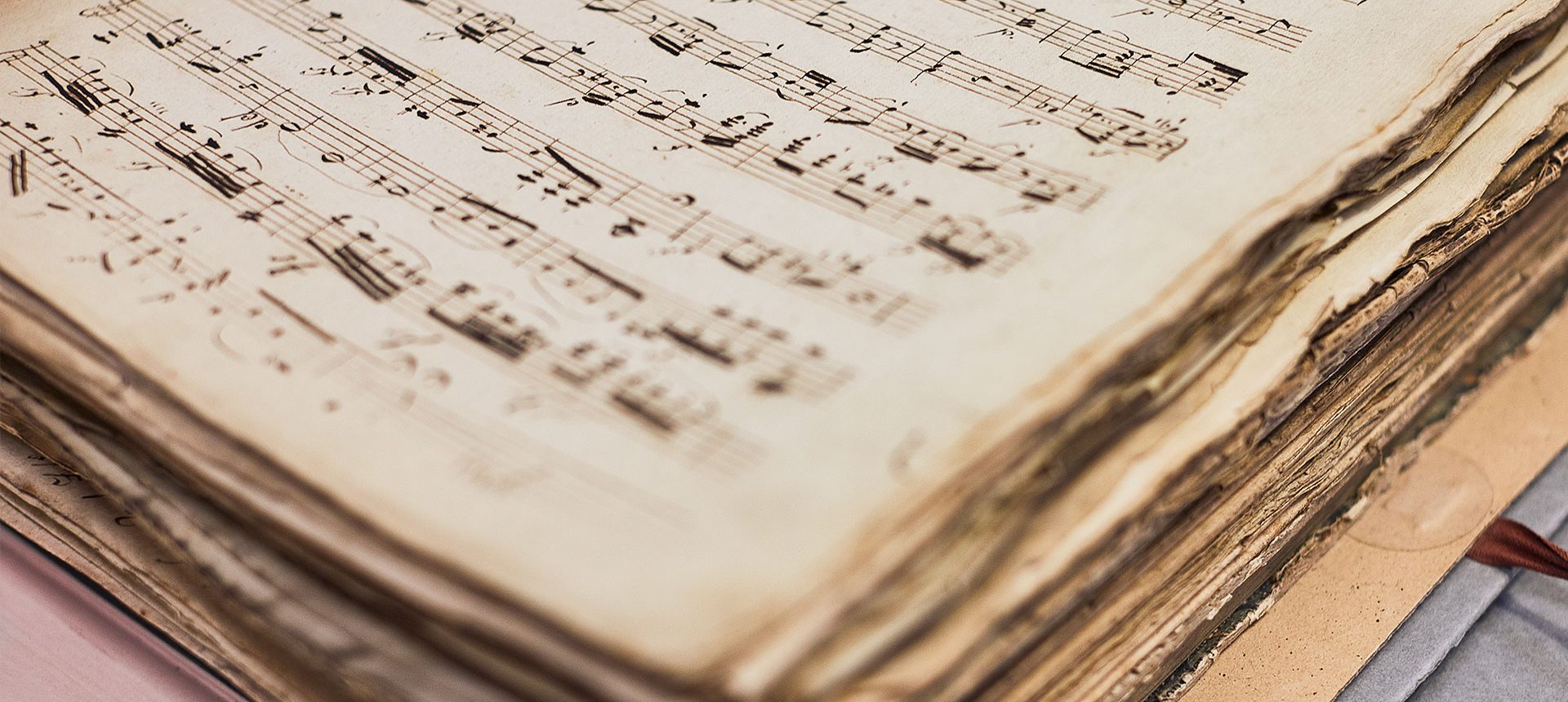
Here you can find almost anything about all the concerts Gothenburg Symphony has played over the years, both in the Concert Hall and on tour.
Search for conductors, soloists and other artists that has played together with us. Or search for composers and music that we have played. And filter on specific seasons. Guesting orchestras and ensembles are also included in the archive.
The result is presented by season.
In the second of pioneer Elfrida Andrée’s three-movement organ symphonies, we encounter a soloist who serves as the work’s sonic, symphonic hub rather than as a traditional counterpart to an orchestra—in this instance, an ensemble consisting entirely of brass instruments. The symphony emerges from the organ; it does not take the form of an interplay between soloist and winds. Instead, Andrée treats both as blocks of sound that are successively layered or stripped away in various strata. The organ becomes, in effect, the harmonic glue around which the music is organized.
Andrée’s aesthetic bears the stamp of the National Romantic legacy, yet it is strikingly international, aligning itself with the prevailing Romantic music of Central Europe. A distinctive feature is the way dynamics shape the work’s structure; musical climaxes often emerge through gradual changes in organ registration rather than through the harmonic development of thematic material.
In this process, we also become aware of Elfrida Andrée the organist: how her relationship with the instrument is audible in the work—the movement of her hands pulling drawstops, her feet pressing pedals, and her fingers shifting between manuals. We hear how she conjures up sonic spaces as organ pipes successively reveal themselves to our listening ears.
1. Montague and Capulet
2. Death of Tybalt
3. Romeo at the tomb of Juliet
Participants
The Gothenburg Symphony was formed in 1905 and today consists of 109 musicians. The orchestra's base is Gothenburg Concert Hall at Götaplatsen that has gathered music lovers since 1935. Since the 2019-2020 season, Barbara Hannigan is Principal guest conductor. We are also a proud partner of Barbara Hannigan's Equilibrium mentoring program focusing on young singers at the start of their careers. The title Principal Guest Conductor is shared by Pekka Kuusisto from 2025.
Wilhelm Stenhammar was the orchestra's chief conductor from 1907 to 1922. He gave the orchestra a strong Nordic profile and invited colleagues Carl Nielsen and Jean Sibelius to the orchestra. Under the direction of conductor Neeme Järvi from 1982-2004, the orchestra made a series of international tours as well as a hundred disc recordings and established themselves among Europe's leading orchestras. In 1996, the Swedish Riksdag appointed the Gothenburg Symphony as Sweden's National Orchestra.
In recent decades, the orchestra has had prominent chief conductors such as Santtu-Matias Rouvali, Mario Venzago and Gustavo Dudamel, following Kent Nagano as Principal Guest conductor. Anna-Karin Larsson is CEO and artistic director, Gustavo Dudamel honorary conductor and Neeme Järvi chief conductor emeritus. The orchestra's owner is the Västra Götaland Region.
The Gothenburg Symphony works regularly with conductors such as Herbert Blomstedt, Joana Carneiro, Jukka-Pekka Saraste, Christian Zacharias and Anja Bihlmaier.
Emilia Hoving has emerged as one of the most exciting young Finnish conductors today. In 2025/26, Hoving begins her three-year tenure as Associate Conductor with the Royal Philharmonic Orchestra, she makes her debut with the Bamberg Symphony and with the Hallé Orchestra, and returns to conduct the Royal Philharmonic Orchestra, Gothenburg Symphony, Malmo Symphony, Orchestre de Chambre de Lausanne, and the BBC Scottish Symphony Orchestra. In 2025 she also made her mainstage opera debut, conducting Opera North in several performances of The Magic Flute.
Emilia Hoving conducted the final concert at Side by Side in 2025 and 2024 and the school concert Bubblor at the Gothenburg Symphony in 2023. In the summer of 2022, she made her Tokyo debut at Suntory Hall as conductor of the Yomiuri Nippon Symphony and her UK debut at the Philharmonia, where she has now become a regular guest. Hoving has conducted many works by living (especially Finnish) composers and gave the Australian premiere of Missy Mazzoli's Procession at the Adelaide Festival.
Hoving studied at the Sibelius Academy in Helsinki with Sakari Oramo, Atso Almila and Jorma Panula. She received the Finnish Critics' Prize in 2021 as best newcomer and was an assistant to Hannu Lintu at Finnish Radio (2019) and to Mikko Franck at Radio France (2020-22).
Marjolein Vermeeren successfully made her professional conducting debut with the Gothenburg Wind Orchestra in 2022. She has worked as a guest conductor with several professional orchestras since then, such as Östgötamusiken, Gotlands Musikstiftelse, Marinens Musikkår and Norrköpings Symphony Orchestra. In the 2025-2026 season, she will return to the Gothenburg Wind Orchestra, the Gothenburg Symphony Orchestra, the Helsingborg Symphony Orchestra and the Swedish Chamber Orchestra. Marjolein Vermeeren is also a flutist in the Gothenburg Symphony Orchestra.
She grew up in the southern Netherlands, where wind music is of great importance, and has worked with youth orchestras and participated for several years at the Side by Side music camp as a conductor and instructor for the oldest participants. Vermeeren is educated at the Tilburg Academy of Music, the Netherlands, and has studied flute at the Royal Academy of Music in London. She has also continued her conducting education by studying with Glenn Mossop in Stockholm.
Birgitta Mannerström-Molin is a choir conductor and singing teacher. She also teaches at the University of Stage and Music in Gothenburg and is involved as a course instructor and choir conductor at national level. She has also been involved in the development of El Sistema in Sweden and is the conductor and artistic advisor for Side by Side by El Sistema, which is performed every year by the Gothenburg Symphony. In 2016, Birgitta Mannerström-Molin was appointed Children's and Youth Choir leader of the Year.
She is also a teacher at Hvitfeldtska Musikgymnasiet and project leader for young people at Sweden's Church Song Association.
The choir was founded in 1917 by cousins Elsa and Wilhelm Stenhammar. Elsa Stenhammar was one of the driving forces in turn-of-the-century choir life in Gothenburg and became the choir's first rehearser. On December 8, 1917, the choir debuted in Beethoven's Choir Fantasy with Wilhelm Stenhammar as soloist at the grand piano. As the country's oldest symphonic choir, they were able to celebrate their 100th anniversary in 2017 with a big celebratory concert where Mozart and Brahms as well as Stenhammar, Elfrida Andrée and Björn & Benny were on the program.
The Gothenburg Symphony Choir is a non-profit association that is linked to the Gothenburg Symphony. The choir participates in concerts and performances under both the orchestra's and its own auspices. The music is mixed and the repertoire extensive. The Gothenburg Symphony Choir has participated in concerts in, among other places, the Royal Albert Hall and Canterbury Cathedral in England, as well as participated with the Gothenburg Symphony in the annual music festival in the Canary Islands and on a tour to China.
Ludwig Göransson (b 1984)
From The Mandalorian, arr. Paul Murtha, adaptation Christian Fevik, Patrik Östholm
Multiple award-winning Ludwig Göransson wrote the music for the Star Wars sequel The Mandalorian in 2019 and is undoubtedly Sweden's most successful film composer. The Mandalorian is an excellent example of Göransson's ability to combine classical orchestrations with modern influences - not least in terms of rhythm - from other more popular musical genres.
The Gothenburg Symphony was formed in 1905 and today consists of 109 musicians. The orchestra's base is Gothenburg Concert Hall at Götaplatsen that has gathered music lovers since 1935. Since the 2019-2020 season, Barbara Hannigan is Principal guest conductor. We are also a proud partner of Barbara Hannigan's Equilibrium mentoring program focusing on young singers at the start of their careers. The title Principal Guest Conductor is shared by Pekka Kuusisto from 2025.
Wilhelm Stenhammar was the orchestra's chief conductor from 1907 to 1922. He gave the orchestra a strong Nordic profile and invited colleagues Carl Nielsen and Jean Sibelius to the orchestra. Under the direction of conductor Neeme Järvi from 1982-2004, the orchestra made a series of international tours as well as a hundred disc recordings and established themselves among Europe's leading orchestras. In 1996, the Swedish Riksdag appointed the Gothenburg Symphony as Sweden's National Orchestra.
In recent decades, the orchestra has had prominent chief conductors such as Santtu-Matias Rouvali, Mario Venzago and Gustavo Dudamel, following Kent Nagano as Principal Guest conductor. Anna-Karin Larsson is CEO and artistic director, Gustavo Dudamel honorary conductor and Neeme Järvi chief conductor emeritus. The orchestra's owner is the Västra Götaland Region.
The Gothenburg Symphony works regularly with conductors such as Herbert Blomstedt, Joana Carneiro, Jukka-Pekka Saraste, Christian Zacharias and Anja Bihlmaier.
“Ron Davis Alvarez is a man accustomed to making miracles” (The New York Times).
The Venezuelan Ron Davis Alvarez, who in 2017 was named one of the world's 50 best teachers by the Varkey Foundation, part of the Global Teacher Prize, specializes in training teachers for children's and youth orchestras. He has lectured at conferences and masterclasses with teachers from Colombia, Mexico, USA, Chile, Great Britain, Denmark, Italy, Germany, France, Greenland, Sweden, Turkey, South Korea, Ecuador, Finland and Greece. In the latter, he taught in a refugee camp.
He is chief conductor of the international music camp Side by Side by Gothenburg Symphony Orchestra. In 2016, he created the Dream Orchestra in Gothenburg for children and young people aged 8 to 19 who are on the run. The orchestra has more than 50 members and has made a series of high-profile performances, including abroad, and is now emulated in several European countries.
Formed by the famous Venezuelan musical and social program El Sistema, Alvarez trained in Miranda State, Venezuela as a violinist, orchestra conductor, teacher and cultural director. His main mentors and inspirations are maestro José Antonio Abreu, Franka Verhagen, Igor Lanz, Gregory Carreño, Ruben Cova, Ann Andreasen, Victor Vivas and Tupac Amaru.
In 2024, Ron Davis Alvarez was recognized by the news channel CNN when he was named a CNN Hero.
The choir was founded in 1917 by cousins Elsa and Wilhelm Stenhammar. Elsa Stenhammar was one of the driving forces in turn-of-the-century choir life in Gothenburg and became the choir's first rehearser. On December 8, 1917, the choir debuted in Beethoven's Choir Fantasy with Wilhelm Stenhammar as soloist at the grand piano. As the country's oldest symphonic choir, they were able to celebrate their 100th anniversary in 2017 with a big celebratory concert where Mozart and Brahms as well as Stenhammar, Elfrida Andrée and Björn & Benny were on the program.
The Gothenburg Symphony Choir is a non-profit association that is linked to the Gothenburg Symphony. The choir participates in concerts and performances under both the orchestra's and its own auspices. The music is mixed and the repertoire extensive. The Gothenburg Symphony Choir has participated in concerts in, among other places, the Royal Albert Hall and Canterbury Cathedral in England, as well as participated with the Gothenburg Symphony in the annual music festival in the Canary Islands and on a tour to China.
Emilia Hoving has emerged as one of the most exciting young Finnish conductors today. In 2025/26, Hoving begins her three-year tenure as Associate Conductor with the Royal Philharmonic Orchestra, she makes her debut with the Bamberg Symphony and with the Hallé Orchestra, and returns to conduct the Royal Philharmonic Orchestra, Gothenburg Symphony, Malmo Symphony, Orchestre de Chambre de Lausanne, and the BBC Scottish Symphony Orchestra. In 2025 she also made her mainstage opera debut, conducting Opera North in several performances of The Magic Flute.
Emilia Hoving conducted the final concert at Side by Side in 2025 and 2024 and the school concert Bubblor at the Gothenburg Symphony in 2023. In the summer of 2022, she made her Tokyo debut at Suntory Hall as conductor of the Yomiuri Nippon Symphony and her UK debut at the Philharmonia, where she has now become a regular guest. Hoving has conducted many works by living (especially Finnish) composers and gave the Australian premiere of Missy Mazzoli's Procession at the Adelaide Festival.
Hoving studied at the Sibelius Academy in Helsinki with Sakari Oramo, Atso Almila and Jorma Panula. She received the Finnish Critics' Prize in 2021 as best newcomer and was an assistant to Hannu Lintu at Finnish Radio (2019) and to Mikko Franck at Radio France (2020-22).
Marjolein Vermeeren successfully made her professional conducting debut with the Gothenburg Wind Orchestra in 2022. She has worked as a guest conductor with several professional orchestras since then, such as Östgötamusiken, Gotlands Musikstiftelse, Marinens Musikkår and Norrköpings Symphony Orchestra. In the 2025-2026 season, she will return to the Gothenburg Wind Orchestra, the Gothenburg Symphony Orchestra, the Helsingborg Symphony Orchestra and the Swedish Chamber Orchestra. Marjolein Vermeeren is also a flutist in the Gothenburg Symphony Orchestra.
She grew up in the southern Netherlands, where wind music is of great importance, and has worked with youth orchestras and participated for several years at the Side by Side music camp as a conductor and instructor for the oldest participants. Vermeeren is educated at the Tilburg Academy of Music, the Netherlands, and has studied flute at the Royal Academy of Music in London. She has also continued her conducting education by studying with Glenn Mossop in Stockholm.
Birgitta Mannerström-Molin is a choir conductor and singing teacher. She also teaches at the University of Stage and Music in Gothenburg and is involved as a course instructor and choir conductor at national level. She has also been involved in the development of El Sistema in Sweden and is the conductor and artistic advisor for Side by Side by El Sistema, which is performed every year by the Gothenburg Symphony. In 2016, Birgitta Mannerström-Molin was appointed Children's and Youth Choir leader of the Year.
She is also a teacher at Hvitfeldtska Musikgymnasiet and project leader for young people at Sweden's Church Song Association.
Lars-Erik Larsson (1908-1986)
Pastoral Suite
Overture - Romance - Scherzo
Lars-Erik Larsson made his debut in Stockholm at the age of 20 and became one of Sweden's most popular composers. The Pastoral Suite was composed in the autumn of 1938 for the programme "Moments of the Day" on Swedish Radio, where Larsson was conductor. He originally wrote six movements, three of which have been retained in the suite. The overture has a slow introduction and a subsequent longer allegro in the composer's typical easygoing, rhythmically varied style. Then the romance, the most frequently performed movement, which is singable with great melodic beauty. Finally, a lively and graceful scherzo. The suite is scored for double woodwinds, two horns, two trumpets, timpani and strings, while the middle movement is for strings only.
The Gothenburg Symphony was formed in 1905 and today consists of 109 musicians. The orchestra's base is Gothenburg Concert Hall at Götaplatsen that has gathered music lovers since 1935. Since the 2019-2020 season, Barbara Hannigan is Principal guest conductor. We are also a proud partner of Barbara Hannigan's Equilibrium mentoring program focusing on young singers at the start of their careers. The title Principal Guest Conductor is shared by Pekka Kuusisto from 2025.
Wilhelm Stenhammar was the orchestra's chief conductor from 1907 to 1922. He gave the orchestra a strong Nordic profile and invited colleagues Carl Nielsen and Jean Sibelius to the orchestra. Under the direction of conductor Neeme Järvi from 1982-2004, the orchestra made a series of international tours as well as a hundred disc recordings and established themselves among Europe's leading orchestras. In 1996, the Swedish Riksdag appointed the Gothenburg Symphony as Sweden's National Orchestra.
In recent decades, the orchestra has had prominent chief conductors such as Santtu-Matias Rouvali, Mario Venzago and Gustavo Dudamel, following Kent Nagano as Principal Guest conductor. Anna-Karin Larsson is CEO and artistic director, Gustavo Dudamel honorary conductor and Neeme Järvi chief conductor emeritus. The orchestra's owner is the Västra Götaland Region.
The Gothenburg Symphony works regularly with conductors such as Herbert Blomstedt, Joana Carneiro, Jukka-Pekka Saraste, Christian Zacharias and Anja Bihlmaier.
The choir was founded in 1917 by cousins Elsa and Wilhelm Stenhammar. Elsa Stenhammar was one of the driving forces in turn-of-the-century choir life in Gothenburg and became the choir's first rehearser. On December 8, 1917, the choir debuted in Beethoven's Choir Fantasy with Wilhelm Stenhammar as soloist at the grand piano. As the country's oldest symphonic choir, they were able to celebrate their 100th anniversary in 2017 with a big celebratory concert where Mozart and Brahms as well as Stenhammar, Elfrida Andrée and Björn & Benny were on the program.
The Gothenburg Symphony Choir is a non-profit association that is linked to the Gothenburg Symphony. The choir participates in concerts and performances under both the orchestra's and its own auspices. The music is mixed and the repertoire extensive. The Gothenburg Symphony Choir has participated in concerts in, among other places, the Royal Albert Hall and Canterbury Cathedral in England, as well as participated with the Gothenburg Symphony in the annual music festival in the Canary Islands and on a tour to China.
Tobias Ringborg is equally successful in opera houses as on concert stages as both a conductor and a violinist. His career began in 1994 when he won the prestigious Soloist Prize and received a soloist diploma from the Royal Academy of Music. He has a lifelong passion for opera and made his debut as an opera conductor at Folkoperan in 2001 with Verdi's La Traviata. In 2002 he joined Malmö Opera and made his debut at the Royal Opera in Stockholm in 2001 with La Bohème. He has also conducted at the Norwegian Opera in Oslo, the Royal Danish Opera in Denmark, Oper Leipzig, Scottish Opera and the English Opera North.
Tobias Ringborg has explored the symphonic repertoire with leading orchestras in the Nordic countries, as well as in Auckland, in Victoria (Canada) and with the Scottish Chamber Orchestra. In 2005 he made his London debut with the English Chamber Orchestra at the Barbican, both as a soloist and conductor. The years 2012-2015 Ringborg was chief conductor of Dalasinfoniettan.
In the 2024-2025 season he conducted Puccini's La Rondine at the Victorian Opera in Melbourne, La Bohème at the Aalborg Opera Festival, Madama Butterfly at the Gothenburg Opera and The Barber of Seville at the Royal Swedish Opera. In addition, a gala evening at the Royal Swedish Opera at the opening of the Riksdag, Verdi's Requiem in the Faroe Islands and Moses Pergaments The Jewish Song at Stockholm Concert Hall.
The 2025-2026 season includes The Marriage of Figaro and Turandot at the Royal Swedish Opera, Così fan tutte with the Swedish Chamber Orchestra, and concerts with the Royal Philharmonic Orchestra, Uppsala Chamber Orchestra, and the orchestras in Aachen and Nuremberg.
Katie Thomas is a choral conductor from Wales and since 2023 the choirmaster of the Gothenburg Symphony Orchestra. She is also the conductor and artistic director of the Gothenburg Symphony Vocal Ensemble. Previous engagements include nine years as a voice coach for the BBC Chorus, assignments as a guest choirmaster and conductor with the BBC Singers, MDR Rundfunkchor, National Youth Choirs of Great Britain and the Junior Royal College of Music, as well as a guest lecturer in choral conducting and director of the chamber choir at the University of Music and Performing Arts in Gothenburg. She has been a teacher of choral conducting techniques at the Association of British Choral Directors and a judge at choral festivals worldwide within the organization Interkultur.
As a professional soprano, Katie Thomas has been engaged with the UK's leading choirs, such as the Monteverdi Choir under the direction of Sir John Eliot Gardiner, Polyphony and the Academy of Ancient Music. She has appeared in major concert venues in Europe and the USA, including the Concertgebouw Amsterdam, the Musikverein Vienna and Carnegie Hall in New York. Together with London Voices, she has recorded several soundtracks for films and video games, often at the renowned Abbey Road Studios, as well as concerts for both television and radio. Katie Thomas is a graduate of Cardiff University and the Royal Academy of Music in London. In 2020, she was appointed an Associate of the Royal Academy of Music (ARAM) in the United Kingdom for outstanding contributions to professional music and significant achievements in conducting and choral music.
2026-04-29 18:00 Stora salen
Göteborgs Symfoniker
Programme
Benjamin Britten (1913-1976)
Jubilate Deo in C
In July 1934 Benjamin Britten, then 20 years old, composed a Te deum in C major for the choir of St Mark’s, North Audley Street, London. He followed it later the same year with a Jubilate in E flat, thereby completing the traditional pairing of Anglican canticles. However, the latter was never released. Almost three decades later, at the request of the Duke of Edinburgh, Britten made good his ‘omission’, producing the Jubilate in C major heard here.
The sparseness of texture is typical of Britten’s later style. Voice parts are often in pairs—with hints of heterophony (divergent versions of the same melody), a feature of the eastern music Britten encountered during this period. Though the music’s tone is generally buoyant, some of the word-setting is reminiscent of Stravinsky’s Symphony of Psalms. ‘Be thankful unto him’, for example, is set not as a hymn of praise, but in a whisper over a long organ chord. History doesn’t record the Duke’s reaction.
Martin Ennis 2018
In addition to his great Mass in B minor, Johann Sebastian Bach composed four shorter masses (BWV 233–236), usually called missae breves, or Lutheran masses. They include only the Kyrie and Gloria from the Ordinary of the Mass, which gives a playing time of about twenty minutes. The works are based on the reuse of earlier compositions with new text, and in all of these (with the exception of a single aria) the music is taken from older cantatas.
The masses were probably composed in the years 1738–39, and were intended for liturgical use. It is possible that they were not intended for his hometown of Leipzig but were commissioned by the Bohemian Count Franz Anton von Sporck, who was in the social circle of Bach's aristocratic patrons in Dresden.
The Mass in G minor (BWV 235) consists of six movements: a Kyrie followed by a five-movement Gloria, where two choral movements frame three solo arias. The music is mainly taken from some of Bach's earlier cantatas, the material of which has been skillfully adapted to the Latin text of the Mass. The work is written for four-part choir, soloists, strings and oboes, and combines powerful choral splendor with a more intimate and expressive soloist tone.
from Cantata No. 187, "Es wartet alles auf dich"
In Serenade for tenor, horn and strings from 1943, English poets from the 15th to 19th centuries contribute texts that revolve around the night. Six songs as both rest and threat. Two horn solos frame the work and the natural tones create with their – to the unaccustomed – almost false-sounding intervals, an ambivalent sound space between light and darkness.
Clearly chiseled movements characterize the serenade. This applies to both the almost parading Nocturne and the more ghostly Dirge, with its trait of mechanical inexorability. Britten works sparingly, and often ties the motif to the horn, where a contrapuntal dialogue arises between horn and tenor soloist. The harmonics move freely, tension is created through shifts, not through traditional resolution.
Perhaps the restraint and the mix of threat and hope are the composer's way of relating to the horrors that unfolded in the midst of a burning war. Such were the conditions when Britten wrote his work, in an England where the concept of night was synonymous with fearful anticipation of the rumble of approaching German bombers.
Participants
The Gothenburg Symphony was formed in 1905 and today consists of 109 musicians. The orchestra's base is Gothenburg Concert Hall at Götaplatsen that has gathered music lovers since 1935. Since the 2019-2020 season, Barbara Hannigan is Principal guest conductor. We are also a proud partner of Barbara Hannigan's Equilibrium mentoring program focusing on young singers at the start of their careers. The title Principal Guest Conductor is shared by Pekka Kuusisto from 2025.
Wilhelm Stenhammar was the orchestra's chief conductor from 1907 to 1922. He gave the orchestra a strong Nordic profile and invited colleagues Carl Nielsen and Jean Sibelius to the orchestra. Under the direction of conductor Neeme Järvi from 1982-2004, the orchestra made a series of international tours as well as a hundred disc recordings and established themselves among Europe's leading orchestras. In 1996, the Swedish Riksdag appointed the Gothenburg Symphony as Sweden's National Orchestra.
In recent decades, the orchestra has had prominent chief conductors such as Santtu-Matias Rouvali, Mario Venzago and Gustavo Dudamel, following Kent Nagano as Principal Guest conductor. Anna-Karin Larsson is CEO and artistic director, Gustavo Dudamel honorary conductor and Neeme Järvi chief conductor emeritus. The orchestra's owner is the Västra Götaland Region.
The Gothenburg Symphony works regularly with conductors such as Herbert Blomstedt, Joana Carneiro, Jukka-Pekka Saraste, Christian Zacharias and Anja Bihlmaier.
The choir was founded in 1917 by cousins Elsa and Wilhelm Stenhammar. Elsa Stenhammar was one of the driving forces in turn-of-the-century choir life in Gothenburg and became the choir's first rehearser. On December 8, 1917, the choir debuted in Beethoven's Choir Fantasy with Wilhelm Stenhammar as soloist at the grand piano. As the country's oldest symphonic choir, they were able to celebrate their 100th anniversary in 2017 with a big celebratory concert where Mozart and Brahms as well as Stenhammar, Elfrida Andrée and Björn & Benny were on the program.
The Gothenburg Symphony Choir is a non-profit association that is linked to the Gothenburg Symphony. The choir participates in concerts and performances under both the orchestra's and its own auspices. The music is mixed and the repertoire extensive. The Gothenburg Symphony Choir has participated in concerts in, among other places, the Royal Albert Hall and Canterbury Cathedral in England, as well as participated with the Gothenburg Symphony in the annual music festival in the Canary Islands and on a tour to China.
The Gothenburg Symphony Vocal Ensemble (GSVE) was formed in 2016 and consists of 12 professional singers. The ensemble works both as part of the Gothenburg Symphony Choir in major symphonic works performed together with the Gothenburg Symphony, and as an independent ensemble under the direction of Katie Thomas.
GSVE is a group of experienced and versatile singers, who perform varied programs and explore a wide repertoire, from medieval music to newly commissioned works. The ensemble has previously collaborated with, among others, the Helsingborg Symphony Orchestra and the Barockakademin Göteborgs Symfoniker and performs regular vocal programs both in Gothenburg's Concert Hall and around the Västra Götaland region.
British Andrew Staples combines a busy schedule as an opera and concert singer with a career as a film and stage director and photographer. To all his creative output, Andrew brings a collaborative approach and a passion to tell better stories that build connections between artists and audiences.
As a distinguished tenor, he has collaborated with conductors such as Sir Simon Rattle, Daniel Harding, Emmanuelle Haïm, Elim Chan, Gustavo Dudamel, Daniel Barenboim, Sir Andrew Davis, Esa-Pekka Salonen and Yannick Nézet-Séguin. He has worked with renowned orchestras such as the Berlin Philharmonic, the Vienna Philharmonic, the Swedish Radio Symphony Orchestra, the Orchestre de Paris, Les Siècles, the Royal Philharmonic Orchestra, the New York Philharmonic and the LA Phil.
Last season he did a European tour and participated in Strauss' Ariadne auf Naxos and Mahler's Das Lied von der Erde, among others. He also performed Bach's St. Matthew Passion under the baton of Sir Simon Rattle. Other highlights were Mendelssohn's Lobegesang with the Sinfonieorchester Basel and Bruckner's Mass No. 3 with the Wiener Symphoniker.
His recent film productions include music films for Voces8, Choir of Trinity College Cambridge, Platoon (Apple) and Arcangelo. He directed a special performance of Stravinsky's The Firebird in a hangar at Charles de Gaulle Airport in collaboration with Arte, Daniel Harding and the Orchestre Philharmonique de Radio France. Previous collaborations include Messiaen's Quartet for the End of Time with Alice Sara Ott for DG Stage+ and a film adaptation of The Planets for the Swedish Radio Symphony Orchestra.
Keiti Strömqvist is an Estonian mezzo-soprano based in Gothenburg. As a concert soloist she has performed in works such as Mozart's Requiem, Haydn's Nelson Mass, Handel's Messiah and Bach's St. John Passion, in collaboration with ensembles such as the Gothenburg Symphony Orchestra, Karlsson Baroque and Borås Symphony Orchestra. On the opera stage she has performed roles such as Carmen in a modern interpretation of Carmen (Bizet/Luup) at the Estonian Opera Festival, Angelina in Rossini's La Cenerentola, Cherubino in The Marriage of Figaro and a cameo as Auntie in Britten's Peter Grimes at the Gothenburg Opera. She is a member of the Gothenburg Symphony Vocal Ensemble.
Keiti Strömqvist has performed at festivals and stages in Sweden, Denmark and Estonia and has a bachelor's degree from the Royal Danish Academy of Music in Copenhagen.
Torbjörn Tällberg Martins has been employed by the Gothenburg Symphony Vocal Ensemble since 2016. He is also frequently hired as a soloist in church settings around Gothenburg and the surrounding area. He began singing at the age of seven in the Gothenburg Boys' Choir and is largely self-taught, supplemented by singing lessons from, among others, Maria Forsström. He has also been active in the Swedish Chamber Choir.
Lisa Ford has been the principal horn player in the Gothenburg Symphony Orchestra for 30 years. Lisa is an active chamber musician and soloist and a member of the ensemble Gageego!. She is a senior lecturer at the Gothenburg Academy of Music and Performing Arts and a mentor in the master's program in symphony orchestra performance, she is a horn teacher and teaches wind and chamber music ensembles. Lisa Ford is educated at the Interlochen Arts Academy. She has been a member of the Civic Orchestra of Chicago and has a diploma from the Norwegian Academy of Music, NMH. She was previously assistant principal horn player in the San Diego Symphony Orchestra. She is also a certified professional coach.
2026-02-27 18:00 Stora salen
Göteborgs Symfoniker
Programme
It is not known exactly when Valborg Aulin wrote Pie Jesu Domine. The work for choir and orchestra is dedicated to Ludvig Norman, who was her teacher, mentor and main supporter during her time at the Stockholm Conservatory of Music. He died at the end of March 1885. Shortly afterwards, Aulin was awarded the Jenny Lind scholarship and went abroad to continue her studies in Copenhagen and Paris. She probably wrote Pie Jesu Domine sometime during this time. As far as we know, it was never performed in connection with Norman’s death.
The text of this solemn little mass consists of the Latin phrase “Pie Jesu Domine, dona eis requiem sempiternam. Amen”, (“Dear Lord Jesus, grant them eternal peace. Amen”). The music consists of only one part with a syncopated figure in the strings that adapts to the changes in harmony. The choir sings long notes, at first in weak dynamics. They then increase in strength and become more rhythmic until the work’s climax in forte. It is a lament that finally ends on a positive note – in major.
Early in his career, the young Lars-Erik Larsson traveled to Vienna to learn twelve-tone music. But it was as a civil servant at Radiotjänst (now Sveriges Radio) that he blossomed as a composer. He was hired in 1937 and that same year also saw the start of Dagens Dikt, a program accompanied by Larsson's music. With works such as Pastoral Suite and Förklädd gud, which were included in other radio programs, Lars-Erik Larsson became one of Sweden's greatest and most beloved composers of the 20th century.
The text for the lyrical suite Förklädd gud is taken from the poems of Love in 21st Century by Hjalmar Gullberg (1933), also from Skåne and one of the radio's employees. The music, written for reciter, soprano, baritone, choir and orchestra, moves between pastoral sounds, Nordic folk tones and neoclassicism. Larsson lets the choir's soft harmonies carry Gullberg's humanistic message while the soloists give the story both intimacy and brilliance.
When Förklädd gud was first performed on the radio in 1940, a world war was raging on the continent. In a time of deep unrest, the music became a quiet respite of hope. The entire work breathes the same idea: that the divine is found in the simple and everyday life.
Gods still walk this earth. One of them may be sitting at your table.
Denmark's national composer began work on his third symphony in 1910. He was in an explosive creative phase, possibly triggered by a marriage in crisis, with underlying frustration and guilt. The symphony is one of his most life-affirming works.
Around the same time, Nielsen developed close ties to Gothenburg. Here he conducted several times and found an artistic soulmate in the Symphony Orchestra's chief conductor Wilhelm Stenhammar. The two shared both aesthetics and ideals: music that speaks directly, organically and freely – unbound by the heavy veils of romanticism.
Sinfonia Espansiva begins forcefully with several unison orchestral thrusts, as if Nielsen wants to open the gates to a new room, where pent-up energy can swirl freely. The music with a driving motoric quality, especially in the strings – constantly in motion, constantly on the move – is reflected in the concluding fourth movement, but is then less heroic and more dance-like and playful. Drive and melody that constantly expands, that is what Nielsen might think of as the meaning of his invented word espansiva. The slow second movement is the heart of the work – a lyrical idyll where two voices, soprano and baritone, emerge in wordless dialogue. What do the voices want to convey to each other? Probably love and happiness.
Participants
The Gothenburg Symphony was formed in 1905 and today consists of 109 musicians. The orchestra's base is Gothenburg Concert Hall at Götaplatsen that has gathered music lovers since 1935. Since the 2019-2020 season, Barbara Hannigan is Principal guest conductor. We are also a proud partner of Barbara Hannigan's Equilibrium mentoring program focusing on young singers at the start of their careers. The title Principal Guest Conductor is shared by Pekka Kuusisto from 2025.
Wilhelm Stenhammar was the orchestra's chief conductor from 1907 to 1922. He gave the orchestra a strong Nordic profile and invited colleagues Carl Nielsen and Jean Sibelius to the orchestra. Under the direction of conductor Neeme Järvi from 1982-2004, the orchestra made a series of international tours as well as a hundred disc recordings and established themselves among Europe's leading orchestras. In 1996, the Swedish Riksdag appointed the Gothenburg Symphony as Sweden's National Orchestra.
In recent decades, the orchestra has had prominent chief conductors such as Santtu-Matias Rouvali, Mario Venzago and Gustavo Dudamel, following Kent Nagano as Principal Guest conductor. Anna-Karin Larsson is CEO and artistic director, Gustavo Dudamel honorary conductor and Neeme Järvi chief conductor emeritus. The orchestra's owner is the Västra Götaland Region.
The Gothenburg Symphony works regularly with conductors such as Herbert Blomstedt, Joana Carneiro, Jukka-Pekka Saraste, Christian Zacharias and Anja Bihlmaier.
The choir was founded in 1917 by cousins Elsa and Wilhelm Stenhammar. Elsa Stenhammar was one of the driving forces in turn-of-the-century choir life in Gothenburg and became the choir's first rehearser. On December 8, 1917, the choir debuted in Beethoven's Choir Fantasy with Wilhelm Stenhammar as soloist at the grand piano. As the country's oldest symphonic choir, they were able to celebrate their 100th anniversary in 2017 with a big celebratory concert where Mozart and Brahms as well as Stenhammar, Elfrida Andrée and Björn & Benny were on the program.
The Gothenburg Symphony Choir is a non-profit association that is linked to the Gothenburg Symphony. The choir participates in concerts and performances under both the orchestra's and its own auspices. The music is mixed and the repertoire extensive. The Gothenburg Symphony Choir has participated in concerts in, among other places, the Royal Albert Hall and Canterbury Cathedral in England, as well as participated with the Gothenburg Symphony in the annual music festival in the Canary Islands and on a tour to China.
The Gothenburg Symphony Vocal Ensemble (GSVE) was formed in 2016 and consists of 12 professional singers. The ensemble works both as part of the Gothenburg Symphony Choir in major symphonic works performed together with the Gothenburg Symphony, and as an independent ensemble under the direction of Katie Thomas.
GSVE is a group of experienced and versatile singers, who perform varied programs and explore a wide repertoire, from medieval music to newly commissioned works. The ensemble has previously collaborated with, among others, the Helsingborg Symphony Orchestra and the Barockakademin Göteborgs Symfoniker and performs regular vocal programs both in Gothenburg's Concert Hall and around the Västra Götaland region.
Swedish conductor Johannes Gustavsson works regularly with all major Nordic orchestras, being in demand as an interpreter of extensive symphonic and operatic repertoire. He established close relationships with orchestras such as the Royal Stockholm Philharmonic, Swedish Radio Symphony, Gothenburg Symphony Orchestra, Oslo Philharmonic, the Norwegian Radio Orchestra, Helsinki Philharmonic Orchestra, the Royal Swedish Opera, and the Gothenburg Opera. The soloists he often performs with include Janine Jansen, Peter Jablonski, Martin Fröst, Nina Stemme, Vikingur Olafsson, Olli Mustonen, Isbelle van Keulen, Torleif Thedeen, Guy Braunstein, and many others.
He has a over 20 year partnership with the Gothenburg Symphony Orchestra, which to date includes almost 40 concerts and countless days in the recording studio.
He has held senior conducting posts at the Ostrobothnian Chamber Orchestra, the Västerås Sinfonietta, the Nordic Chamber Orchestra, and was chief conductor at the Wermland Opera and at the Oulu Symphony Orchestra until 2021. As a champion of new music, he is dedicated to ensuring that works of his contemporaries are heard in concert halls, and to date he has premiered over 50 orchestral works written in the 21st century. Since 2023 he is Artistic director of Jönköping's Sinfonietta.
His recordings includes world premiere of Valborg Aulin’s Tableaux Parisiens for Nilento Records, and Anders Eliasson’s Double Concerto and Sinfonia per Archi with the Swedish Radio Symphony Orchestra for the CPO label. He has recorded for Dacapo with the Danish National Symphony Orchestra, for Ondine with the Iceland Symphony Orchestra (works by Jón Nordal) andthe Oulu Symphony Orchestra (works by Uuno Klami and Einar Englung), to name a few.
He was prizewinner at the Solti Conducting Competition in Frankfurt and the Toscanini Competition in Parma, and the first artist to be awarded both the Swedish Conductor’s Prize and the Herbert Blomstedt Award. Originally trained as a violist, his strong passion for conducting led him to study conducting at the Norwegian Academy of Music with Ole Kristian Ruud and Olav Anton Thommessen, and with the great Finnish conductor Jorma Panula.
Soprano Kathrin Lorenzen was the 2024 winner of the Soloist Prize awarded by the Swedish Royal Academy of Music, the first singer in 16 years to be awarded 1st prize. In 2023 she won 1st prize in the International Telemann Competition and in 2024 2nd prize in the Mirjam Helin International Voice Competition.
Kathrin Lorenzen was born in Flensburg, Germany in 1994 and began church music studies at HMT Leipzig. After further organ and vocal studies at HfM Saar, she moved to Stockholm in 2021 for employment in the Swedish Radio choir. She has studied singing at the Royal Academy of Music in Stockholm under professor Bo Rosenkull. She has a strong passion for chamber music and collaborates, among other things, with pianist Oskar Ekberg.
Arvid Eriksson is a sought-after baritone on the concert stage. He has appeared with the Gulbenkian Orchestra in Lisbon in Mozart's Mass in C minor under Ton Koopman, and made his debut with the Gothenburg Symphony in Haydn's Creation in 2024. He also participated in the prestigious Lieder concert series at the Stockholm Concert Hall, and made his debut with the Royal Philharmonic in 2025.
He graduated from the Royal Academy of Music in Stockholm in 2021. He also has a degree in church music and has been a member of the ensemble Göteborg Baroque. His extensive concert repertoire includes all of Bach's major choral works such as the St. John Passion and the Christmas Oratorio and several cantatas; Handel's Messiah; Haydn's Stabat Mater; and requiems by Brahms, Mozart, Fauré and Duruflé. He has also performed works by Beethoven, Britten, Monteverdi, Roman, Larsson and many others.
Tomas von Brömssen is one of our most popular actors. He has been a prominent figure on the Gothenburg theatre scene since the 1970s and is known from countless film and television productions. Through television series such as Albert & Herbert and Saltön, he has won a place in the hearts of the Swedish people. In 1995 he received a Guldbagge for his role in Bo Widerberg's Lust och fägring stor. In the same year he was named Gothenburger of the Year.
Tomas von Brömssen is also a musician, including in the orchestra Majornas Tredje Rote. At Gothenburg City Theatre he has appeared in Påklädaren, Pygmalion and Karl Gerhard, and in Gisslan 1994 at Backa Teater, all directed by Eva Bergman. In 2022 he had great success with the performance Kontrabasen.
2026-02-26 19:00 Stora salen
Göteborgs Symfoniker
Programme
It is not known exactly when Valborg Aulin wrote Pie Jesu Domine. The work for choir and orchestra is dedicated to Ludvig Norman, who was her teacher, mentor and main supporter during her time at the Stockholm Conservatory of Music. He died at the end of March 1885. Shortly afterwards, Aulin was awarded the Jenny Lind scholarship and went abroad to continue her studies in Copenhagen and Paris. She probably wrote Pie Jesu Domine sometime during this time. As far as we know, it was never performed in connection with Norman’s death.
The text of this solemn little mass consists of the Latin phrase “Pie Jesu Domine, dona eis requiem sempiternam. Amen”, (“Dear Lord Jesus, grant them eternal peace. Amen”). The music consists of only one part with a syncopated figure in the strings that adapts to the changes in harmony. The choir sings long notes, at first in weak dynamics. They then increase in strength and become more rhythmic until the work’s climax in forte. It is a lament that finally ends on a positive note – in major.
Early in his career, the young Lars-Erik Larsson traveled to Vienna to learn twelve-tone music. But it was as a civil servant at Radiotjänst (now Sveriges Radio) that he blossomed as a composer. He was hired in 1937 and that same year also saw the start of Dagens Dikt, a program accompanied by Larsson's music. With works such as Pastoral Suite and Förklädd gud, which were included in other radio programs, Lars-Erik Larsson became one of Sweden's greatest and most beloved composers of the 20th century.
The text for the lyrical suite Förklädd gud is taken from the poems of Love in 21st Century by Hjalmar Gullberg (1933), also from Skåne and one of the radio's employees. The music, written for reciter, soprano, baritone, choir and orchestra, moves between pastoral sounds, Nordic folk tones and neoclassicism. Larsson lets the choir's soft harmonies carry Gullberg's humanistic message while the soloists give the story both intimacy and brilliance.
When Förklädd gud was first performed on the radio in 1940, a world war was raging on the continent. In a time of deep unrest, the music became a quiet respite of hope. The entire work breathes the same idea: that the divine is found in the simple and everyday life.
Gods still walk this earth. One of them may be sitting at your table.
Denmark's national composer began work on his third symphony in 1910. He was in an explosive creative phase, possibly triggered by a marriage in crisis, with underlying frustration and guilt. The symphony is one of his most life-affirming works.
Around the same time, Nielsen developed close ties to Gothenburg. Here he conducted several times and found an artistic soulmate in the Symphony Orchestra's chief conductor Wilhelm Stenhammar. The two shared both aesthetics and ideals: music that speaks directly, organically and freely – unbound by the heavy veils of romanticism.
Sinfonia Espansiva begins forcefully with several unison orchestral thrusts, as if Nielsen wants to open the gates to a new room, where pent-up energy can swirl freely. The music with a driving motoric quality, especially in the strings – constantly in motion, constantly on the move – is reflected in the concluding fourth movement, but is then less heroic and more dance-like and playful. Drive and melody that constantly expands, that is what Nielsen might think of as the meaning of his invented word espansiva. The slow second movement is the heart of the work – a lyrical idyll where two voices, soprano and baritone, emerge in wordless dialogue. What do the voices want to convey to each other? Probably love and happiness.
Participants
The Gothenburg Symphony was formed in 1905 and today consists of 109 musicians. The orchestra's base is Gothenburg Concert Hall at Götaplatsen that has gathered music lovers since 1935. Since the 2019-2020 season, Barbara Hannigan is Principal guest conductor. We are also a proud partner of Barbara Hannigan's Equilibrium mentoring program focusing on young singers at the start of their careers. The title Principal Guest Conductor is shared by Pekka Kuusisto from 2025.
Wilhelm Stenhammar was the orchestra's chief conductor from 1907 to 1922. He gave the orchestra a strong Nordic profile and invited colleagues Carl Nielsen and Jean Sibelius to the orchestra. Under the direction of conductor Neeme Järvi from 1982-2004, the orchestra made a series of international tours as well as a hundred disc recordings and established themselves among Europe's leading orchestras. In 1996, the Swedish Riksdag appointed the Gothenburg Symphony as Sweden's National Orchestra.
In recent decades, the orchestra has had prominent chief conductors such as Santtu-Matias Rouvali, Mario Venzago and Gustavo Dudamel, following Kent Nagano as Principal Guest conductor. Anna-Karin Larsson is CEO and artistic director, Gustavo Dudamel honorary conductor and Neeme Järvi chief conductor emeritus. The orchestra's owner is the Västra Götaland Region.
The Gothenburg Symphony works regularly with conductors such as Herbert Blomstedt, Joana Carneiro, Jukka-Pekka Saraste, Christian Zacharias and Anja Bihlmaier.
The choir was founded in 1917 by cousins Elsa and Wilhelm Stenhammar. Elsa Stenhammar was one of the driving forces in turn-of-the-century choir life in Gothenburg and became the choir's first rehearser. On December 8, 1917, the choir debuted in Beethoven's Choir Fantasy with Wilhelm Stenhammar as soloist at the grand piano. As the country's oldest symphonic choir, they were able to celebrate their 100th anniversary in 2017 with a big celebratory concert where Mozart and Brahms as well as Stenhammar, Elfrida Andrée and Björn & Benny were on the program.
The Gothenburg Symphony Choir is a non-profit association that is linked to the Gothenburg Symphony. The choir participates in concerts and performances under both the orchestra's and its own auspices. The music is mixed and the repertoire extensive. The Gothenburg Symphony Choir has participated in concerts in, among other places, the Royal Albert Hall and Canterbury Cathedral in England, as well as participated with the Gothenburg Symphony in the annual music festival in the Canary Islands and on a tour to China.
The Gothenburg Symphony Vocal Ensemble (GSVE) was formed in 2016 and consists of 12 professional singers. The ensemble works both as part of the Gothenburg Symphony Choir in major symphonic works performed together with the Gothenburg Symphony, and as an independent ensemble under the direction of Katie Thomas.
GSVE is a group of experienced and versatile singers, who perform varied programs and explore a wide repertoire, from medieval music to newly commissioned works. The ensemble has previously collaborated with, among others, the Helsingborg Symphony Orchestra and the Barockakademin Göteborgs Symfoniker and performs regular vocal programs both in Gothenburg's Concert Hall and around the Västra Götaland region.
Swedish conductor Johannes Gustavsson works regularly with all major Nordic orchestras, being in demand as an interpreter of extensive symphonic and operatic repertoire. He established close relationships with orchestras such as the Royal Stockholm Philharmonic, Swedish Radio Symphony, Gothenburg Symphony Orchestra, Oslo Philharmonic, the Norwegian Radio Orchestra, Helsinki Philharmonic Orchestra, the Royal Swedish Opera, and the Gothenburg Opera. The soloists he often performs with include Janine Jansen, Peter Jablonski, Martin Fröst, Nina Stemme, Vikingur Olafsson, Olli Mustonen, Isbelle van Keulen, Torleif Thedeen, Guy Braunstein, and many others.
He has a over 20 year partnership with the Gothenburg Symphony Orchestra, which to date includes almost 40 concerts and countless days in the recording studio.
He has held senior conducting posts at the Ostrobothnian Chamber Orchestra, the Västerås Sinfonietta, the Nordic Chamber Orchestra, and was chief conductor at the Wermland Opera and at the Oulu Symphony Orchestra until 2021. As a champion of new music, he is dedicated to ensuring that works of his contemporaries are heard in concert halls, and to date he has premiered over 50 orchestral works written in the 21st century. Since 2023 he is Artistic director of Jönköping's Sinfonietta.
His recordings includes world premiere of Valborg Aulin’s Tableaux Parisiens for Nilento Records, and Anders Eliasson’s Double Concerto and Sinfonia per Archi with the Swedish Radio Symphony Orchestra for the CPO label. He has recorded for Dacapo with the Danish National Symphony Orchestra, for Ondine with the Iceland Symphony Orchestra (works by Jón Nordal) andthe Oulu Symphony Orchestra (works by Uuno Klami and Einar Englung), to name a few.
He was prizewinner at the Solti Conducting Competition in Frankfurt and the Toscanini Competition in Parma, and the first artist to be awarded both the Swedish Conductor’s Prize and the Herbert Blomstedt Award. Originally trained as a violist, his strong passion for conducting led him to study conducting at the Norwegian Academy of Music with Ole Kristian Ruud and Olav Anton Thommessen, and with the great Finnish conductor Jorma Panula.
Arvid Eriksson is a sought-after baritone on the concert stage. He has appeared with the Gulbenkian Orchestra in Lisbon in Mozart's Mass in C minor under Ton Koopman, and made his debut with the Gothenburg Symphony in Haydn's Creation in 2024. He also participated in the prestigious Lieder concert series at the Stockholm Concert Hall, and made his debut with the Royal Philharmonic in 2025.
He graduated from the Royal Academy of Music in Stockholm in 2021. He also has a degree in church music and has been a member of the ensemble Göteborg Baroque. His extensive concert repertoire includes all of Bach's major choral works such as the St. John Passion and the Christmas Oratorio and several cantatas; Handel's Messiah; Haydn's Stabat Mater; and requiems by Brahms, Mozart, Fauré and Duruflé. He has also performed works by Beethoven, Britten, Monteverdi, Roman, Larsson and many others.
Soprano Kathrin Lorenzen was the 2024 winner of the Soloist Prize awarded by the Swedish Royal Academy of Music, the first singer in 16 years to be awarded 1st prize. In 2023 she won 1st prize in the International Telemann Competition and in 2024 2nd prize in the Mirjam Helin International Voice Competition.
Kathrin Lorenzen was born in Flensburg, Germany in 1994 and began church music studies at HMT Leipzig. After further organ and vocal studies at HfM Saar, she moved to Stockholm in 2021 for employment in the Swedish Radio choir. She has studied singing at the Royal Academy of Music in Stockholm under professor Bo Rosenkull. She has a strong passion for chamber music and collaborates, among other things, with pianist Oskar Ekberg.
Tomas von Brömssen is one of our most popular actors. He has been a prominent figure on the Gothenburg theatre scene since the 1970s and is known from countless film and television productions. Through television series such as Albert & Herbert and Saltön, he has won a place in the hearts of the Swedish people. In 1995 he received a Guldbagge for his role in Bo Widerberg's Lust och fägring stor. In the same year he was named Gothenburger of the Year.
Tomas von Brömssen is also a musician, including in the orchestra Majornas Tredje Rote. At Gothenburg City Theatre he has appeared in Påklädaren, Pygmalion and Karl Gerhard, and in Gisslan 1994 at Backa Teater, all directed by Eva Bergman. In 2022 he had great success with the performance Kontrabasen.
2025-12-13 15:00 Stora salen
Göteborgs Symfoniker
Programme
Allegro ma non tanto: The Silver Sleigh Bells
Lento: The Mellow Wedding Bells
Presto: The Loud Alarm Bells
Lento lugubre: The Mournful Iron Bells.
“You should compose this!” In the winter of 1912, Sergei Rachmaninoff received an anonymous letter. He was in Rome at the time to rest, but also for inspiration. Rachmaninoff rented the same apartment near the Piazza de Spagna where Tchaikovsky had lived and worked for a few decades earlier. In addition to the invitation, the letter contained a Russian translation of Edgar Allan Poe’s poem The Bells, translated into Russian by the poet Konstantin Balmont. The poem with bells from four different phases of life – from childhood, marriage, life crisis and death – was already divided into a symphony.
The choral symphony The Bells (in Russian Kolokola) is based on a rich orchestration, with soloists and choir, where of course bells – both real and symbolic – sound throughout the work. The score includes celesta, glockenspiel, reed bells and xylophone, but piano, harp and high-pitched strings are also used to create the sonorous impression of ringing bells.
A well-known doomsday theme also resonates in the orchestral fabric: Dies irae. The medieval Catholic falling four-tone phrase darkens in the background in the first three movements. Rachmaninoff lets the heavy doom lie in wait, then it liberately fades away in the fourth movement. But before that, the tones sound worthy the master of horror Edgar Allan Poe.
Initially, Sibelius believed this first symphony would be programmatic: a symphony telling of his homeland’s geology and the triumph of Christianity over paganism. But seven years after the success of his choral-orchestral work based Finnish folklore Kullervo, friends and critics were urging Sibelius to think in more rigorous symphonic terms. Finland, they argued, needed art that was more international than parochial – a symphony that stood its ground on musical terms alone. Such thinking would give the First Symphony its musical weight irrespective of political context.
In his student days in Vienna and Berlin, Sibelius’s teachers had stressed the importance of working through musical themes – lathing them continuously until they were fit for purpose. Ultimately, Sibelius took that advice to a level that couldn’t have been anticipated. Already in this symphony, the composer was handling his material in a distinctive way. Its misty opening on a solitary clarinet doesn’t just prepare us for the shock of the movement’s fast-paced Allegro; it infiltrates the work’s musical ideas like nutrients in their soil. The shape of the clarinet’s theme can be detected in numerous fragments right up to the final bars. The fourth movement launches with a transfigured version of it on thrusting strings.
That gesture speaks of another conceptual difference in Sibelius’s symphonic designs: his response to the colours and capabilities of instruments. In a departure from traditional Germanic symphonic argument (which would make sense on a piano), Sibelius allowed the particular colour of instruments and instrumental groups to shape the path of his music. The symphony’s opening clarinet solo presents one example. The long-held pedal notes in the slow Andante, and the pizzicatos of the Scherzo, two more. These led the critic Ernest Newman to conclude that ‘every page breathes of another manner of thought, another way of living, even another landscape.’
That ‘other way of living’ can be rationalized. The use of recitation – a note repeating itself, like something half-sung – has its roots in Finland’s runic singing tradition. Others have heard something distinctly Russian in the clarinet solo, in the fur-wrapped melancholy of the slow movement and in the feverish way in which the final Allegro molto erupts. It’s in this movement that we hear Sibelius at his most unique. The organic treatment of themes continues. But as part of that process, the movement appears to reconcile the symphony’s poles of energy and stasis in a way only Sibelius could have conceived: by tricking us into assuming the music is operating at one distinct velocity when it’s actually locked into another.
Andrew Mellor, from Sibelius: Symphony 1 & En Saga; Rouvali & Göteborgs Symfoniker (Alpha, 2019)
Participants
The Gothenburg Symphony was formed in 1905 and today consists of 109 musicians. The orchestra's base is Gothenburg Concert Hall at Götaplatsen that has gathered music lovers since 1935. Since the 2019-2020 season, Barbara Hannigan is Principal guest conductor. We are also a proud partner of Barbara Hannigan's Equilibrium mentoring program focusing on young singers at the start of their careers. The title Principal Guest Conductor is shared by Pekka Kuusisto from 2025.
Wilhelm Stenhammar was the orchestra's chief conductor from 1907 to 1922. He gave the orchestra a strong Nordic profile and invited colleagues Carl Nielsen and Jean Sibelius to the orchestra. Under the direction of conductor Neeme Järvi from 1982-2004, the orchestra made a series of international tours as well as a hundred disc recordings and established themselves among Europe's leading orchestras. In 1996, the Swedish Riksdag appointed the Gothenburg Symphony as Sweden's National Orchestra.
In recent decades, the orchestra has had prominent chief conductors such as Santtu-Matias Rouvali, Mario Venzago and Gustavo Dudamel, following Kent Nagano as Principal Guest conductor. Anna-Karin Larsson is CEO and artistic director, Gustavo Dudamel honorary conductor and Neeme Järvi chief conductor emeritus. The orchestra's owner is the Västra Götaland Region.
The Gothenburg Symphony works regularly with conductors such as Herbert Blomstedt, Joana Carneiro, Jukka-Pekka Saraste, Christian Zacharias and Anja Bihlmaier.
The Gothenburg Symphony Vocal Ensemble (GSVE) was formed in 2016 and consists of 12 professional singers. The ensemble works both as part of the Gothenburg Symphony Choir in major symphonic works performed together with the Gothenburg Symphony, and as an independent ensemble under the direction of Katie Thomas.
GSVE is a group of experienced and versatile singers, who perform varied programs and explore a wide repertoire, from medieval music to newly commissioned works. The ensemble has previously collaborated with, among others, the Helsingborg Symphony Orchestra and the Barockakademin Göteborgs Symfoniker and performs regular vocal programs both in Gothenburg's Concert Hall and around the Västra Götaland region.
The choir was founded in 1917 by cousins Elsa and Wilhelm Stenhammar. Elsa Stenhammar was one of the driving forces in turn-of-the-century choir life in Gothenburg and became the choir's first rehearser. On December 8, 1917, the choir debuted in Beethoven's Choir Fantasy with Wilhelm Stenhammar as soloist at the grand piano. As the country's oldest symphonic choir, they were able to celebrate their 100th anniversary in 2017 with a big celebratory concert where Mozart and Brahms as well as Stenhammar, Elfrida Andrée and Björn & Benny were on the program.
The Gothenburg Symphony Choir is a non-profit association that is linked to the Gothenburg Symphony. The choir participates in concerts and performances under both the orchestra's and its own auspices. The music is mixed and the repertoire extensive. The Gothenburg Symphony Choir has participated in concerts in, among other places, the Royal Albert Hall and Canterbury Cathedral in England, as well as participated with the Gothenburg Symphony in the annual music festival in the Canary Islands and on a tour to China.
Tobias Ringborg is equally successful in opera houses as on concert stages as both a conductor and a violinist. His career began in 1994 when he won the prestigious Soloist Prize and received a soloist diploma from the Royal Academy of Music. He has a lifelong passion for opera and made his debut as an opera conductor at Folkoperan in 2001 with Verdi's La Traviata. In 2002 he joined Malmö Opera and made his debut at the Royal Opera in Stockholm in 2001 with La Bohème. He has also conducted at the Norwegian Opera in Oslo, the Royal Danish Opera in Denmark, Oper Leipzig, Scottish Opera and the English Opera North.
Tobias Ringborg has explored the symphonic repertoire with leading orchestras in the Nordic countries, as well as in Auckland, in Victoria (Canada) and with the Scottish Chamber Orchestra. In 2005 he made his London debut with the English Chamber Orchestra at the Barbican, both as a soloist and conductor. The years 2012-2015 Ringborg was chief conductor of Dalasinfoniettan.
In the 2024-2025 season he conducted Puccini's La Rondine at the Victorian Opera in Melbourne, La Bohème at the Aalborg Opera Festival, Madama Butterfly at the Gothenburg Opera and The Barber of Seville at the Royal Swedish Opera. In addition, a gala evening at the Royal Swedish Opera at the opening of the Riksdag, Verdi's Requiem in the Faroe Islands and Moses Pergaments The Jewish Song at Stockholm Concert Hall.
The 2025-2026 season includes The Marriage of Figaro and Turandot at the Royal Swedish Opera, Così fan tutte with the Swedish Chamber Orchestra, and concerts with the Royal Philharmonic Orchestra, Uppsala Chamber Orchestra, and the orchestras in Aachen and Nuremberg.
Soprano Iwona Sobotka gained international recognition when she won the Queen Elisabeth International Music Competition in Belgium. She was also awarded first prize at the Warsaw Singing Competition and first prize at the East & West Artists International Auditions in New York, which led to her debut at Carnegie Hall.
Last season, Iwona Sobotka performed Verdi's Requiem with Riccardo Muti and the Orchestra National de France. She took on roles such as Aida and Turandot at the Teatr Wielki in Poznan, Amelia in Un ballo in maschera at the Slovak National Theatre, Gioconda at the Teatro Massimo Bellini in Catania and Desdemona in Otello at the Teatro Coccia in Novara. She also reprised roles such as Madama Butterfly and Rusalka in her home country of Poland.
Highlights from previous seasons include several symphonic programs with Sir Simon Rattle, including Beethoven's Christ on the Mount of Olives and Symphony No. 9 with the Berliner Philharmoniker. She has also performed Janácek's Glagolitic Mass, Szymanowski's Stabat Mater and Brahms' Ein deutches Requiem. She has appeared with the Orchestre Philharmonique de Radio France, the Vienna Symphony Orchestra, the Berlin Radio Symphony Orchestra, the Royal Philharmonic Orchestra, the Mahler Chamber Orchestra and the Nashville Symphony, working with distinguished conductors such as Sir Colin Davis, Marek Janowski, Vladimir Jurowski, Marco Armiliato and Teodor Currentzis.
American tenor Daniel Brenna was recognized at the Gothenburg Opera in 2021 when he sang the title role in Wagner's opera Siegfried. The role has taken the American tenor to a number of different stages around the world, such as San Francisco Opera, Washington National Opera, Theater an der Wien, Budapest Wagner Days, Ravello Festival and Opéra Dijon. In 2025, he has played Parsifal in concert performances at Den Norske Opera and debuted as Tristan at Opéra de Lille. He has also performed in Salome at the Helsinki Opera.
Daniel Brenna was educated in Boston and had an international breakthrough in Moses and Aaron at Opernhaus Zürich in 2011. In 2015, he made his debut at the Metropolitan Opera New York in Lulu, a production named the best of the year by the New York Times, and in 2016 he returned to the Metropolitan in Jenufa.
He has also guested the Bilbao Opera House, the Nederlandse Opera Amsterdam, the Edmonton Opera, the Comic Opera Berlin, Leipzig Opera House, Aalto-Theatre Essen, Festival St. Margarethen and Munich Radio Symphony.
Lithuanian singer Kostas Smoriginas is a world leading baryton. He was recently seen on SVT as the Toreador in Carmen from Royal Opera House Covent Garden. He made his debut at the Deutsche Staatsoper in Berlin in this role, and has also performed it with the Berliner Philharmoniker and Sir Simon Rattle (recorded for EMI Classics) at the Salzburg Easter Festival, the Santa Fe Music Festival and the Dresden Semperoper.
In the 2024-2025 season, Smoriginas sang the role of Jochanaan in Salome at the operas in Hanover, Antwerp and Malmö. At the Zurich Opera he performed Verdi's Requiem with the Deutsches Symphonie-Orchester Berlin, and made his debut at the Bayerische Staatsoper in Lohengrin. The previous season he appeared at the Hamburg Opera, with the Munich Radio Orchestra and at the Palau de les Arts Reina Sofía. He also sang the role of Orest in a concert performance of Elektra with the Accademia Nazionale di Santa Cecilia under Sir Antonio Pappano in Rome.
Smoriginas studied at the Lithuanian Academy of Music and Theatre and represented his country in the BBC Cardiff Singer of the World Competition. He is a graduate of the Royal College of Music and has been a member of the Jette Parker Young Artist Programme at the Royal Opera House.
2025-12-12 18:00 Stora salen
Göteborgs Symfoniker
Programme
Allegro ma non tanto: The Silver Sleigh Bells
Lento: The Mellow Wedding Bells
Presto: The Loud Alarm Bells
Lento lugubre: The Mournful Iron Bells.
“You should compose this!” In the winter of 1912, Sergei Rachmaninoff received an anonymous letter. He was in Rome at the time to rest, but also for inspiration. Rachmaninoff rented the same apartment near the Piazza de Spagna where Tchaikovsky had lived and worked for a few decades earlier. In addition to the invitation, the letter contained a Russian translation of Edgar Allan Poe’s poem The Bells, translated into Russian by the poet Konstantin Balmont. The poem with bells from four different phases of life – from childhood, marriage, life crisis and death – was already divided into a symphony.
The choral symphony The Bells (in Russian Kolokola) is based on a rich orchestration, with soloists and choir, where of course bells – both real and symbolic – sound throughout the work. The score includes celesta, glockenspiel, reed bells and xylophone, but piano, harp and high-pitched strings are also used to create the sonorous impression of ringing bells.
A well-known doomsday theme also resonates in the orchestral fabric: Dies irae. The medieval Catholic falling four-tone phrase darkens in the background in the first three movements. Rachmaninoff lets the heavy doom lie in wait, then it liberately fades away in the fourth movement. But before that, the tones sound worthy the master of horror Edgar Allan Poe.
Initially, Sibelius believed this first symphony would be programmatic: a symphony telling of his homeland’s geology and the triumph of Christianity over paganism. But seven years after the success of his choral-orchestral work based Finnish folklore Kullervo, friends and critics were urging Sibelius to think in more rigorous symphonic terms. Finland, they argued, needed art that was more international than parochial – a symphony that stood its ground on musical terms alone. Such thinking would give the First Symphony its musical weight irrespective of political context.
In his student days in Vienna and Berlin, Sibelius’s teachers had stressed the importance of working through musical themes – lathing them continuously until they were fit for purpose. Ultimately, Sibelius took that advice to a level that couldn’t have been anticipated. Already in this symphony, the composer was handling his material in a distinctive way. Its misty opening on a solitary clarinet doesn’t just prepare us for the shock of the movement’s fast-paced Allegro; it infiltrates the work’s musical ideas like nutrients in their soil. The shape of the clarinet’s theme can be detected in numerous fragments right up to the final bars. The fourth movement launches with a transfigured version of it on thrusting strings.
That gesture speaks of another conceptual difference in Sibelius’s symphonic designs: his response to the colours and capabilities of instruments. In a departure from traditional Germanic symphonic argument (which would make sense on a piano), Sibelius allowed the particular colour of instruments and instrumental groups to shape the path of his music. The symphony’s opening clarinet solo presents one example. The long-held pedal notes in the slow Andante, and the pizzicatos of the Scherzo, two more. These led the critic Ernest Newman to conclude that ‘every page breathes of another manner of thought, another way of living, even another landscape.’
That ‘other way of living’ can be rationalized. The use of recitation – a note repeating itself, like something half-sung – has its roots in Finland’s runic singing tradition. Others have heard something distinctly Russian in the clarinet solo, in the fur-wrapped melancholy of the slow movement and in the feverish way in which the final Allegro molto erupts. It’s in this movement that we hear Sibelius at his most unique. The organic treatment of themes continues. But as part of that process, the movement appears to reconcile the symphony’s poles of energy and stasis in a way only Sibelius could have conceived: by tricking us into assuming the music is operating at one distinct velocity when it’s actually locked into another.
Andrew Mellor, from Sibelius: Symphony 1 & En Saga; Rouvali & Göteborgs Symfoniker (Alpha, 2019)
Participants
The Gothenburg Symphony was formed in 1905 and today consists of 109 musicians. The orchestra's base is Gothenburg Concert Hall at Götaplatsen that has gathered music lovers since 1935. Since the 2019-2020 season, Barbara Hannigan is Principal guest conductor. We are also a proud partner of Barbara Hannigan's Equilibrium mentoring program focusing on young singers at the start of their careers. The title Principal Guest Conductor is shared by Pekka Kuusisto from 2025.
Wilhelm Stenhammar was the orchestra's chief conductor from 1907 to 1922. He gave the orchestra a strong Nordic profile and invited colleagues Carl Nielsen and Jean Sibelius to the orchestra. Under the direction of conductor Neeme Järvi from 1982-2004, the orchestra made a series of international tours as well as a hundred disc recordings and established themselves among Europe's leading orchestras. In 1996, the Swedish Riksdag appointed the Gothenburg Symphony as Sweden's National Orchestra.
In recent decades, the orchestra has had prominent chief conductors such as Santtu-Matias Rouvali, Mario Venzago and Gustavo Dudamel, following Kent Nagano as Principal Guest conductor. Anna-Karin Larsson is CEO and artistic director, Gustavo Dudamel honorary conductor and Neeme Järvi chief conductor emeritus. The orchestra's owner is the Västra Götaland Region.
The Gothenburg Symphony works regularly with conductors such as Herbert Blomstedt, Joana Carneiro, Jukka-Pekka Saraste, Christian Zacharias and Anja Bihlmaier.
The Gothenburg Symphony Vocal Ensemble (GSVE) was formed in 2016 and consists of 12 professional singers. The ensemble works both as part of the Gothenburg Symphony Choir in major symphonic works performed together with the Gothenburg Symphony, and as an independent ensemble under the direction of Katie Thomas.
GSVE is a group of experienced and versatile singers, who perform varied programs and explore a wide repertoire, from medieval music to newly commissioned works. The ensemble has previously collaborated with, among others, the Helsingborg Symphony Orchestra and the Barockakademin Göteborgs Symfoniker and performs regular vocal programs both in Gothenburg's Concert Hall and around the Västra Götaland region.
The choir was founded in 1917 by cousins Elsa and Wilhelm Stenhammar. Elsa Stenhammar was one of the driving forces in turn-of-the-century choir life in Gothenburg and became the choir's first rehearser. On December 8, 1917, the choir debuted in Beethoven's Choir Fantasy with Wilhelm Stenhammar as soloist at the grand piano. As the country's oldest symphonic choir, they were able to celebrate their 100th anniversary in 2017 with a big celebratory concert where Mozart and Brahms as well as Stenhammar, Elfrida Andrée and Björn & Benny were on the program.
The Gothenburg Symphony Choir is a non-profit association that is linked to the Gothenburg Symphony. The choir participates in concerts and performances under both the orchestra's and its own auspices. The music is mixed and the repertoire extensive. The Gothenburg Symphony Choir has participated in concerts in, among other places, the Royal Albert Hall and Canterbury Cathedral in England, as well as participated with the Gothenburg Symphony in the annual music festival in the Canary Islands and on a tour to China.
Tobias Ringborg is equally successful in opera houses as on concert stages as both a conductor and a violinist. His career began in 1994 when he won the prestigious Soloist Prize and received a soloist diploma from the Royal Academy of Music. He has a lifelong passion for opera and made his debut as an opera conductor at Folkoperan in 2001 with Verdi's La Traviata. In 2002 he joined Malmö Opera and made his debut at the Royal Opera in Stockholm in 2001 with La Bohème. He has also conducted at the Norwegian Opera in Oslo, the Royal Danish Opera in Denmark, Oper Leipzig, Scottish Opera and the English Opera North.
Tobias Ringborg has explored the symphonic repertoire with leading orchestras in the Nordic countries, as well as in Auckland, in Victoria (Canada) and with the Scottish Chamber Orchestra. In 2005 he made his London debut with the English Chamber Orchestra at the Barbican, both as a soloist and conductor. The years 2012-2015 Ringborg was chief conductor of Dalasinfoniettan.
In the 2024-2025 season he conducted Puccini's La Rondine at the Victorian Opera in Melbourne, La Bohème at the Aalborg Opera Festival, Madama Butterfly at the Gothenburg Opera and The Barber of Seville at the Royal Swedish Opera. In addition, a gala evening at the Royal Swedish Opera at the opening of the Riksdag, Verdi's Requiem in the Faroe Islands and Moses Pergaments The Jewish Song at Stockholm Concert Hall.
The 2025-2026 season includes The Marriage of Figaro and Turandot at the Royal Swedish Opera, Così fan tutte with the Swedish Chamber Orchestra, and concerts with the Royal Philharmonic Orchestra, Uppsala Chamber Orchestra, and the orchestras in Aachen and Nuremberg.
Soprano Iwona Sobotka gained international recognition when she won the Queen Elisabeth International Music Competition in Belgium. She was also awarded first prize at the Warsaw Singing Competition and first prize at the East & West Artists International Auditions in New York, which led to her debut at Carnegie Hall.
Last season, Iwona Sobotka performed Verdi's Requiem with Riccardo Muti and the Orchestra National de France. She took on roles such as Aida and Turandot at the Teatr Wielki in Poznan, Amelia in Un ballo in maschera at the Slovak National Theatre, Gioconda at the Teatro Massimo Bellini in Catania and Desdemona in Otello at the Teatro Coccia in Novara. She also reprised roles such as Madama Butterfly and Rusalka in her home country of Poland.
Highlights from previous seasons include several symphonic programs with Sir Simon Rattle, including Beethoven's Christ on the Mount of Olives and Symphony No. 9 with the Berliner Philharmoniker. She has also performed Janácek's Glagolitic Mass, Szymanowski's Stabat Mater and Brahms' Ein deutches Requiem. She has appeared with the Orchestre Philharmonique de Radio France, the Vienna Symphony Orchestra, the Berlin Radio Symphony Orchestra, the Royal Philharmonic Orchestra, the Mahler Chamber Orchestra and the Nashville Symphony, working with distinguished conductors such as Sir Colin Davis, Marek Janowski, Vladimir Jurowski, Marco Armiliato and Teodor Currentzis.
American tenor Daniel Brenna was recognized at the Gothenburg Opera in 2021 when he sang the title role in Wagner's opera Siegfried. The role has taken the American tenor to a number of different stages around the world, such as San Francisco Opera, Washington National Opera, Theater an der Wien, Budapest Wagner Days, Ravello Festival and Opéra Dijon. In 2025, he has played Parsifal in concert performances at Den Norske Opera and debuted as Tristan at Opéra de Lille. He has also performed in Salome at the Helsinki Opera.
Daniel Brenna was educated in Boston and had an international breakthrough in Moses and Aaron at Opernhaus Zürich in 2011. In 2015, he made his debut at the Metropolitan Opera New York in Lulu, a production named the best of the year by the New York Times, and in 2016 he returned to the Metropolitan in Jenufa.
He has also guested the Bilbao Opera House, the Nederlandse Opera Amsterdam, the Edmonton Opera, the Comic Opera Berlin, Leipzig Opera House, Aalto-Theatre Essen, Festival St. Margarethen and Munich Radio Symphony.
Lithuanian singer Kostas Smoriginas is a world leading baryton. He was recently seen on SVT as the Toreador in Carmen from Royal Opera House Covent Garden. He made his debut at the Deutsche Staatsoper in Berlin in this role, and has also performed it with the Berliner Philharmoniker and Sir Simon Rattle (recorded for EMI Classics) at the Salzburg Easter Festival, the Santa Fe Music Festival and the Dresden Semperoper.
In the 2024-2025 season, Smoriginas sang the role of Jochanaan in Salome at the operas in Hanover, Antwerp and Malmö. At the Zurich Opera he performed Verdi's Requiem with the Deutsches Symphonie-Orchester Berlin, and made his debut at the Bayerische Staatsoper in Lohengrin. The previous season he appeared at the Hamburg Opera, with the Munich Radio Orchestra and at the Palau de les Arts Reina Sofía. He also sang the role of Orest in a concert performance of Elektra with the Accademia Nazionale di Santa Cecilia under Sir Antonio Pappano in Rome.
Smoriginas studied at the Lithuanian Academy of Music and Theatre and represented his country in the BBC Cardiff Singer of the World Competition. He is a graduate of the Royal College of Music and has been a member of the Jette Parker Young Artist Programme at the Royal Opera House.
Carl Orff (1895-1982)
Carmina Burana
Fortuna imperatrix mundi - Primo vere - In taberna´- Cour d'amours - Blanziflor et Helena - Fortuna imperatrix mundi
During the 1930s, Carl Orff was one of the most noted composers in Germany. Much of his fame came with Carmina burana which was composed in 1935-1936. Its subtitle reads "secular songs for soli and choir accompanied by orchestra and with magical images" - a scenography of a medieval kind where evocative paintings and decorations in concert with the large choir create an overwhelming impression. Carmina burana was first performed in Frankfurt am Main in 1937, given at La Scala in 1942 and shortly afterwards also in Vienna, but despite this Orff only became more widely known as a composer after the war.
The music was not like anything else, it felt original and stood outside contemporary trends and schools. His musical inspiration can be said to have its roots in the dramatic imagery, with Greek tragedy and Italian baroque opera as two major sources of inspiration. Musically, there is a closer influence: Stravinsky's dramatic cantata Oedipus Rex and above all Les noces - rhythmically marked music of a deliberately simple style with a sparse orchestral movement (lots of percussion) and the choir as basic elements.
Orff's work often grew out of a combined vision of the scenic and the musical - everything he created reveals a lush, visible imagination. Most of what he produced is intended for the stage, including Carmina burana. But the piece has shown its strength even without stage arrangements and is just as often performed in the concert hall with great success.
Participants
The Gothenburg Symphony was formed in 1905 and today consists of 109 musicians. The orchestra's base is Gothenburg Concert Hall at Götaplatsen that has gathered music lovers since 1935. Since the 2019-2020 season, Barbara Hannigan is Principal guest conductor. We are also a proud partner of Barbara Hannigan's Equilibrium mentoring program focusing on young singers at the start of their careers. The title Principal Guest Conductor is shared by Pekka Kuusisto from 2025.
Wilhelm Stenhammar was the orchestra's chief conductor from 1907 to 1922. He gave the orchestra a strong Nordic profile and invited colleagues Carl Nielsen and Jean Sibelius to the orchestra. Under the direction of conductor Neeme Järvi from 1982-2004, the orchestra made a series of international tours as well as a hundred disc recordings and established themselves among Europe's leading orchestras. In 1996, the Swedish Riksdag appointed the Gothenburg Symphony as Sweden's National Orchestra.
In recent decades, the orchestra has had prominent chief conductors such as Santtu-Matias Rouvali, Mario Venzago and Gustavo Dudamel, following Kent Nagano as Principal Guest conductor. Anna-Karin Larsson is CEO and artistic director, Gustavo Dudamel honorary conductor and Neeme Järvi chief conductor emeritus. The orchestra's owner is the Västra Götaland Region.
The Gothenburg Symphony works regularly with conductors such as Herbert Blomstedt, Joana Carneiro, Jukka-Pekka Saraste, Christian Zacharias and Anja Bihlmaier.
Emilia Hoving has emerged as one of the most exciting young Finnish conductors today. In 2025/26, Hoving begins her three-year tenure as Associate Conductor with the Royal Philharmonic Orchestra, she makes her debut with the Bamberg Symphony and with the Hallé Orchestra, and returns to conduct the Royal Philharmonic Orchestra, Gothenburg Symphony, Malmo Symphony, Orchestre de Chambre de Lausanne, and the BBC Scottish Symphony Orchestra. In 2025 she also made her mainstage opera debut, conducting Opera North in several performances of The Magic Flute.
Emilia Hoving conducted the final concert at Side by Side in 2025 and 2024 and the school concert Bubblor at the Gothenburg Symphony in 2023. In the summer of 2022, she made her Tokyo debut at Suntory Hall as conductor of the Yomiuri Nippon Symphony and her UK debut at the Philharmonia, where she has now become a regular guest. Hoving has conducted many works by living (especially Finnish) composers and gave the Australian premiere of Missy Mazzoli's Procession at the Adelaide Festival.
Hoving studied at the Sibelius Academy in Helsinki with Sakari Oramo, Atso Almila and Jorma Panula. She received the Finnish Critics' Prize in 2021 as best newcomer and was an assistant to Hannu Lintu at Finnish Radio (2019) and to Mikko Franck at Radio France (2020-22).
The young Polish baritone David Roy has performed in Gianni at the Teatro Comunale Bolzano, in La traviata at the Opera Nova in Bydgoszcz and made his debut at the Royal Swedish Opera in The Barber of Seville. He also sang in Carmina Burana with the Kalisz Philharmonic. From the 2025-2026 season, he will join the Junges Ensemble at the Semperoper in Dresden. He is currently studying in the soloist class at the Hannover University of Music, Drama and Media.
David Roy took his first steps on stage at the Opera Nova in Bydgoszcz. Since 2022, he has collaborated with the Royal Polish Opera in Warsaw and participated in the Rossini Festival in Pesaro. He has also won prizes in several prominent competitions.
Australian tenor Michael Smallwood commenced vocal training while completing a law degree the University of Melbourne. He joined the Opera Studio at the Hamburg State Opera in 2001. His wide repertoire ranges from Monteverdi, Handel, Gluck and Mozart via Flotow, Wagner and Verdi to Richard Strauss, Janacek, Britten and Berg.
Guest engagements have taken him to La Scala in Milan, the Paris National Opera, the Opéra de Lyon, the Flemish Opera and the Dutch National Opera, the Gran Teatre del Liceu in Barcelona and the Teatro Real in Madrid. He works closely with the Staatsoper Unter den Linden in Berlin, where he has performed roles such as Mercure in Rameau's Hippolyte et Aricie, Monostatos in The Magic Flute, Goro in Madama Butterfly and Spoletta in Tosca.
He has worked with renowned conductors such as Daniel Barenboim, Philippe Jordan, Sir Simon Rattle, Marek Janowski, René Jacobs and Vladimir Jurowski. His most recent engagements include Tosca at the Semperoper Dresden and the Opéra de Lyon. He has also sung Hansel and Gretel at the Nederlandse Reisopera and The Magic Flute at the Sydney Opera.
Swedish soprano Clarice Granado recently had great success in Carmina Burana at Folkoperan in Stockholm. She studied musical and acting at The American Musical and Dramatic Academy in New York and at the University College of Opera in Stockholm where she graduated in 2024.
Clarice Clarice Granado made her operatic debut in the lead in Il Colore fa la Regina by Carlo Francesco Pollarolo in 2022 at the Vadstena Academy. In spring 2025 she sang Pamina at Folkoperan. She is also sought after as a concert singer with a wide ranging repertoir.
The choir was founded in 1917 by cousins Elsa and Wilhelm Stenhammar. Elsa Stenhammar was one of the driving forces in turn-of-the-century choir life in Gothenburg and became the choir's first rehearser. On December 8, 1917, the choir debuted in Beethoven's Choir Fantasy with Wilhelm Stenhammar as soloist at the grand piano. As the country's oldest symphonic choir, they were able to celebrate their 100th anniversary in 2017 with a big celebratory concert where Mozart and Brahms as well as Stenhammar, Elfrida Andrée and Björn & Benny were on the program.
The Gothenburg Symphony Choir is a non-profit association that is linked to the Gothenburg Symphony. The choir participates in concerts and performances under both the orchestra's and its own auspices. The music is mixed and the repertoire extensive. The Gothenburg Symphony Choir has participated in concerts in, among other places, the Royal Albert Hall and Canterbury Cathedral in England, as well as participated with the Gothenburg Symphony in the annual music festival in the Canary Islands and on a tour to China.
The Gothenburg Symphony Vocal Ensemble (GSVE) was formed in 2016 and consists of 12 professional singers. The ensemble works both as part of the Gothenburg Symphony Choir in major symphonic works performed together with the Gothenburg Symphony, and as an independent ensemble under the direction of Katie Thomas.
GSVE is a group of experienced and versatile singers, who perform varied programs and explore a wide repertoire, from medieval music to newly commissioned works. The ensemble has previously collaborated with, among others, the Helsingborg Symphony Orchestra and the Barockakademin Göteborgs Symfoniker and performs regular vocal programs both in Gothenburg's Concert Hall and around the Västra Götaland region.
Katie Thomas is a choral conductor from Wales and since 2023 the choirmaster of the Gothenburg Symphony Orchestra. She is also the conductor and artistic director of the Gothenburg Symphony Vocal Ensemble. Previous engagements include nine years as a voice coach for the BBC Chorus, assignments as a guest choirmaster and conductor with the BBC Singers, MDR Rundfunkchor, National Youth Choirs of Great Britain and the Junior Royal College of Music, as well as a guest lecturer in choral conducting and director of the chamber choir at the University of Music and Performing Arts in Gothenburg. She has been a teacher of choral conducting techniques at the Association of British Choral Directors and a judge at choral festivals worldwide within the organization Interkultur.
As a professional soprano, Katie Thomas has been engaged with the UK's leading choirs, such as the Monteverdi Choir under the direction of Sir John Eliot Gardiner, Polyphony and the Academy of Ancient Music. She has appeared in major concert venues in Europe and the USA, including the Concertgebouw Amsterdam, the Musikverein Vienna and Carnegie Hall in New York. Together with London Voices, she has recorded several soundtracks for films and video games, often at the renowned Abbey Road Studios, as well as concerts for both television and radio. Katie Thomas is a graduate of Cardiff University and the Royal Academy of Music in London. In 2020, she was appointed an Associate of the Royal Academy of Music (ARAM) in the United Kingdom for outstanding contributions to professional music and significant achievements in conducting and choral music.
Carl Orff (1895-1982)
Carmina Burana
Fortuna imperatrix mundi - Primo vere - In taberna´- Cour d'amours - Blanziflor et Helena - Fortuna imperatrix mundi
During the 1930s, Carl Orff was one of the most noted composers in Germany. Much of his fame came with Carmina burana which was composed in 1935-1936. Its subtitle reads "secular songs for soli and choir accompanied by orchestra and with magical images" - a scenography of a medieval kind where evocative paintings and decorations in concert with the large choir create an overwhelming impression. Carmina burana was first performed in Frankfurt am Main in 1937, given at La Scala in 1942 and shortly afterwards also in Vienna, but despite this Orff only became more widely known as a composer after the war.
The music was not like anything else, it felt original and stood outside contemporary trends and schools. His musical inspiration can be said to have its roots in the dramatic imagery, with Greek tragedy and Italian baroque opera as two major sources of inspiration. Musically, there is a closer influence: Stravinsky's dramatic cantata Oedipus Rex and above all Les noces - rhythmically marked music of a deliberately simple style with a sparse orchestral movement (lots of percussion) and the choir as basic elements.
Orff's work often grew out of a combined vision of the scenic and the musical - everything he created reveals a lush, visible imagination. Most of what he produced is intended for the stage, including Carmina burana. But the piece has shown its strength even without stage arrangements and is just as often performed in the concert hall with great success.
Participants
The Gothenburg Symphony was formed in 1905 and today consists of 109 musicians. The orchestra's base is Gothenburg Concert Hall at Götaplatsen that has gathered music lovers since 1935. Since the 2019-2020 season, Barbara Hannigan is Principal guest conductor. We are also a proud partner of Barbara Hannigan's Equilibrium mentoring program focusing on young singers at the start of their careers. The title Principal Guest Conductor is shared by Pekka Kuusisto from 2025.
Wilhelm Stenhammar was the orchestra's chief conductor from 1907 to 1922. He gave the orchestra a strong Nordic profile and invited colleagues Carl Nielsen and Jean Sibelius to the orchestra. Under the direction of conductor Neeme Järvi from 1982-2004, the orchestra made a series of international tours as well as a hundred disc recordings and established themselves among Europe's leading orchestras. In 1996, the Swedish Riksdag appointed the Gothenburg Symphony as Sweden's National Orchestra.
In recent decades, the orchestra has had prominent chief conductors such as Santtu-Matias Rouvali, Mario Venzago and Gustavo Dudamel, following Kent Nagano as Principal Guest conductor. Anna-Karin Larsson is CEO and artistic director, Gustavo Dudamel honorary conductor and Neeme Järvi chief conductor emeritus. The orchestra's owner is the Västra Götaland Region.
The Gothenburg Symphony works regularly with conductors such as Herbert Blomstedt, Joana Carneiro, Jukka-Pekka Saraste, Christian Zacharias and Anja Bihlmaier.
Emilia Hoving has emerged as one of the most exciting young Finnish conductors today. In 2025/26, Hoving begins her three-year tenure as Associate Conductor with the Royal Philharmonic Orchestra, she makes her debut with the Bamberg Symphony and with the Hallé Orchestra, and returns to conduct the Royal Philharmonic Orchestra, Gothenburg Symphony, Malmo Symphony, Orchestre de Chambre de Lausanne, and the BBC Scottish Symphony Orchestra. In 2025 she also made her mainstage opera debut, conducting Opera North in several performances of The Magic Flute.
Emilia Hoving conducted the final concert at Side by Side in 2025 and 2024 and the school concert Bubblor at the Gothenburg Symphony in 2023. In the summer of 2022, she made her Tokyo debut at Suntory Hall as conductor of the Yomiuri Nippon Symphony and her UK debut at the Philharmonia, where she has now become a regular guest. Hoving has conducted many works by living (especially Finnish) composers and gave the Australian premiere of Missy Mazzoli's Procession at the Adelaide Festival.
Hoving studied at the Sibelius Academy in Helsinki with Sakari Oramo, Atso Almila and Jorma Panula. She received the Finnish Critics' Prize in 2021 as best newcomer and was an assistant to Hannu Lintu at Finnish Radio (2019) and to Mikko Franck at Radio France (2020-22).
The young Polish baritone David Roy has performed in Gianni at the Teatro Comunale Bolzano, in La traviata at the Opera Nova in Bydgoszcz and made his debut at the Royal Swedish Opera in The Barber of Seville. He also sang in Carmina Burana with the Kalisz Philharmonic. From the 2025-2026 season, he will join the Junges Ensemble at the Semperoper in Dresden. He is currently studying in the soloist class at the Hannover University of Music, Drama and Media.
David Roy took his first steps on stage at the Opera Nova in Bydgoszcz. Since 2022, he has collaborated with the Royal Polish Opera in Warsaw and participated in the Rossini Festival in Pesaro. He has also won prizes in several prominent competitions.
Swedish soprano Clarice Granado recently had great success in Carmina Burana at Folkoperan in Stockholm. She studied musical and acting at The American Musical and Dramatic Academy in New York and at the University College of Opera in Stockholm where she graduated in 2024.
Clarice Clarice Granado made her operatic debut in the lead in Il Colore fa la Regina by Carlo Francesco Pollarolo in 2022 at the Vadstena Academy. In spring 2025 she sang Pamina at Folkoperan. She is also sought after as a concert singer with a wide ranging repertoir.
Australian tenor Michael Smallwood commenced vocal training while completing a law degree the University of Melbourne. He joined the Opera Studio at the Hamburg State Opera in 2001. His wide repertoire ranges from Monteverdi, Handel, Gluck and Mozart via Flotow, Wagner and Verdi to Richard Strauss, Janacek, Britten and Berg.
Guest engagements have taken him to La Scala in Milan, the Paris National Opera, the Opéra de Lyon, the Flemish Opera and the Dutch National Opera, the Gran Teatre del Liceu in Barcelona and the Teatro Real in Madrid. He works closely with the Staatsoper Unter den Linden in Berlin, where he has performed roles such as Mercure in Rameau's Hippolyte et Aricie, Monostatos in The Magic Flute, Goro in Madama Butterfly and Spoletta in Tosca.
He has worked with renowned conductors such as Daniel Barenboim, Philippe Jordan, Sir Simon Rattle, Marek Janowski, René Jacobs and Vladimir Jurowski. His most recent engagements include Tosca at the Semperoper Dresden and the Opéra de Lyon. He has also sung Hansel and Gretel at the Nederlandse Reisopera and The Magic Flute at the Sydney Opera.
The choir was founded in 1917 by cousins Elsa and Wilhelm Stenhammar. Elsa Stenhammar was one of the driving forces in turn-of-the-century choir life in Gothenburg and became the choir's first rehearser. On December 8, 1917, the choir debuted in Beethoven's Choir Fantasy with Wilhelm Stenhammar as soloist at the grand piano. As the country's oldest symphonic choir, they were able to celebrate their 100th anniversary in 2017 with a big celebratory concert where Mozart and Brahms as well as Stenhammar, Elfrida Andrée and Björn & Benny were on the program.
The Gothenburg Symphony Choir is a non-profit association that is linked to the Gothenburg Symphony. The choir participates in concerts and performances under both the orchestra's and its own auspices. The music is mixed and the repertoire extensive. The Gothenburg Symphony Choir has participated in concerts in, among other places, the Royal Albert Hall and Canterbury Cathedral in England, as well as participated with the Gothenburg Symphony in the annual music festival in the Canary Islands and on a tour to China.
The Gothenburg Symphony Vocal Ensemble (GSVE) was formed in 2016 and consists of 12 professional singers. The ensemble works both as part of the Gothenburg Symphony Choir in major symphonic works performed together with the Gothenburg Symphony, and as an independent ensemble under the direction of Katie Thomas.
GSVE is a group of experienced and versatile singers, who perform varied programs and explore a wide repertoire, from medieval music to newly commissioned works. The ensemble has previously collaborated with, among others, the Helsingborg Symphony Orchestra and the Barockakademin Göteborgs Symfoniker and performs regular vocal programs both in Gothenburg's Concert Hall and around the Västra Götaland region.
Katie Thomas is a choral conductor from Wales and since 2023 the choirmaster of the Gothenburg Symphony Orchestra. She is also the conductor and artistic director of the Gothenburg Symphony Vocal Ensemble. Previous engagements include nine years as a voice coach for the BBC Chorus, assignments as a guest choirmaster and conductor with the BBC Singers, MDR Rundfunkchor, National Youth Choirs of Great Britain and the Junior Royal College of Music, as well as a guest lecturer in choral conducting and director of the chamber choir at the University of Music and Performing Arts in Gothenburg. She has been a teacher of choral conducting techniques at the Association of British Choral Directors and a judge at choral festivals worldwide within the organization Interkultur.
As a professional soprano, Katie Thomas has been engaged with the UK's leading choirs, such as the Monteverdi Choir under the direction of Sir John Eliot Gardiner, Polyphony and the Academy of Ancient Music. She has appeared in major concert venues in Europe and the USA, including the Concertgebouw Amsterdam, the Musikverein Vienna and Carnegie Hall in New York. Together with London Voices, she has recorded several soundtracks for films and video games, often at the renowned Abbey Road Studios, as well as concerts for both television and radio. Katie Thomas is a graduate of Cardiff University and the Royal Academy of Music in London. In 2020, she was appointed an Associate of the Royal Academy of Music (ARAM) in the United Kingdom for outstanding contributions to professional music and significant achievements in conducting and choral music.
Karin Rehnqvist (b 1957)
Silent Earth
-Silent Earth
-We, Who Once Were
-The Burning Earth
Karin Rehnqvist is one of Sweden's most played composers of her generation and got her brake through in the early 1980s. Vocal music in particular has become a very important part of her creation, and is performed by choirs of all ages. She has also written chamber music, orchestral works, musical theater and solo concerts. In 2009, she became a professor of composition at the Royal Academy of Music.
Silent Earth (2020) is a collaboration with the poet Kerstin Perski about the trials that befall planet Earth. Karin Rehnkvist writes herself: "The proportions are terrifying. What will happen? What is happening right now? In our minds we transported ourselves to another planet. We sat there staring into the distance at our beautiful blue planet. The earth. So beautifully suspended in space. Yes, there it is. But what do we find there? Can there be life? Are there people?”
The first movement is desolate with wind gongs, cymbals and chilly brass. In the middle, the choir is heard; humanity. In the second movement, the people sing to the earth to tell us who we were, ending with: Save yourself from us! Save us from ourselves! Save us!
The last movement is dramatic, a depiction of a natural disaster and a lament over the scorched earth.
Gustav Mahler (1860-1911)
Symphony No. 1, Titan
The first symphony was premiered in Budapest with the composer as conductor. The music attracted violent criticism, because this was something that was not expected. Mahler had made a name for himself as a brilliant opera conductor but as a composer he was virtually unknown, and now he came up with an ambitious, stylistically variegated and strangely personal symphony. Few works by Mahler have since undergone so many revisions - right up until 1898. When the first version was found in the 1960s, it was clear that the differences were large.
The opening is compelling: it begins with an unforgettable feeling of space and stillness. Perhaps Mahler was thinking of when he was left alone in the forest by his father with the promise not to move until his father returned - and it took many hours. Gradually, thematic fragments emerge: horn calls, trumpet fanfares, birdsong. The second movement was first called "Full Sails" and reflects a longing for nature and lively, Austrian-inspired peasant dances.
"Mourning march à la Callot" he called the third movement, and the etching intended by the artist shows the dead hunter being carried on a stretcher by the animals of the forest. It is a parodic picture and a highly parodic piece of music, which is based on the well-known children's song Frère Jacques in an ironic, grotesque and bitter minor version. In the trio part there is another quote from Lieder eines fahrenden Gesellen. The finale is the despair of a wounded heart. He borrowed the title of the movement from Dante: "From inferno to paradise". Music may seem to start in hell, and Mahler was probably a long way to paradise. But he didn't get there yet, he did so only in the second symphony - and it was started immediately after the first.
Participants
The Gothenburg Symphony was formed in 1905 and today consists of 109 musicians. The orchestra's base is Gothenburg Concert Hall at Götaplatsen that has gathered music lovers since 1935. Since the 2019-2020 season, Barbara Hannigan is Principal guest conductor. We are also a proud partner of Barbara Hannigan's Equilibrium mentoring program focusing on young singers at the start of their careers. The title Principal Guest Conductor is shared by Pekka Kuusisto from 2025.
Wilhelm Stenhammar was the orchestra's chief conductor from 1907 to 1922. He gave the orchestra a strong Nordic profile and invited colleagues Carl Nielsen and Jean Sibelius to the orchestra. Under the direction of conductor Neeme Järvi from 1982-2004, the orchestra made a series of international tours as well as a hundred disc recordings and established themselves among Europe's leading orchestras. In 1996, the Swedish Riksdag appointed the Gothenburg Symphony as Sweden's National Orchestra.
In recent decades, the orchestra has had prominent chief conductors such as Santtu-Matias Rouvali, Mario Venzago and Gustavo Dudamel, following Kent Nagano as Principal Guest conductor. Anna-Karin Larsson is CEO and artistic director, Gustavo Dudamel honorary conductor and Neeme Järvi chief conductor emeritus. The orchestra's owner is the Västra Götaland Region.
The Gothenburg Symphony works regularly with conductors such as Herbert Blomstedt, Joana Carneiro, Jukka-Pekka Saraste, Christian Zacharias and Anja Bihlmaier.
With her expressive body language, natural stage presence and infectious musicality, Eva Ollikainen is one of the leading conductors of our time. Since 2020, she has been chief conductor and artistic director of the Iceland Symphony Orchestra and previously chief conductor of the Nordic Chamber Orchestra.
In the 2024-2025 season, Ollikainen makes her debut with the Orchester National de France, Tonhalle-Orchester Zürich, Danish Radio Symphony Orchestra, London Philharmonic Orchestra and Auditorium-Orchester National de Lyon. She makes guest appearances with the Wiener Symphoniker, returns to the Deutsches Symphonie-Orchester Berlin, the Helsinki Philharmonic and the Gothenburg Symphony and conducts an August Everding production of The Magic Flute at the Staatsoper Berlin. In opera, Ollikainen has also conducted at Semperoper Dresden, Det Kongelige in Copenhagen, Gothenburg Opera, Royal Opera in Stockholm and the Finnish National Opera.
Eva Ollikainen is curious about contemporary music and performs a wide repertoire with the Iceland Symphony Orchestra. She has a close collaboration with the Icelandic composer Anna Thorvaldsdottir. In 2023 Ollikainen released her album ARCHORA / AION on Sono Luminus to critical acclaim; the album was selected by the New York Times as one of the best of 2023.
Eva Ollikainen won Jorma Panula's conducting competition at the age of 21. She regularly teaches at the Sibelius Academy and founded Iceland's Conducting Academy in 2021.
The Gothenburg Symphony Vocal Ensemble (GSVE) was formed in 2016 and consists of 12 professional singers. The ensemble works both as part of the Gothenburg Symphony Choir in major symphonic works performed together with the Gothenburg Symphony, and as an independent ensemble under the direction of Katie Thomas.
GSVE is a group of experienced and versatile singers, who perform varied programs and explore a wide repertoire, from medieval music to newly commissioned works. The ensemble has previously collaborated with, among others, the Helsingborg Symphony Orchestra and the Barockakademin Göteborgs Symfoniker and performs regular vocal programs both in Gothenburg's Concert Hall and around the Västra Götaland region.
The choir was founded in 1917 by cousins Elsa and Wilhelm Stenhammar. Elsa Stenhammar was one of the driving forces in turn-of-the-century choir life in Gothenburg and became the choir's first rehearser. On December 8, 1917, the choir debuted in Beethoven's Choir Fantasy with Wilhelm Stenhammar as soloist at the grand piano. As the country's oldest symphonic choir, they were able to celebrate their 100th anniversary in 2017 with a big celebratory concert where Mozart and Brahms as well as Stenhammar, Elfrida Andrée and Björn & Benny were on the program.
The Gothenburg Symphony Choir is a non-profit association that is linked to the Gothenburg Symphony. The choir participates in concerts and performances under both the orchestra's and its own auspices. The music is mixed and the repertoire extensive. The Gothenburg Symphony Choir has participated in concerts in, among other places, the Royal Albert Hall and Canterbury Cathedral in England, as well as participated with the Gothenburg Symphony in the annual music festival in the Canary Islands and on a tour to China.
2025-05-08 19:30 Stora salen
Göteborgs Symfoniker
Programme
Karin Rehnqvist (b 1957)
Silent Earth
-Silent Earth
-We, Who Once Were
-The Burning Earth
Karin Rehnqvist is one of Sweden's most played composers of her generation and got her brake through in the early 1980s. Vocal music in particular has become a very important part of her creation, and is performed by choirs of all ages. She has also written chamber music, orchestral works, musical theater and solo concerts. In 2009, she became a professor of composition at the Royal Academy of Music.
Silent Earth (2020) is a collaboration with the poet Kerstin Perski about the trials that befall planet Earth. Karin Rehnkvist writes herself: "The proportions are terrifying. What will happen? What is happening right now? In our minds we transported ourselves to another planet. We sat there staring into the distance at our beautiful blue planet. The earth. So beautifully suspended in space. Yes, there it is. But what do we find there? Can there be life? Are there people?”
The first movement is desolate with wind gongs, cymbals and chilly brass. In the middle, the choir is heard; humanity. In the second movement, the people sing to the earth to tell us who we were, ending with: Save yourself from us! Save us from ourselves! Save us!
The last movement is dramatic, a depiction of a natural disaster and a lament over the scorched earth.
Gustav Mahler (1860-1911)
Symphony No. 1, Titan
The first symphony was premiered in Budapest with the composer as conductor. The music attracted violent criticism, because this was something that was not expected. Mahler had made a name for himself as a brilliant opera conductor but as a composer he was virtually unknown, and now he came up with an ambitious, stylistically variegated and strangely personal symphony. Few works by Mahler have since undergone so many revisions - right up until 1898. When the first version was found in the 1960s, it was clear that the differences were large.
The opening is compelling: it begins with an unforgettable feeling of space and stillness. Perhaps Mahler was thinking of when he was left alone in the forest by his father with the promise not to move until his father returned - and it took many hours. Gradually, thematic fragments emerge: horn calls, trumpet fanfares, birdsong. The second movement was first called "Full Sails" and reflects a longing for nature and lively, Austrian-inspired peasant dances.
"Mourning march à la Callot" he called the third movement, and the etching intended by the artist shows the dead hunter being carried on a stretcher by the animals of the forest. It is a parodic picture and a highly parodic piece of music, which is based on the well-known children's song Frère Jacques in an ironic, grotesque and bitter minor version. In the trio part there is another quote from Lieder eines fahrenden Gesellen. The finale is the despair of a wounded heart. He borrowed the title of the movement from Dante: "From inferno to paradise". Music may seem to start in hell, and Mahler was probably a long way to paradise. But he didn't get there yet, he did so only in the second symphony - and it was started immediately after the first.
Participants
The Gothenburg Symphony was formed in 1905 and today consists of 109 musicians. The orchestra's base is Gothenburg Concert Hall at Götaplatsen that has gathered music lovers since 1935. Since the 2019-2020 season, Barbara Hannigan is Principal guest conductor. We are also a proud partner of Barbara Hannigan's Equilibrium mentoring program focusing on young singers at the start of their careers. The title Principal Guest Conductor is shared by Pekka Kuusisto from 2025.
Wilhelm Stenhammar was the orchestra's chief conductor from 1907 to 1922. He gave the orchestra a strong Nordic profile and invited colleagues Carl Nielsen and Jean Sibelius to the orchestra. Under the direction of conductor Neeme Järvi from 1982-2004, the orchestra made a series of international tours as well as a hundred disc recordings and established themselves among Europe's leading orchestras. In 1996, the Swedish Riksdag appointed the Gothenburg Symphony as Sweden's National Orchestra.
In recent decades, the orchestra has had prominent chief conductors such as Santtu-Matias Rouvali, Mario Venzago and Gustavo Dudamel, following Kent Nagano as Principal Guest conductor. Anna-Karin Larsson is CEO and artistic director, Gustavo Dudamel honorary conductor and Neeme Järvi chief conductor emeritus. The orchestra's owner is the Västra Götaland Region.
The Gothenburg Symphony works regularly with conductors such as Herbert Blomstedt, Joana Carneiro, Jukka-Pekka Saraste, Christian Zacharias and Anja Bihlmaier.
With her expressive body language, natural stage presence and infectious musicality, Eva Ollikainen is one of the leading conductors of our time. Since 2020, she has been chief conductor and artistic director of the Iceland Symphony Orchestra and previously chief conductor of the Nordic Chamber Orchestra.
In the 2024-2025 season, Ollikainen makes her debut with the Orchester National de France, Tonhalle-Orchester Zürich, Danish Radio Symphony Orchestra, London Philharmonic Orchestra and Auditorium-Orchester National de Lyon. She makes guest appearances with the Wiener Symphoniker, returns to the Deutsches Symphonie-Orchester Berlin, the Helsinki Philharmonic and the Gothenburg Symphony and conducts an August Everding production of The Magic Flute at the Staatsoper Berlin. In opera, Ollikainen has also conducted at Semperoper Dresden, Det Kongelige in Copenhagen, Gothenburg Opera, Royal Opera in Stockholm and the Finnish National Opera.
Eva Ollikainen is curious about contemporary music and performs a wide repertoire with the Iceland Symphony Orchestra. She has a close collaboration with the Icelandic composer Anna Thorvaldsdottir. In 2023 Ollikainen released her album ARCHORA / AION on Sono Luminus to critical acclaim; the album was selected by the New York Times as one of the best of 2023.
Eva Ollikainen won Jorma Panula's conducting competition at the age of 21. She regularly teaches at the Sibelius Academy and founded Iceland's Conducting Academy in 2021.
The Gothenburg Symphony Vocal Ensemble (GSVE) was formed in 2016 and consists of 12 professional singers. The ensemble works both as part of the Gothenburg Symphony Choir in major symphonic works performed together with the Gothenburg Symphony, and as an independent ensemble under the direction of Katie Thomas.
GSVE is a group of experienced and versatile singers, who perform varied programs and explore a wide repertoire, from medieval music to newly commissioned works. The ensemble has previously collaborated with, among others, the Helsingborg Symphony Orchestra and the Barockakademin Göteborgs Symfoniker and performs regular vocal programs both in Gothenburg's Concert Hall and around the Västra Götaland region.
The choir was founded in 1917 by cousins Elsa and Wilhelm Stenhammar. Elsa Stenhammar was one of the driving forces in turn-of-the-century choir life in Gothenburg and became the choir's first rehearser. On December 8, 1917, the choir debuted in Beethoven's Choir Fantasy with Wilhelm Stenhammar as soloist at the grand piano. As the country's oldest symphonic choir, they were able to celebrate their 100th anniversary in 2017 with a big celebratory concert where Mozart and Brahms as well as Stenhammar, Elfrida Andrée and Björn & Benny were on the program.
The Gothenburg Symphony Choir is a non-profit association that is linked to the Gothenburg Symphony. The choir participates in concerts and performances under both the orchestra's and its own auspices. The music is mixed and the repertoire extensive. The Gothenburg Symphony Choir has participated in concerts in, among other places, the Royal Albert Hall and Canterbury Cathedral in England, as well as participated with the Gothenburg Symphony in the annual music festival in the Canary Islands and on a tour to China.
Katie Thomas is a choral conductor from Wales and since 2023 the choirmaster of the Gothenburg Symphony Orchestra. She is also the conductor and artistic director of the Gothenburg Symphony Vocal Ensemble. Previous engagements include nine years as a voice coach for the BBC Chorus, assignments as a guest choirmaster and conductor with the BBC Singers, MDR Rundfunkchor, National Youth Choirs of Great Britain and the Junior Royal College of Music, as well as a guest lecturer in choral conducting and director of the chamber choir at the University of Music and Performing Arts in Gothenburg. She has been a teacher of choral conducting techniques at the Association of British Choral Directors and a judge at choral festivals worldwide within the organization Interkultur.
As a professional soprano, Katie Thomas has been engaged with the UK's leading choirs, such as the Monteverdi Choir under the direction of Sir John Eliot Gardiner, Polyphony and the Academy of Ancient Music. She has appeared in major concert venues in Europe and the USA, including the Concertgebouw Amsterdam, the Musikverein Vienna and Carnegie Hall in New York. Together with London Voices, she has recorded several soundtracks for films and video games, often at the renowned Abbey Road Studios, as well as concerts for both television and radio. Katie Thomas is a graduate of Cardiff University and the Royal Academy of Music in London. In 2020, she was appointed an Associate of the Royal Academy of Music (ARAM) in the United Kingdom for outstanding contributions to professional music and significant achievements in conducting and choral music.
The Gothenburg Symphony Vocal Ensemble (GSVE) was formed in 2016 and consists of 12 professional singers. The ensemble works both as part of the Gothenburg Symphony Choir in major symphonic works performed together with the Gothenburg Symphony, and as an independent ensemble under the direction of Katie Thomas.
GSVE is a group of experienced and versatile singers, who perform varied programs and explore a wide repertoire, from medieval music to newly commissioned works. The ensemble has previously collaborated with, among others, the Helsingborg Symphony Orchestra and the Barockakademin Göteborgs Symfoniker and performs regular vocal programs both in Gothenburg's Concert Hall and around the Västra Götaland region.
The choir was founded in 1917 by cousins Elsa and Wilhelm Stenhammar. Elsa Stenhammar was one of the driving forces in turn-of-the-century choir life in Gothenburg and became the choir's first rehearser. On December 8, 1917, the choir debuted in Beethoven's Choir Fantasy with Wilhelm Stenhammar as soloist at the grand piano. As the country's oldest symphonic choir, they were able to celebrate their 100th anniversary in 2017 with a big celebratory concert where Mozart and Brahms as well as Stenhammar, Elfrida Andrée and Björn & Benny were on the program.
The Gothenburg Symphony Choir is a non-profit association that is linked to the Gothenburg Symphony. The choir participates in concerts and performances under both the orchestra's and its own auspices. The music is mixed and the repertoire extensive. The Gothenburg Symphony Choir has participated in concerts in, among other places, the Royal Albert Hall and Canterbury Cathedral in England, as well as participated with the Gothenburg Symphony in the annual music festival in the Canary Islands and on a tour to China.
Katie Thomas is a choral conductor from Wales and since 2023 the choirmaster of the Gothenburg Symphony Orchestra. She is also the conductor and artistic director of the Gothenburg Symphony Vocal Ensemble. Previous engagements include nine years as a voice coach for the BBC Chorus, assignments as a guest choirmaster and conductor with the BBC Singers, MDR Rundfunkchor, National Youth Choirs of Great Britain and the Junior Royal College of Music, as well as a guest lecturer in choral conducting and director of the chamber choir at the University of Music and Performing Arts in Gothenburg. She has been a teacher of choral conducting techniques at the Association of British Choral Directors and a judge at choral festivals worldwide within the organization Interkultur.
As a professional soprano, Katie Thomas has been engaged with the UK's leading choirs, such as the Monteverdi Choir under the direction of Sir John Eliot Gardiner, Polyphony and the Academy of Ancient Music. She has appeared in major concert venues in Europe and the USA, including the Concertgebouw Amsterdam, the Musikverein Vienna and Carnegie Hall in New York. Together with London Voices, she has recorded several soundtracks for films and video games, often at the renowned Abbey Road Studios, as well as concerts for both television and radio. Katie Thomas is a graduate of Cardiff University and the Royal Academy of Music in London. In 2020, she was appointed an Associate of the Royal Academy of Music (ARAM) in the United Kingdom for outstanding contributions to professional music and significant achievements in conducting and choral music.
The Gothenburg Symphony Vocal Ensemble (GSVE) was formed in 2016 and consists of 12 professional singers. The ensemble works both as part of the Gothenburg Symphony Choir in major symphonic works performed together with the Gothenburg Symphony, and as an independent ensemble under the direction of Katie Thomas.
GSVE is a group of experienced and versatile singers, who perform varied programs and explore a wide repertoire, from medieval music to newly commissioned works. The ensemble has previously collaborated with, among others, the Helsingborg Symphony Orchestra and the Barockakademin Göteborgs Symfoniker and performs regular vocal programs both in Gothenburg's Concert Hall and around the Västra Götaland region.
The choir was founded in 1917 by cousins Elsa and Wilhelm Stenhammar. Elsa Stenhammar was one of the driving forces in turn-of-the-century choir life in Gothenburg and became the choir's first rehearser. On December 8, 1917, the choir debuted in Beethoven's Choir Fantasy with Wilhelm Stenhammar as soloist at the grand piano. As the country's oldest symphonic choir, they were able to celebrate their 100th anniversary in 2017 with a big celebratory concert where Mozart and Brahms as well as Stenhammar, Elfrida Andrée and Björn & Benny were on the program.
The Gothenburg Symphony Choir is a non-profit association that is linked to the Gothenburg Symphony. The choir participates in concerts and performances under both the orchestra's and its own auspices. The music is mixed and the repertoire extensive. The Gothenburg Symphony Choir has participated in concerts in, among other places, the Royal Albert Hall and Canterbury Cathedral in England, as well as participated with the Gothenburg Symphony in the annual music festival in the Canary Islands and on a tour to China.
The Gothenburg Symphony was formed in 1905 and today consists of 109 musicians. The orchestra's base is Gothenburg Concert Hall at Götaplatsen that has gathered music lovers since 1935. Since the 2019-2020 season, Barbara Hannigan is Principal guest conductor. We are also a proud partner of Barbara Hannigan's Equilibrium mentoring program focusing on young singers at the start of their careers. The title Principal Guest Conductor is shared by Pekka Kuusisto from 2025.
Wilhelm Stenhammar was the orchestra's chief conductor from 1907 to 1922. He gave the orchestra a strong Nordic profile and invited colleagues Carl Nielsen and Jean Sibelius to the orchestra. Under the direction of conductor Neeme Järvi from 1982-2004, the orchestra made a series of international tours as well as a hundred disc recordings and established themselves among Europe's leading orchestras. In 1996, the Swedish Riksdag appointed the Gothenburg Symphony as Sweden's National Orchestra.
In recent decades, the orchestra has had prominent chief conductors such as Santtu-Matias Rouvali, Mario Venzago and Gustavo Dudamel, following Kent Nagano as Principal Guest conductor. Anna-Karin Larsson is CEO and artistic director, Gustavo Dudamel honorary conductor and Neeme Järvi chief conductor emeritus. The orchestra's owner is the Västra Götaland Region.
The Gothenburg Symphony works regularly with conductors such as Herbert Blomstedt, Joana Carneiro, Jukka-Pekka Saraste, Christian Zacharias and Anja Bihlmaier.
The Gothenburg Symphony Vocal Ensemble (GSVE) was formed in 2016 and consists of 12 professional singers. The ensemble works both as part of the Gothenburg Symphony Choir in major symphonic works performed together with the Gothenburg Symphony, and as an independent ensemble under the direction of Katie Thomas.
GSVE is a group of experienced and versatile singers, who perform varied programs and explore a wide repertoire, from medieval music to newly commissioned works. The ensemble has previously collaborated with, among others, the Helsingborg Symphony Orchestra and the Barockakademin Göteborgs Symfoniker and performs regular vocal programs both in Gothenburg's Concert Hall and around the Västra Götaland region.
The choir was founded in 1917 by cousins Elsa and Wilhelm Stenhammar. Elsa Stenhammar was one of the driving forces in turn-of-the-century choir life in Gothenburg and became the choir's first rehearser. On December 8, 1917, the choir debuted in Beethoven's Choir Fantasy with Wilhelm Stenhammar as soloist at the grand piano. As the country's oldest symphonic choir, they were able to celebrate their 100th anniversary in 2017 with a big celebratory concert where Mozart and Brahms as well as Stenhammar, Elfrida Andrée and Björn & Benny were on the program.
The Gothenburg Symphony Choir is a non-profit association that is linked to the Gothenburg Symphony. The choir participates in concerts and performances under both the orchestra's and its own auspices. The music is mixed and the repertoire extensive. The Gothenburg Symphony Choir has participated in concerts in, among other places, the Royal Albert Hall and Canterbury Cathedral in England, as well as participated with the Gothenburg Symphony in the annual music festival in the Canary Islands and on a tour to China.
The Gothenburg Symphony was formed in 1905 and today consists of 109 musicians. The orchestra's base is Gothenburg Concert Hall at Götaplatsen that has gathered music lovers since 1935. Since the 2019-2020 season, Barbara Hannigan is Principal guest conductor. We are also a proud partner of Barbara Hannigan's Equilibrium mentoring program focusing on young singers at the start of their careers. The title Principal Guest Conductor is shared by Pekka Kuusisto from 2025.
Wilhelm Stenhammar was the orchestra's chief conductor from 1907 to 1922. He gave the orchestra a strong Nordic profile and invited colleagues Carl Nielsen and Jean Sibelius to the orchestra. Under the direction of conductor Neeme Järvi from 1982-2004, the orchestra made a series of international tours as well as a hundred disc recordings and established themselves among Europe's leading orchestras. In 1996, the Swedish Riksdag appointed the Gothenburg Symphony as Sweden's National Orchestra.
In recent decades, the orchestra has had prominent chief conductors such as Santtu-Matias Rouvali, Mario Venzago and Gustavo Dudamel, following Kent Nagano as Principal Guest conductor. Anna-Karin Larsson is CEO and artistic director, Gustavo Dudamel honorary conductor and Neeme Järvi chief conductor emeritus. The orchestra's owner is the Västra Götaland Region.
The Gothenburg Symphony works regularly with conductors such as Herbert Blomstedt, Joana Carneiro, Jukka-Pekka Saraste, Christian Zacharias and Anja Bihlmaier.
The Gothenburg Symphony Vocal Ensemble (GSVE) was formed in 2016 and consists of 12 professional singers. The ensemble works both as part of the Gothenburg Symphony Choir in major symphonic works performed together with the Gothenburg Symphony, and as an independent ensemble under the direction of Katie Thomas.
GSVE is a group of experienced and versatile singers, who perform varied programs and explore a wide repertoire, from medieval music to newly commissioned works. The ensemble has previously collaborated with, among others, the Helsingborg Symphony Orchestra and the Barockakademin Göteborgs Symfoniker and performs regular vocal programs both in Gothenburg's Concert Hall and around the Västra Götaland region.
The choir was founded in 1917 by cousins Elsa and Wilhelm Stenhammar. Elsa Stenhammar was one of the driving forces in turn-of-the-century choir life in Gothenburg and became the choir's first rehearser. On December 8, 1917, the choir debuted in Beethoven's Choir Fantasy with Wilhelm Stenhammar as soloist at the grand piano. As the country's oldest symphonic choir, they were able to celebrate their 100th anniversary in 2017 with a big celebratory concert where Mozart and Brahms as well as Stenhammar, Elfrida Andrée and Björn & Benny were on the program.
The Gothenburg Symphony Choir is a non-profit association that is linked to the Gothenburg Symphony. The choir participates in concerts and performances under both the orchestra's and its own auspices. The music is mixed and the repertoire extensive. The Gothenburg Symphony Choir has participated in concerts in, among other places, the Royal Albert Hall and Canterbury Cathedral in England, as well as participated with the Gothenburg Symphony in the annual music festival in the Canary Islands and on a tour to China.
The Gothenburg Symphony was formed in 1905 and today consists of 109 musicians. The orchestra's base is Gothenburg Concert Hall at Götaplatsen that has gathered music lovers since 1935. Since the 2019-2020 season, Barbara Hannigan is Principal guest conductor. We are also a proud partner of Barbara Hannigan's Equilibrium mentoring program focusing on young singers at the start of their careers. The title Principal Guest Conductor is shared by Pekka Kuusisto from 2025.
Wilhelm Stenhammar was the orchestra's chief conductor from 1907 to 1922. He gave the orchestra a strong Nordic profile and invited colleagues Carl Nielsen and Jean Sibelius to the orchestra. Under the direction of conductor Neeme Järvi from 1982-2004, the orchestra made a series of international tours as well as a hundred disc recordings and established themselves among Europe's leading orchestras. In 1996, the Swedish Riksdag appointed the Gothenburg Symphony as Sweden's National Orchestra.
In recent decades, the orchestra has had prominent chief conductors such as Santtu-Matias Rouvali, Mario Venzago and Gustavo Dudamel, following Kent Nagano as Principal Guest conductor. Anna-Karin Larsson is CEO and artistic director, Gustavo Dudamel honorary conductor and Neeme Järvi chief conductor emeritus. The orchestra's owner is the Västra Götaland Region.
The Gothenburg Symphony works regularly with conductors such as Herbert Blomstedt, Joana Carneiro, Jukka-Pekka Saraste, Christian Zacharias and Anja Bihlmaier.
Santtu-Matias Rouvali was Chief Conductor of the Gothenburg Symphony in the years 2017-2025. Since 2021, he is Chief conductor of Philharmonia Orchestra and also honorary conductor of the Tampere Philharmonic Orchestra back home in Finland.
He collaborates with top-level orchestras and soloists across Europe, including the Münchner Philharmoniker, Berliner Philharmoniker, Orchester Philharmonique de Radio France, Deutsches Symphonie-Orchester Berlin, Orchestra dell'Accademia Nazionale di Santa Cecilia, Royal Concertgebouw Orchestra and Tonhalle-Orchester Zürich. He also works with the Chicago Symphony Orchestra, the Cleveland Orchestra and the New York Philharmonic.
International soloists with whom Rouvali plays are Bruce Liu, Lisa Batiashvili, Seong-Jin Cho, Nicola Benedetti, Jean-Yves Thibaudet, Nemanja Radulovic, Stephen Hough, Augustin Hadelich, Nikolai Lugansky, Christian Tetzlaff, Gil Shaham, Baiba Skride, Ava Bahari and Arabella Steinbacher.
During his long tenure with the Gothenburg Symphony Orchestra, Rouvali performed over 100 concerts in the Great Hall and made over 30 recordings and live concerts for the digital concert hall GSOplay. His collaboration with the orchestra included successful tours in the Nordic countries, Austria, Germany and the Czech Republic, as well as a six-volume Sibelius recording with the Alpha Classics label. The releases have been acclaimed with awards such as the Gramophone Editor's Choice award, Choc de Classica, the prestigious French Diapason d'Or 'Découverte', and the Radio Classiques 'TROPHÉE'. Santtu-Matias Rouvali also has an extensive record label with Philharmonia Records.
The trumpeter Per Ivarsson has been principal trumpet in the Gothenburg Symphony Orchestra since 2011. He was recruited to the Malmö Symphony Orchestra even before he graduated from the Academy of Music in Karlsruhe, where he studied for six years. Per Ivarsson was born and raised in Malmö and started playing the trumpet when he was six years old. He has studied with Björn Lovén, Reinhold Friedrich and Håkan Hardenberger. Per Ivarsson is also a devoted chamber musician. With the Gothenburg Symphony Orchestra, Per Ivarsson has, among many other things, been a soloist in Jolivet's Heptade for trumpet and percussion and in Jolivet's second trumpet concerto. He has also made several recordings for GSOplay.
The Gothenburg Symphony Vocal Ensemble (GSVE) was formed in 2016 and consists of 12 professional singers. The ensemble works both as part of the Gothenburg Symphony Choir in major symphonic works performed together with the Gothenburg Symphony, and as an independent ensemble under the direction of Katie Thomas.
GSVE is a group of experienced and versatile singers, who perform varied programs and explore a wide repertoire, from medieval music to newly commissioned works. The ensemble has previously collaborated with, among others, the Helsingborg Symphony Orchestra and the Barockakademin Göteborgs Symfoniker and performs regular vocal programs both in Gothenburg's Concert Hall and around the Västra Götaland region.
The choir was founded in 1917 by cousins Elsa and Wilhelm Stenhammar. Elsa Stenhammar was one of the driving forces in turn-of-the-century choir life in Gothenburg and became the choir's first rehearser. On December 8, 1917, the choir debuted in Beethoven's Choir Fantasy with Wilhelm Stenhammar as soloist at the grand piano. As the country's oldest symphonic choir, they were able to celebrate their 100th anniversary in 2017 with a big celebratory concert where Mozart and Brahms as well as Stenhammar, Elfrida Andrée and Björn & Benny were on the program.
The Gothenburg Symphony Choir is a non-profit association that is linked to the Gothenburg Symphony. The choir participates in concerts and performances under both the orchestra's and its own auspices. The music is mixed and the repertoire extensive. The Gothenburg Symphony Choir has participated in concerts in, among other places, the Royal Albert Hall and Canterbury Cathedral in England, as well as participated with the Gothenburg Symphony in the annual music festival in the Canary Islands and on a tour to China.
The Gothenburg Symphony was formed in 1905 and today consists of 109 musicians. The orchestra's base is Gothenburg Concert Hall at Götaplatsen that has gathered music lovers since 1935. Since the 2019-2020 season, Barbara Hannigan is Principal guest conductor. We are also a proud partner of Barbara Hannigan's Equilibrium mentoring program focusing on young singers at the start of their careers. The title Principal Guest Conductor is shared by Pekka Kuusisto from 2025.
Wilhelm Stenhammar was the orchestra's chief conductor from 1907 to 1922. He gave the orchestra a strong Nordic profile and invited colleagues Carl Nielsen and Jean Sibelius to the orchestra. Under the direction of conductor Neeme Järvi from 1982-2004, the orchestra made a series of international tours as well as a hundred disc recordings and established themselves among Europe's leading orchestras. In 1996, the Swedish Riksdag appointed the Gothenburg Symphony as Sweden's National Orchestra.
In recent decades, the orchestra has had prominent chief conductors such as Santtu-Matias Rouvali, Mario Venzago and Gustavo Dudamel, following Kent Nagano as Principal Guest conductor. Anna-Karin Larsson is CEO and artistic director, Gustavo Dudamel honorary conductor and Neeme Järvi chief conductor emeritus. The orchestra's owner is the Västra Götaland Region.
The Gothenburg Symphony works regularly with conductors such as Herbert Blomstedt, Joana Carneiro, Jukka-Pekka Saraste, Christian Zacharias and Anja Bihlmaier.
Santtu-Matias Rouvali was Chief Conductor of the Gothenburg Symphony in the years 2017-2025. Since 2021, he is Chief conductor of Philharmonia Orchestra and also honorary conductor of the Tampere Philharmonic Orchestra back home in Finland.
He collaborates with top-level orchestras and soloists across Europe, including the Münchner Philharmoniker, Berliner Philharmoniker, Orchester Philharmonique de Radio France, Deutsches Symphonie-Orchester Berlin, Orchestra dell'Accademia Nazionale di Santa Cecilia, Royal Concertgebouw Orchestra and Tonhalle-Orchester Zürich. He also works with the Chicago Symphony Orchestra, the Cleveland Orchestra and the New York Philharmonic.
International soloists with whom Rouvali plays are Bruce Liu, Lisa Batiashvili, Seong-Jin Cho, Nicola Benedetti, Jean-Yves Thibaudet, Nemanja Radulovic, Stephen Hough, Augustin Hadelich, Nikolai Lugansky, Christian Tetzlaff, Gil Shaham, Baiba Skride, Ava Bahari and Arabella Steinbacher.
During his long tenure with the Gothenburg Symphony Orchestra, Rouvali performed over 100 concerts in the Great Hall and made over 30 recordings and live concerts for the digital concert hall GSOplay. His collaboration with the orchestra included successful tours in the Nordic countries, Austria, Germany and the Czech Republic, as well as a six-volume Sibelius recording with the Alpha Classics label. The releases have been acclaimed with awards such as the Gramophone Editor's Choice award, Choc de Classica, the prestigious French Diapason d'Or 'Découverte', and the Radio Classiques 'TROPHÉE'. Santtu-Matias Rouvali also has an extensive record label with Philharmonia Records.
The trumpeter Per Ivarsson has been principal trumpet in the Gothenburg Symphony Orchestra since 2011. He was recruited to the Malmö Symphony Orchestra even before he graduated from the Academy of Music in Karlsruhe, where he studied for six years. Per Ivarsson was born and raised in Malmö and started playing the trumpet when he was six years old. He has studied with Björn Lovén, Reinhold Friedrich and Håkan Hardenberger. Per Ivarsson is also a devoted chamber musician. With the Gothenburg Symphony Orchestra, Per Ivarsson has, among many other things, been a soloist in Jolivet's Heptade for trumpet and percussion and in Jolivet's second trumpet concerto. He has also made several recordings for GSOplay.
The Gothenburg Symphony Vocal Ensemble (GSVE) was formed in 2016 and consists of 12 professional singers. The ensemble works both as part of the Gothenburg Symphony Choir in major symphonic works performed together with the Gothenburg Symphony, and as an independent ensemble under the direction of Katie Thomas.
GSVE is a group of experienced and versatile singers, who perform varied programs and explore a wide repertoire, from medieval music to newly commissioned works. The ensemble has previously collaborated with, among others, the Helsingborg Symphony Orchestra and the Barockakademin Göteborgs Symfoniker and performs regular vocal programs both in Gothenburg's Concert Hall and around the Västra Götaland region.
The choir was founded in 1917 by cousins Elsa and Wilhelm Stenhammar. Elsa Stenhammar was one of the driving forces in turn-of-the-century choir life in Gothenburg and became the choir's first rehearser. On December 8, 1917, the choir debuted in Beethoven's Choir Fantasy with Wilhelm Stenhammar as soloist at the grand piano. As the country's oldest symphonic choir, they were able to celebrate their 100th anniversary in 2017 with a big celebratory concert where Mozart and Brahms as well as Stenhammar, Elfrida Andrée and Björn & Benny were on the program.
The Gothenburg Symphony Choir is a non-profit association that is linked to the Gothenburg Symphony. The choir participates in concerts and performances under both the orchestra's and its own auspices. The music is mixed and the repertoire extensive. The Gothenburg Symphony Choir has participated in concerts in, among other places, the Royal Albert Hall and Canterbury Cathedral in England, as well as participated with the Gothenburg Symphony in the annual music festival in the Canary Islands and on a tour to China.
The Gothenburg Symphony was formed in 1905 and today consists of 109 musicians. The orchestra's base is Gothenburg Concert Hall at Götaplatsen that has gathered music lovers since 1935. Since the 2019-2020 season, Barbara Hannigan is Principal guest conductor. We are also a proud partner of Barbara Hannigan's Equilibrium mentoring program focusing on young singers at the start of their careers. The title Principal Guest Conductor is shared by Pekka Kuusisto from 2025.
Wilhelm Stenhammar was the orchestra's chief conductor from 1907 to 1922. He gave the orchestra a strong Nordic profile and invited colleagues Carl Nielsen and Jean Sibelius to the orchestra. Under the direction of conductor Neeme Järvi from 1982-2004, the orchestra made a series of international tours as well as a hundred disc recordings and established themselves among Europe's leading orchestras. In 1996, the Swedish Riksdag appointed the Gothenburg Symphony as Sweden's National Orchestra.
In recent decades, the orchestra has had prominent chief conductors such as Santtu-Matias Rouvali, Mario Venzago and Gustavo Dudamel, following Kent Nagano as Principal Guest conductor. Anna-Karin Larsson is CEO and artistic director, Gustavo Dudamel honorary conductor and Neeme Järvi chief conductor emeritus. The orchestra's owner is the Västra Götaland Region.
The Gothenburg Symphony works regularly with conductors such as Herbert Blomstedt, Joana Carneiro, Jukka-Pekka Saraste, Christian Zacharias and Anja Bihlmaier.
Santtu-Matias Rouvali was Chief Conductor of the Gothenburg Symphony in the years 2017-2025. Since 2021, he is Chief conductor of Philharmonia Orchestra and also honorary conductor of the Tampere Philharmonic Orchestra back home in Finland.
He collaborates with top-level orchestras and soloists across Europe, including the Münchner Philharmoniker, Berliner Philharmoniker, Orchester Philharmonique de Radio France, Deutsches Symphonie-Orchester Berlin, Orchestra dell'Accademia Nazionale di Santa Cecilia, Royal Concertgebouw Orchestra and Tonhalle-Orchester Zürich. He also works with the Chicago Symphony Orchestra, the Cleveland Orchestra and the New York Philharmonic.
International soloists with whom Rouvali plays are Bruce Liu, Lisa Batiashvili, Seong-Jin Cho, Nicola Benedetti, Jean-Yves Thibaudet, Nemanja Radulovic, Stephen Hough, Augustin Hadelich, Nikolai Lugansky, Christian Tetzlaff, Gil Shaham, Baiba Skride, Ava Bahari and Arabella Steinbacher.
During his long tenure with the Gothenburg Symphony Orchestra, Rouvali performed over 100 concerts in the Great Hall and made over 30 recordings and live concerts for the digital concert hall GSOplay. His collaboration with the orchestra included successful tours in the Nordic countries, Austria, Germany and the Czech Republic, as well as a six-volume Sibelius recording with the Alpha Classics label. The releases have been acclaimed with awards such as the Gramophone Editor's Choice award, Choc de Classica, the prestigious French Diapason d'Or 'Découverte', and the Radio Classiques 'TROPHÉE'. Santtu-Matias Rouvali also has an extensive record label with Philharmonia Records.
The trumpeter Per Ivarsson has been principal trumpet in the Gothenburg Symphony Orchestra since 2011. He was recruited to the Malmö Symphony Orchestra even before he graduated from the Academy of Music in Karlsruhe, where he studied for six years. Per Ivarsson was born and raised in Malmö and started playing the trumpet when he was six years old. He has studied with Björn Lovén, Reinhold Friedrich and Håkan Hardenberger. Per Ivarsson is also a devoted chamber musician. With the Gothenburg Symphony Orchestra, Per Ivarsson has, among many other things, been a soloist in Jolivet's Heptade for trumpet and percussion and in Jolivet's second trumpet concerto. He has also made several recordings for GSOplay.
The Gothenburg Symphony Vocal Ensemble (GSVE) was formed in 2016 and consists of 12 professional singers. The ensemble works both as part of the Gothenburg Symphony Choir in major symphonic works performed together with the Gothenburg Symphony, and as an independent ensemble under the direction of Katie Thomas.
GSVE is a group of experienced and versatile singers, who perform varied programs and explore a wide repertoire, from medieval music to newly commissioned works. The ensemble has previously collaborated with, among others, the Helsingborg Symphony Orchestra and the Barockakademin Göteborgs Symfoniker and performs regular vocal programs both in Gothenburg's Concert Hall and around the Västra Götaland region.
The choir was founded in 1917 by cousins Elsa and Wilhelm Stenhammar. Elsa Stenhammar was one of the driving forces in turn-of-the-century choir life in Gothenburg and became the choir's first rehearser. On December 8, 1917, the choir debuted in Beethoven's Choir Fantasy with Wilhelm Stenhammar as soloist at the grand piano. As the country's oldest symphonic choir, they were able to celebrate their 100th anniversary in 2017 with a big celebratory concert where Mozart and Brahms as well as Stenhammar, Elfrida Andrée and Björn & Benny were on the program.
The Gothenburg Symphony Choir is a non-profit association that is linked to the Gothenburg Symphony. The choir participates in concerts and performances under both the orchestra's and its own auspices. The music is mixed and the repertoire extensive. The Gothenburg Symphony Choir has participated in concerts in, among other places, the Royal Albert Hall and Canterbury Cathedral in England, as well as participated with the Gothenburg Symphony in the annual music festival in the Canary Islands and on a tour to China.
Katie Thomas is a choral conductor from Wales and since 2023 the choirmaster of the Gothenburg Symphony Orchestra. She is also the conductor and artistic director of the Gothenburg Symphony Vocal Ensemble. Previous engagements include nine years as a voice coach for the BBC Chorus, assignments as a guest choirmaster and conductor with the BBC Singers, MDR Rundfunkchor, National Youth Choirs of Great Britain and the Junior Royal College of Music, as well as a guest lecturer in choral conducting and director of the chamber choir at the University of Music and Performing Arts in Gothenburg. She has been a teacher of choral conducting techniques at the Association of British Choral Directors and a judge at choral festivals worldwide within the organization Interkultur.
As a professional soprano, Katie Thomas has been engaged with the UK's leading choirs, such as the Monteverdi Choir under the direction of Sir John Eliot Gardiner, Polyphony and the Academy of Ancient Music. She has appeared in major concert venues in Europe and the USA, including the Concertgebouw Amsterdam, the Musikverein Vienna and Carnegie Hall in New York. Together with London Voices, she has recorded several soundtracks for films and video games, often at the renowned Abbey Road Studios, as well as concerts for both television and radio. Katie Thomas is a graduate of Cardiff University and the Royal Academy of Music in London. In 2020, she was appointed an Associate of the Royal Academy of Music (ARAM) in the United Kingdom for outstanding contributions to professional music and significant achievements in conducting and choral music.
The choir was founded in 1917 by cousins Elsa and Wilhelm Stenhammar. Elsa Stenhammar was one of the driving forces in turn-of-the-century choir life in Gothenburg and became the choir's first rehearser. On December 8, 1917, the choir debuted in Beethoven's Choir Fantasy with Wilhelm Stenhammar as soloist at the grand piano. As the country's oldest symphonic choir, they were able to celebrate their 100th anniversary in 2017 with a big celebratory concert where Mozart and Brahms as well as Stenhammar, Elfrida Andrée and Björn & Benny were on the program.
The Gothenburg Symphony Choir is a non-profit association that is linked to the Gothenburg Symphony. The choir participates in concerts and performances under both the orchestra's and its own auspices. The music is mixed and the repertoire extensive. The Gothenburg Symphony Choir has participated in concerts in, among other places, the Royal Albert Hall and Canterbury Cathedral in England, as well as participated with the Gothenburg Symphony in the annual music festival in the Canary Islands and on a tour to China.
Comedian and presenter Anna Mannheimer has appeared in TV and radio shows such as Let’s Go, Detta Har Hänt and Mannheimer och Tengby . She was also a member of the Rally comedy show on Sveriges Radio P3. With Mia Skäringer she has had one of Sweden’s largest podcasts. Together with her husband Peter Apelgren she has written and performed in stage plays such as Gift, Kids and Döden – Andra sidan e ni klara?.
Mårten Larsson was born in Örebro and trained at the Royal Academy of Music under Alf Nilsson. He has been a leading oboist in Sweden for many years and is solo oboist in the Gothenburg Symphony Orchestra. He has also been a member of the Stockholm Sinfonietta. Mårten Larsson teaches at the Gothenburg Academy of Music and Drama and has released albums with music by Johan Helmich Roman, JS Bach and Keith Jarrett, among others.
Tommy Jonsson is a Swedish organist and musician. He is a trained organist at the University of Music and Drama in Gothenburg and has had assignments as an accompanist and arranger at the Gothenburg Symphony Orchestra, the Gothenburg Opera, the Folk Theatre and the City Theatre in Gothenburg. He is an organist at the Church of Sweden, and also participates in stage productions as an arranger, musical director and musician.
Katie Thomas is a choral conductor from Wales and since 2023 the choirmaster of the Gothenburg Symphony Orchestra. She is also the conductor and artistic director of the Gothenburg Symphony Vocal Ensemble. Previous engagements include nine years as a voice coach for the BBC Chorus, assignments as a guest choirmaster and conductor with the BBC Singers, MDR Rundfunkchor, National Youth Choirs of Great Britain and the Junior Royal College of Music, as well as a guest lecturer in choral conducting and director of the chamber choir at the University of Music and Performing Arts in Gothenburg. She has been a teacher of choral conducting techniques at the Association of British Choral Directors and a judge at choral festivals worldwide within the organization Interkultur.
As a professional soprano, Katie Thomas has been engaged with the UK's leading choirs, such as the Monteverdi Choir under the direction of Sir John Eliot Gardiner, Polyphony and the Academy of Ancient Music. She has appeared in major concert venues in Europe and the USA, including the Concertgebouw Amsterdam, the Musikverein Vienna and Carnegie Hall in New York. Together with London Voices, she has recorded several soundtracks for films and video games, often at the renowned Abbey Road Studios, as well as concerts for both television and radio. Katie Thomas is a graduate of Cardiff University and the Royal Academy of Music in London. In 2020, she was appointed an Associate of the Royal Academy of Music (ARAM) in the United Kingdom for outstanding contributions to professional music and significant achievements in conducting and choral music.
The choir was founded in 1917 by cousins Elsa and Wilhelm Stenhammar. Elsa Stenhammar was one of the driving forces in turn-of-the-century choir life in Gothenburg and became the choir's first rehearser. On December 8, 1917, the choir debuted in Beethoven's Choir Fantasy with Wilhelm Stenhammar as soloist at the grand piano. As the country's oldest symphonic choir, they were able to celebrate their 100th anniversary in 2017 with a big celebratory concert where Mozart and Brahms as well as Stenhammar, Elfrida Andrée and Björn & Benny were on the program.
The Gothenburg Symphony Choir is a non-profit association that is linked to the Gothenburg Symphony. The choir participates in concerts and performances under both the orchestra's and its own auspices. The music is mixed and the repertoire extensive. The Gothenburg Symphony Choir has participated in concerts in, among other places, the Royal Albert Hall and Canterbury Cathedral in England, as well as participated with the Gothenburg Symphony in the annual music festival in the Canary Islands and on a tour to China.
Comedian and presenter Anna Mannheimer has appeared in TV and radio shows such as Let’s Go, Detta Har Hänt and Mannheimer och Tengby . She was also a member of the Rally comedy show on Sveriges Radio P3. With Mia Skäringer she has had one of Sweden’s largest podcasts. Together with her husband Peter Apelgren she has written and performed in stage plays such as Gift, Kids and Döden – Andra sidan e ni klara?.
Mårten Larsson was born in Örebro and trained at the Royal Academy of Music under Alf Nilsson. He has been a leading oboist in Sweden for many years and is solo oboist in the Gothenburg Symphony Orchestra. He has also been a member of the Stockholm Sinfonietta. Mårten Larsson teaches at the Gothenburg Academy of Music and Drama and has released albums with music by Johan Helmich Roman, JS Bach and Keith Jarrett, among others.
Tommy Jonsson is a Swedish organist and musician. He is a trained organist at the University of Music and Drama in Gothenburg and has had assignments as an accompanist and arranger at the Gothenburg Symphony Orchestra, the Gothenburg Opera, the Folk Theatre and the City Theatre in Gothenburg. He is an organist at the Church of Sweden, and also participates in stage productions as an arranger, musical director and musician.
The Gothenburg Symphony was formed in 1905 and today consists of 109 musicians. The orchestra's base is Gothenburg Concert Hall at Götaplatsen that has gathered music lovers since 1935. Since the 2019-2020 season, Barbara Hannigan is Principal guest conductor. We are also a proud partner of Barbara Hannigan's Equilibrium mentoring program focusing on young singers at the start of their careers. The title Principal Guest Conductor is shared by Pekka Kuusisto from 2025.
Wilhelm Stenhammar was the orchestra's chief conductor from 1907 to 1922. He gave the orchestra a strong Nordic profile and invited colleagues Carl Nielsen and Jean Sibelius to the orchestra. Under the direction of conductor Neeme Järvi from 1982-2004, the orchestra made a series of international tours as well as a hundred disc recordings and established themselves among Europe's leading orchestras. In 1996, the Swedish Riksdag appointed the Gothenburg Symphony as Sweden's National Orchestra.
In recent decades, the orchestra has had prominent chief conductors such as Santtu-Matias Rouvali, Mario Venzago and Gustavo Dudamel, following Kent Nagano as Principal Guest conductor. Anna-Karin Larsson is CEO and artistic director, Gustavo Dudamel honorary conductor and Neeme Järvi chief conductor emeritus. The orchestra's owner is the Västra Götaland Region.
The Gothenburg Symphony works regularly with conductors such as Herbert Blomstedt, Joana Carneiro, Jukka-Pekka Saraste, Christian Zacharias and Anja Bihlmaier.
The Gothenburg Symphony Vocal Ensemble (GSVE) was formed in 2016 and consists of 12 professional singers. The ensemble works both as part of the Gothenburg Symphony Choir in major symphonic works performed together with the Gothenburg Symphony, and as an independent ensemble under the direction of Katie Thomas.
GSVE is a group of experienced and versatile singers, who perform varied programs and explore a wide repertoire, from medieval music to newly commissioned works. The ensemble has previously collaborated with, among others, the Helsingborg Symphony Orchestra and the Barockakademin Göteborgs Symfoniker and performs regular vocal programs both in Gothenburg's Concert Hall and around the Västra Götaland region.
The choir was founded in 1917 by cousins Elsa and Wilhelm Stenhammar. Elsa Stenhammar was one of the driving forces in turn-of-the-century choir life in Gothenburg and became the choir's first rehearser. On December 8, 1917, the choir debuted in Beethoven's Choir Fantasy with Wilhelm Stenhammar as soloist at the grand piano. As the country's oldest symphonic choir, they were able to celebrate their 100th anniversary in 2017 with a big celebratory concert where Mozart and Brahms as well as Stenhammar, Elfrida Andrée and Björn & Benny were on the program.
The Gothenburg Symphony Choir is a non-profit association that is linked to the Gothenburg Symphony. The choir participates in concerts and performances under both the orchestra's and its own auspices. The music is mixed and the repertoire extensive. The Gothenburg Symphony Choir has participated in concerts in, among other places, the Royal Albert Hall and Canterbury Cathedral in England, as well as participated with the Gothenburg Symphony in the annual music festival in the Canary Islands and on a tour to China.
The Gothenburg Symphony was formed in 1905 and today consists of 109 musicians. The orchestra's base is Gothenburg Concert Hall at Götaplatsen that has gathered music lovers since 1935. Since the 2019-2020 season, Barbara Hannigan is Principal guest conductor. We are also a proud partner of Barbara Hannigan's Equilibrium mentoring program focusing on young singers at the start of their careers. The title Principal Guest Conductor is shared by Pekka Kuusisto from 2025.
Wilhelm Stenhammar was the orchestra's chief conductor from 1907 to 1922. He gave the orchestra a strong Nordic profile and invited colleagues Carl Nielsen and Jean Sibelius to the orchestra. Under the direction of conductor Neeme Järvi from 1982-2004, the orchestra made a series of international tours as well as a hundred disc recordings and established themselves among Europe's leading orchestras. In 1996, the Swedish Riksdag appointed the Gothenburg Symphony as Sweden's National Orchestra.
In recent decades, the orchestra has had prominent chief conductors such as Santtu-Matias Rouvali, Mario Venzago and Gustavo Dudamel, following Kent Nagano as Principal Guest conductor. Anna-Karin Larsson is CEO and artistic director, Gustavo Dudamel honorary conductor and Neeme Järvi chief conductor emeritus. The orchestra's owner is the Västra Götaland Region.
The Gothenburg Symphony works regularly with conductors such as Herbert Blomstedt, Joana Carneiro, Jukka-Pekka Saraste, Christian Zacharias and Anja Bihlmaier.
The Gothenburg Symphony Vocal Ensemble (GSVE) was formed in 2016 and consists of 12 professional singers. The ensemble works both as part of the Gothenburg Symphony Choir in major symphonic works performed together with the Gothenburg Symphony, and as an independent ensemble under the direction of Katie Thomas.
GSVE is a group of experienced and versatile singers, who perform varied programs and explore a wide repertoire, from medieval music to newly commissioned works. The ensemble has previously collaborated with, among others, the Helsingborg Symphony Orchestra and the Barockakademin Göteborgs Symfoniker and performs regular vocal programs both in Gothenburg's Concert Hall and around the Västra Götaland region.
The choir was founded in 1917 by cousins Elsa and Wilhelm Stenhammar. Elsa Stenhammar was one of the driving forces in turn-of-the-century choir life in Gothenburg and became the choir's first rehearser. On December 8, 1917, the choir debuted in Beethoven's Choir Fantasy with Wilhelm Stenhammar as soloist at the grand piano. As the country's oldest symphonic choir, they were able to celebrate their 100th anniversary in 2017 with a big celebratory concert where Mozart and Brahms as well as Stenhammar, Elfrida Andrée and Björn & Benny were on the program.
The Gothenburg Symphony Choir is a non-profit association that is linked to the Gothenburg Symphony. The choir participates in concerts and performances under both the orchestra's and its own auspices. The music is mixed and the repertoire extensive. The Gothenburg Symphony Choir has participated in concerts in, among other places, the Royal Albert Hall and Canterbury Cathedral in England, as well as participated with the Gothenburg Symphony in the annual music festival in the Canary Islands and on a tour to China.
The Gothenburg Symphony was formed in 1905 and today consists of 109 musicians. The orchestra's base is Gothenburg Concert Hall at Götaplatsen that has gathered music lovers since 1935. Since the 2019-2020 season, Barbara Hannigan is Principal guest conductor. We are also a proud partner of Barbara Hannigan's Equilibrium mentoring program focusing on young singers at the start of their careers. The title Principal Guest Conductor is shared by Pekka Kuusisto from 2025.
Wilhelm Stenhammar was the orchestra's chief conductor from 1907 to 1922. He gave the orchestra a strong Nordic profile and invited colleagues Carl Nielsen and Jean Sibelius to the orchestra. Under the direction of conductor Neeme Järvi from 1982-2004, the orchestra made a series of international tours as well as a hundred disc recordings and established themselves among Europe's leading orchestras. In 1996, the Swedish Riksdag appointed the Gothenburg Symphony as Sweden's National Orchestra.
In recent decades, the orchestra has had prominent chief conductors such as Santtu-Matias Rouvali, Mario Venzago and Gustavo Dudamel, following Kent Nagano as Principal Guest conductor. Anna-Karin Larsson is CEO and artistic director, Gustavo Dudamel honorary conductor and Neeme Järvi chief conductor emeritus. The orchestra's owner is the Västra Götaland Region.
The Gothenburg Symphony works regularly with conductors such as Herbert Blomstedt, Joana Carneiro, Jukka-Pekka Saraste, Christian Zacharias and Anja Bihlmaier.
The choir was founded in 1917 by cousins Elsa and Wilhelm Stenhammar. Elsa Stenhammar was one of the driving forces in turn-of-the-century choir life in Gothenburg and became the choir's first rehearser. On December 8, 1917, the choir debuted in Beethoven's Choir Fantasy with Wilhelm Stenhammar as soloist at the grand piano. As the country's oldest symphonic choir, they were able to celebrate their 100th anniversary in 2017 with a big celebratory concert where Mozart and Brahms as well as Stenhammar, Elfrida Andrée and Björn & Benny were on the program.
The Gothenburg Symphony Choir is a non-profit association that is linked to the Gothenburg Symphony. The choir participates in concerts and performances under both the orchestra's and its own auspices. The music is mixed and the repertoire extensive. The Gothenburg Symphony Choir has participated in concerts in, among other places, the Royal Albert Hall and Canterbury Cathedral in England, as well as participated with the Gothenburg Symphony in the annual music festival in the Canary Islands and on a tour to China.
The Gothenburg Symphony Vocal Ensemble (GSVE) was formed in 2016 and consists of 12 professional singers. The ensemble works both as part of the Gothenburg Symphony Choir in major symphonic works performed together with the Gothenburg Symphony, and as an independent ensemble under the direction of Katie Thomas.
GSVE is a group of experienced and versatile singers, who perform varied programs and explore a wide repertoire, from medieval music to newly commissioned works. The ensemble has previously collaborated with, among others, the Helsingborg Symphony Orchestra and the Barockakademin Göteborgs Symfoniker and performs regular vocal programs both in Gothenburg's Concert Hall and around the Västra Götaland region.
The Gothenburg Symphony was formed in 1905 and today consists of 109 musicians. The orchestra's base is Gothenburg Concert Hall at Götaplatsen that has gathered music lovers since 1935. Since the 2019-2020 season, Barbara Hannigan is Principal guest conductor. We are also a proud partner of Barbara Hannigan's Equilibrium mentoring program focusing on young singers at the start of their careers. The title Principal Guest Conductor is shared by Pekka Kuusisto from 2025.
Wilhelm Stenhammar was the orchestra's chief conductor from 1907 to 1922. He gave the orchestra a strong Nordic profile and invited colleagues Carl Nielsen and Jean Sibelius to the orchestra. Under the direction of conductor Neeme Järvi from 1982-2004, the orchestra made a series of international tours as well as a hundred disc recordings and established themselves among Europe's leading orchestras. In 1996, the Swedish Riksdag appointed the Gothenburg Symphony as Sweden's National Orchestra.
In recent decades, the orchestra has had prominent chief conductors such as Santtu-Matias Rouvali, Mario Venzago and Gustavo Dudamel, following Kent Nagano as Principal Guest conductor. Anna-Karin Larsson is CEO and artistic director, Gustavo Dudamel honorary conductor and Neeme Järvi chief conductor emeritus. The orchestra's owner is the Västra Götaland Region.
The Gothenburg Symphony works regularly with conductors such as Herbert Blomstedt, Joana Carneiro, Jukka-Pekka Saraste, Christian Zacharias and Anja Bihlmaier.
The choir was founded in 1917 by cousins Elsa and Wilhelm Stenhammar. Elsa Stenhammar was one of the driving forces in turn-of-the-century choir life in Gothenburg and became the choir's first rehearser. On December 8, 1917, the choir debuted in Beethoven's Choir Fantasy with Wilhelm Stenhammar as soloist at the grand piano. As the country's oldest symphonic choir, they were able to celebrate their 100th anniversary in 2017 with a big celebratory concert where Mozart and Brahms as well as Stenhammar, Elfrida Andrée and Björn & Benny were on the program.
The Gothenburg Symphony Choir is a non-profit association that is linked to the Gothenburg Symphony. The choir participates in concerts and performances under both the orchestra's and its own auspices. The music is mixed and the repertoire extensive. The Gothenburg Symphony Choir has participated in concerts in, among other places, the Royal Albert Hall and Canterbury Cathedral in England, as well as participated with the Gothenburg Symphony in the annual music festival in the Canary Islands and on a tour to China.
The Gothenburg Symphony Vocal Ensemble (GSVE) was formed in 2016 and consists of 12 professional singers. The ensemble works both as part of the Gothenburg Symphony Choir in major symphonic works performed together with the Gothenburg Symphony, and as an independent ensemble under the direction of Katie Thomas.
GSVE is a group of experienced and versatile singers, who perform varied programs and explore a wide repertoire, from medieval music to newly commissioned works. The ensemble has previously collaborated with, among others, the Helsingborg Symphony Orchestra and the Barockakademin Göteborgs Symfoniker and performs regular vocal programs both in Gothenburg's Concert Hall and around the Västra Götaland region.
The Gothenburg Symphony was formed in 1905 and today consists of 109 musicians. The orchestra's base is Gothenburg Concert Hall at Götaplatsen that has gathered music lovers since 1935. Since the 2019-2020 season, Barbara Hannigan is Principal guest conductor. We are also a proud partner of Barbara Hannigan's Equilibrium mentoring program focusing on young singers at the start of their careers. The title Principal Guest Conductor is shared by Pekka Kuusisto from 2025.
Wilhelm Stenhammar was the orchestra's chief conductor from 1907 to 1922. He gave the orchestra a strong Nordic profile and invited colleagues Carl Nielsen and Jean Sibelius to the orchestra. Under the direction of conductor Neeme Järvi from 1982-2004, the orchestra made a series of international tours as well as a hundred disc recordings and established themselves among Europe's leading orchestras. In 1996, the Swedish Riksdag appointed the Gothenburg Symphony as Sweden's National Orchestra.
In recent decades, the orchestra has had prominent chief conductors such as Santtu-Matias Rouvali, Mario Venzago and Gustavo Dudamel, following Kent Nagano as Principal Guest conductor. Anna-Karin Larsson is CEO and artistic director, Gustavo Dudamel honorary conductor and Neeme Järvi chief conductor emeritus. The orchestra's owner is the Västra Götaland Region.
The Gothenburg Symphony works regularly with conductors such as Herbert Blomstedt, Joana Carneiro, Jukka-Pekka Saraste, Christian Zacharias and Anja Bihlmaier.
The choir was founded in 1917 by cousins Elsa and Wilhelm Stenhammar. Elsa Stenhammar was one of the driving forces in turn-of-the-century choir life in Gothenburg and became the choir's first rehearser. On December 8, 1917, the choir debuted in Beethoven's Choir Fantasy with Wilhelm Stenhammar as soloist at the grand piano. As the country's oldest symphonic choir, they were able to celebrate their 100th anniversary in 2017 with a big celebratory concert where Mozart and Brahms as well as Stenhammar, Elfrida Andrée and Björn & Benny were on the program.
The Gothenburg Symphony Choir is a non-profit association that is linked to the Gothenburg Symphony. The choir participates in concerts and performances under both the orchestra's and its own auspices. The music is mixed and the repertoire extensive. The Gothenburg Symphony Choir has participated in concerts in, among other places, the Royal Albert Hall and Canterbury Cathedral in England, as well as participated with the Gothenburg Symphony in the annual music festival in the Canary Islands and on a tour to China.
The Gothenburg Symphony Vocal Ensemble (GSVE) was formed in 2016 and consists of 12 professional singers. The ensemble works both as part of the Gothenburg Symphony Choir in major symphonic works performed together with the Gothenburg Symphony, and as an independent ensemble under the direction of Katie Thomas.
GSVE is a group of experienced and versatile singers, who perform varied programs and explore a wide repertoire, from medieval music to newly commissioned works. The ensemble has previously collaborated with, among others, the Helsingborg Symphony Orchestra and the Barockakademin Göteborgs Symfoniker and performs regular vocal programs both in Gothenburg's Concert Hall and around the Västra Götaland region.
The Gothenburg Symphony was formed in 1905 and today consists of 109 musicians. The orchestra's base is Gothenburg Concert Hall at Götaplatsen that has gathered music lovers since 1935. Since the 2019-2020 season, Barbara Hannigan is Principal guest conductor. We are also a proud partner of Barbara Hannigan's Equilibrium mentoring program focusing on young singers at the start of their careers. The title Principal Guest Conductor is shared by Pekka Kuusisto from 2025.
Wilhelm Stenhammar was the orchestra's chief conductor from 1907 to 1922. He gave the orchestra a strong Nordic profile and invited colleagues Carl Nielsen and Jean Sibelius to the orchestra. Under the direction of conductor Neeme Järvi from 1982-2004, the orchestra made a series of international tours as well as a hundred disc recordings and established themselves among Europe's leading orchestras. In 1996, the Swedish Riksdag appointed the Gothenburg Symphony as Sweden's National Orchestra.
In recent decades, the orchestra has had prominent chief conductors such as Santtu-Matias Rouvali, Mario Venzago and Gustavo Dudamel, following Kent Nagano as Principal Guest conductor. Anna-Karin Larsson is CEO and artistic director, Gustavo Dudamel honorary conductor and Neeme Järvi chief conductor emeritus. The orchestra's owner is the Västra Götaland Region.
The Gothenburg Symphony works regularly with conductors such as Herbert Blomstedt, Joana Carneiro, Jukka-Pekka Saraste, Christian Zacharias and Anja Bihlmaier.
The choir was founded in 1917 by cousins Elsa and Wilhelm Stenhammar. Elsa Stenhammar was one of the driving forces in turn-of-the-century choir life in Gothenburg and became the choir's first rehearser. On December 8, 1917, the choir debuted in Beethoven's Choir Fantasy with Wilhelm Stenhammar as soloist at the grand piano. As the country's oldest symphonic choir, they were able to celebrate their 100th anniversary in 2017 with a big celebratory concert where Mozart and Brahms as well as Stenhammar, Elfrida Andrée and Björn & Benny were on the program.
The Gothenburg Symphony Choir is a non-profit association that is linked to the Gothenburg Symphony. The choir participates in concerts and performances under both the orchestra's and its own auspices. The music is mixed and the repertoire extensive. The Gothenburg Symphony Choir has participated in concerts in, among other places, the Royal Albert Hall and Canterbury Cathedral in England, as well as participated with the Gothenburg Symphony in the annual music festival in the Canary Islands and on a tour to China.
Katie Thomas is a choral conductor from Wales and since 2023 the choirmaster of the Gothenburg Symphony Orchestra. She is also the conductor and artistic director of the Gothenburg Symphony Vocal Ensemble. Previous engagements include nine years as a voice coach for the BBC Chorus, assignments as a guest choirmaster and conductor with the BBC Singers, MDR Rundfunkchor, National Youth Choirs of Great Britain and the Junior Royal College of Music, as well as a guest lecturer in choral conducting and director of the chamber choir at the University of Music and Performing Arts in Gothenburg. She has been a teacher of choral conducting techniques at the Association of British Choral Directors and a judge at choral festivals worldwide within the organization Interkultur.
As a professional soprano, Katie Thomas has been engaged with the UK's leading choirs, such as the Monteverdi Choir under the direction of Sir John Eliot Gardiner, Polyphony and the Academy of Ancient Music. She has appeared in major concert venues in Europe and the USA, including the Concertgebouw Amsterdam, the Musikverein Vienna and Carnegie Hall in New York. Together with London Voices, she has recorded several soundtracks for films and video games, often at the renowned Abbey Road Studios, as well as concerts for both television and radio. Katie Thomas is a graduate of Cardiff University and the Royal Academy of Music in London. In 2020, she was appointed an Associate of the Royal Academy of Music (ARAM) in the United Kingdom for outstanding contributions to professional music and significant achievements in conducting and choral music.
The Gothenburg Symphony was formed in 1905 and today consists of 109 musicians. The orchestra's base is Gothenburg Concert Hall at Götaplatsen that has gathered music lovers since 1935. Since the 2019-2020 season, Barbara Hannigan is Principal guest conductor. We are also a proud partner of Barbara Hannigan's Equilibrium mentoring program focusing on young singers at the start of their careers. The title Principal Guest Conductor is shared by Pekka Kuusisto from 2025.
Wilhelm Stenhammar was the orchestra's chief conductor from 1907 to 1922. He gave the orchestra a strong Nordic profile and invited colleagues Carl Nielsen and Jean Sibelius to the orchestra. Under the direction of conductor Neeme Järvi from 1982-2004, the orchestra made a series of international tours as well as a hundred disc recordings and established themselves among Europe's leading orchestras. In 1996, the Swedish Riksdag appointed the Gothenburg Symphony as Sweden's National Orchestra.
In recent decades, the orchestra has had prominent chief conductors such as Santtu-Matias Rouvali, Mario Venzago and Gustavo Dudamel, following Kent Nagano as Principal Guest conductor. Anna-Karin Larsson is CEO and artistic director, Gustavo Dudamel honorary conductor and Neeme Järvi chief conductor emeritus. The orchestra's owner is the Västra Götaland Region.
The Gothenburg Symphony works regularly with conductors such as Herbert Blomstedt, Joana Carneiro, Jukka-Pekka Saraste, Christian Zacharias and Anja Bihlmaier.
Arvid Eriksson is a sought-after baritone on the concert stage. He has appeared with the Gulbenkian Orchestra in Lisbon in Mozart's Mass in C minor under Ton Koopman, and made his debut with the Gothenburg Symphony in Haydn's Creation in 2024. He also participated in the prestigious Lieder concert series at the Stockholm Concert Hall, and made his debut with the Royal Philharmonic in 2025.
He graduated from the Royal Academy of Music in Stockholm in 2021. He also has a degree in church music and has been a member of the ensemble Göteborg Baroque. His extensive concert repertoire includes all of Bach's major choral works such as the St. John Passion and the Christmas Oratorio and several cantatas; Handel's Messiah; Haydn's Stabat Mater; and requiems by Brahms, Mozart, Fauré and Duruflé. He has also performed works by Beethoven, Britten, Monteverdi, Roman, Larsson and many others.
The choir was founded in 1917 by cousins Elsa and Wilhelm Stenhammar. Elsa Stenhammar was one of the driving forces in turn-of-the-century choir life in Gothenburg and became the choir's first rehearser. On December 8, 1917, the choir debuted in Beethoven's Choir Fantasy with Wilhelm Stenhammar as soloist at the grand piano. As the country's oldest symphonic choir, they were able to celebrate their 100th anniversary in 2017 with a big celebratory concert where Mozart and Brahms as well as Stenhammar, Elfrida Andrée and Björn & Benny were on the program.
The Gothenburg Symphony Choir is a non-profit association that is linked to the Gothenburg Symphony. The choir participates in concerts and performances under both the orchestra's and its own auspices. The music is mixed and the repertoire extensive. The Gothenburg Symphony Choir has participated in concerts in, among other places, the Royal Albert Hall and Canterbury Cathedral in England, as well as participated with the Gothenburg Symphony in the annual music festival in the Canary Islands and on a tour to China.
The Gothenburg Symphony was formed in 1905 and today consists of 109 musicians. The orchestra's base is Gothenburg Concert Hall at Götaplatsen that has gathered music lovers since 1935. Since the 2019-2020 season, Barbara Hannigan is Principal guest conductor. We are also a proud partner of Barbara Hannigan's Equilibrium mentoring program focusing on young singers at the start of their careers. The title Principal Guest Conductor is shared by Pekka Kuusisto from 2025.
Wilhelm Stenhammar was the orchestra's chief conductor from 1907 to 1922. He gave the orchestra a strong Nordic profile and invited colleagues Carl Nielsen and Jean Sibelius to the orchestra. Under the direction of conductor Neeme Järvi from 1982-2004, the orchestra made a series of international tours as well as a hundred disc recordings and established themselves among Europe's leading orchestras. In 1996, the Swedish Riksdag appointed the Gothenburg Symphony as Sweden's National Orchestra.
In recent decades, the orchestra has had prominent chief conductors such as Santtu-Matias Rouvali, Mario Venzago and Gustavo Dudamel, following Kent Nagano as Principal Guest conductor. Anna-Karin Larsson is CEO and artistic director, Gustavo Dudamel honorary conductor and Neeme Järvi chief conductor emeritus. The orchestra's owner is the Västra Götaland Region.
The Gothenburg Symphony works regularly with conductors such as Herbert Blomstedt, Joana Carneiro, Jukka-Pekka Saraste, Christian Zacharias and Anja Bihlmaier.
Arvid Eriksson is a sought-after baritone on the concert stage. He has appeared with the Gulbenkian Orchestra in Lisbon in Mozart's Mass in C minor under Ton Koopman, and made his debut with the Gothenburg Symphony in Haydn's Creation in 2024. He also participated in the prestigious Lieder concert series at the Stockholm Concert Hall, and made his debut with the Royal Philharmonic in 2025.
He graduated from the Royal Academy of Music in Stockholm in 2021. He also has a degree in church music and has been a member of the ensemble Göteborg Baroque. His extensive concert repertoire includes all of Bach's major choral works such as the St. John Passion and the Christmas Oratorio and several cantatas; Handel's Messiah; Haydn's Stabat Mater; and requiems by Brahms, Mozart, Fauré and Duruflé. He has also performed works by Beethoven, Britten, Monteverdi, Roman, Larsson and many others.
The choir was founded in 1917 by cousins Elsa and Wilhelm Stenhammar. Elsa Stenhammar was one of the driving forces in turn-of-the-century choir life in Gothenburg and became the choir's first rehearser. On December 8, 1917, the choir debuted in Beethoven's Choir Fantasy with Wilhelm Stenhammar as soloist at the grand piano. As the country's oldest symphonic choir, they were able to celebrate their 100th anniversary in 2017 with a big celebratory concert where Mozart and Brahms as well as Stenhammar, Elfrida Andrée and Björn & Benny were on the program.
The Gothenburg Symphony Choir is a non-profit association that is linked to the Gothenburg Symphony. The choir participates in concerts and performances under both the orchestra's and its own auspices. The music is mixed and the repertoire extensive. The Gothenburg Symphony Choir has participated in concerts in, among other places, the Royal Albert Hall and Canterbury Cathedral in England, as well as participated with the Gothenburg Symphony in the annual music festival in the Canary Islands and on a tour to China.
The Gothenburg Symphony was formed in 1905 and today consists of 109 musicians. The orchestra's base is Gothenburg Concert Hall at Götaplatsen that has gathered music lovers since 1935. Since the 2019-2020 season, Barbara Hannigan is Principal guest conductor. We are also a proud partner of Barbara Hannigan's Equilibrium mentoring program focusing on young singers at the start of their careers. The title Principal Guest Conductor is shared by Pekka Kuusisto from 2025.
Wilhelm Stenhammar was the orchestra's chief conductor from 1907 to 1922. He gave the orchestra a strong Nordic profile and invited colleagues Carl Nielsen and Jean Sibelius to the orchestra. Under the direction of conductor Neeme Järvi from 1982-2004, the orchestra made a series of international tours as well as a hundred disc recordings and established themselves among Europe's leading orchestras. In 1996, the Swedish Riksdag appointed the Gothenburg Symphony as Sweden's National Orchestra.
In recent decades, the orchestra has had prominent chief conductors such as Santtu-Matias Rouvali, Mario Venzago and Gustavo Dudamel, following Kent Nagano as Principal Guest conductor. Anna-Karin Larsson is CEO and artistic director, Gustavo Dudamel honorary conductor and Neeme Järvi chief conductor emeritus. The orchestra's owner is the Västra Götaland Region.
The Gothenburg Symphony works regularly with conductors such as Herbert Blomstedt, Joana Carneiro, Jukka-Pekka Saraste, Christian Zacharias and Anja Bihlmaier.
The choir was founded in 1917 by cousins Elsa and Wilhelm Stenhammar. Elsa Stenhammar was one of the driving forces in turn-of-the-century choir life in Gothenburg and became the choir's first rehearser. On December 8, 1917, the choir debuted in Beethoven's Choir Fantasy with Wilhelm Stenhammar as soloist at the grand piano. As the country's oldest symphonic choir, they were able to celebrate their 100th anniversary in 2017 with a big celebratory concert where Mozart and Brahms as well as Stenhammar, Elfrida Andrée and Björn & Benny were on the program.
The Gothenburg Symphony Choir is a non-profit association that is linked to the Gothenburg Symphony. The choir participates in concerts and performances under both the orchestra's and its own auspices. The music is mixed and the repertoire extensive. The Gothenburg Symphony Choir has participated in concerts in, among other places, the Royal Albert Hall and Canterbury Cathedral in England, as well as participated with the Gothenburg Symphony in the annual music festival in the Canary Islands and on a tour to China.