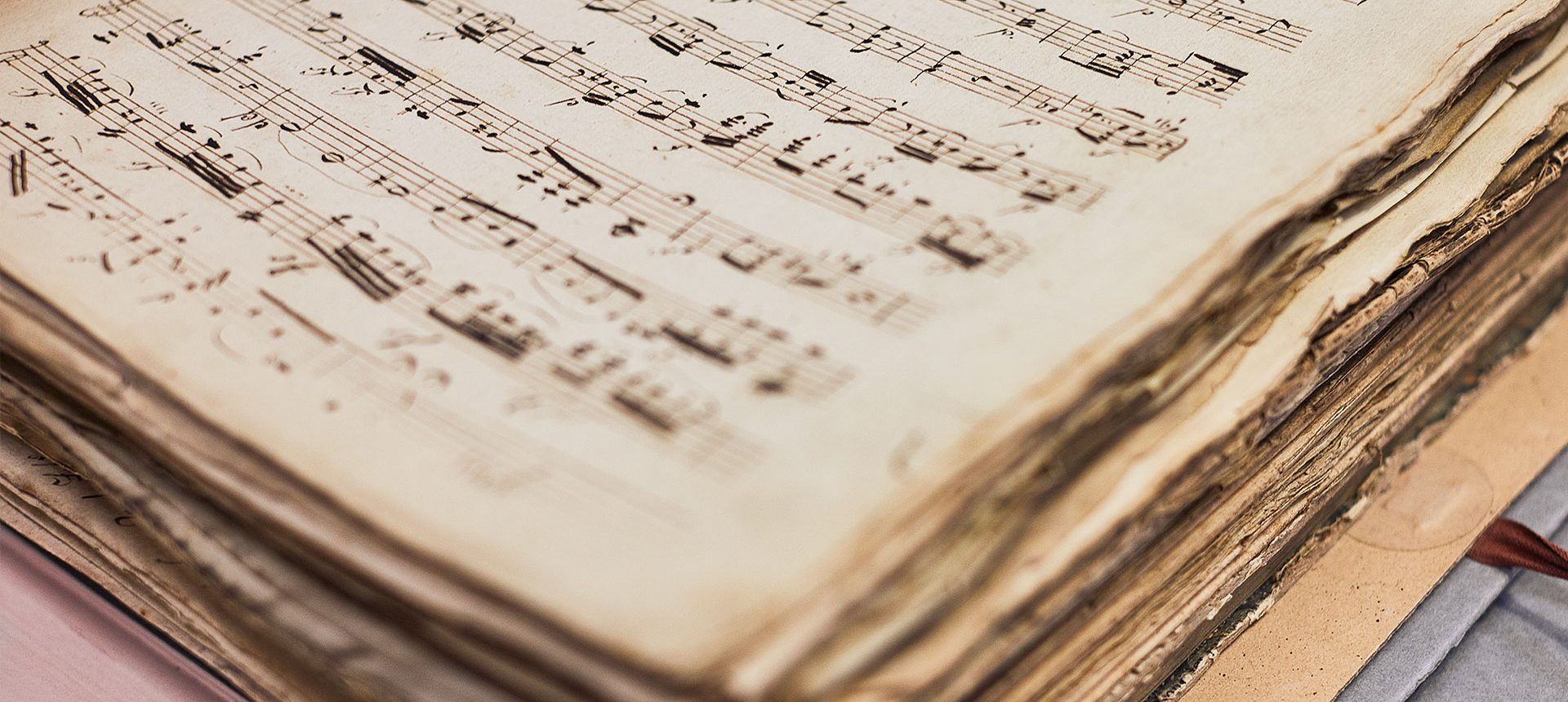
Here you can find almost anything about all the concerts Gothenburg Symphony has played over the years, both in the Concert Hall and on tour.
Search for conductors, soloists and other artists that has played together with us. Or search for composers and music that we have played. And filter on specific seasons. Guesting orchestras and ensembles are also included in the archive.
The result is presented by season.
The Gothenburg Symphony Vocal Ensemble (GSVE) was formed in 2016 and consists of 12 professional singers. The ensemble works both as part of the Gothenburg Symphony Choir in major symphonic works performed together with the Gothenburg Symphony, and as an independent ensemble under the direction of Katie Thomas.
GSVE is a group of experienced and versatile singers, who perform varied programs and explore a wide repertoire, from medieval music to newly commissioned works. The ensemble has previously collaborated with, among others, the Helsingborg Symphony Orchestra and the Barockakademin Göteborgs Symfoniker and performs regular vocal programs both in Gothenburg's Concert Hall and around the Västra Götaland region.
Simon Kim Phipps founded the Västra Götaland Youth Orchestra in 2000 and was their leader up till 2025. He is artistic director of Läcköoperan since 2003 and conductor of the award-winning Swedish Chamber Orchestra, which he also founded.
Simon Kim Phipps was born in London and received his early musical training as a chorister at New College, Oxford. He took his B.A. as a Choral Scholar at King's College, Cambridge and went on to study singing at the Guildhall School in London. Conducting studies in Munich and Manchester followed and he made his professional debut at the Gothenburg Opera in 1985. The next ten years were largely devoted to opera with engagements at Sadlers Wells and English National Opera in London, Krefeld in Germany, and Malmö in Sweden. In 1994 Phipps moved to Sweden and has since then lived in Gothenburg. Simon Kim Phipps has conducted most of the professional orchestras in Sweden including the Gothenburg Symphony.
Arvid Eriksson is a sought-after baritone on the concert stage. He has appeared with the Gulbenkian Orchestra in Lisbon in Mozart's Mass in C minor under Ton Koopman, and made his debut with the Gothenburg Symphony in Haydn's Creation in 2024. He also participated in the prestigious Lieder concert series at the Stockholm Concert Hall, and made his debut with the Royal Philharmonic in 2025.
He graduated from the Royal Academy of Music in Stockholm in 2021. He also has a degree in church music and has been a member of the ensemble Göteborg Baroque. His extensive concert repertoire includes all of Bach's major choral works such as the St. John Passion and the Christmas Oratorio and several cantatas; Handel's Messiah; Haydn's Stabat Mater; and requiems by Brahms, Mozart, Fauré and Duruflé. He has also performed works by Beethoven, Britten, Monteverdi, Roman, Larsson and many others.
Simon Kim Phipps founded the Västra Götaland Youth Orchestra in 2000 and was their leader up till 2025. He is artistic director of Läcköoperan since 2003 and conductor of the award-winning Swedish Chamber Orchestra, which he also founded.
Simon Kim Phipps was born in London and received his early musical training as a chorister at New College, Oxford. He took his B.A. as a Choral Scholar at King's College, Cambridge and went on to study singing at the Guildhall School in London. Conducting studies in Munich and Manchester followed and he made his professional debut at the Gothenburg Opera in 1985. The next ten years were largely devoted to opera with engagements at Sadlers Wells and English National Opera in London, Krefeld in Germany, and Malmö in Sweden. In 1994 Phipps moved to Sweden and has since then lived in Gothenburg. Simon Kim Phipps has conducted most of the professional orchestras in Sweden including the Gothenburg Symphony.
Allegro
Andante
Vivace non troppo
Johannes Brahms composed his Double Concerto for violin, cello and orchestra in the summer of 1887. It was his last work for orchestra and, despite being only 30 minutes long, is a truly magnificent work. Brahms himself called the work “entertaining” and a “joke” – words that a listener finds difficult to reconcile with such an intense and powerful concert.
The usual understanding of Brahms’ Double Concerto is that its serious appearance goes back to the conflict that arose between Brahms and his friend, the violinist Joseph Joachim, regarding an affair between Joachim’s wife and Brahms’ publisher. The concerto – which was premiered by Joachim and the cellist Robert Hausmann with Brahms conducting – is said to have been an outstretched hand after several years of silence. An emotional melody in the cello turns gently towards the violinist, and in the end the two are united.
The double concerto received mixed reviews. Some, such as Clara Schumann, considered it lacking in warmth. Today it stands as one of the last great concertos of the 19th century, dating back to Mozart and Beethoven – and a unique example of Brahms' late style of composition for full orchestra, in which he also uses the full range of the solo instruments.
Richard Strauss’s symphonic poem Till Eulenspiegels lustige Streiche is one of the great masterpieces of the orchestral repertoire. Until this point the composer had been known as a scholarly and rather serious young master, but after the premiere of Till in Cologne on 5 November 1895, it became clear that he also possessed a sparkling sense of humour.
Formally the work resembles a rondo, inviting us to follow the various escapades of the title character. Till Eulenspiegel, a famous trickster who had appeared in literature since the Middle Ages, is introduced in unmistakably fairy-tale fashion: the violins begin the piece with a dreamy phrase that seems to sing, “Once upon a time...”.
We then encounter Till as an itinerant preacher, see him fall in love, watch as he is brought to trial and sentenced to death, and finally witness his hanging. No name was inscribed on his gravestone, but an image of an owl and a mirror got to illustrate an old proverb: “Man sees his own faults as little as an owl recognizes his ugliness in looking into a mirror.” Hence the name Eulenspiegel (The Owl’s Mirror).
Simon Kim Phipps founded the Västra Götaland Youth Orchestra in 2000 and was their leader up till 2025. He is artistic director of Läcköoperan since 2003 and conductor of the award-winning Swedish Chamber Orchestra, which he also founded.
Simon Kim Phipps was born in London and received his early musical training as a chorister at New College, Oxford. He took his B.A. as a Choral Scholar at King's College, Cambridge and went on to study singing at the Guildhall School in London. Conducting studies in Munich and Manchester followed and he made his professional debut at the Gothenburg Opera in 1985. The next ten years were largely devoted to opera with engagements at Sadlers Wells and English National Opera in London, Krefeld in Germany, and Malmö in Sweden. In 1994 Phipps moved to Sweden and has since then lived in Gothenburg. Simon Kim Phipps has conducted most of the professional orchestras in Sweden including the Gothenburg Symphony.
Alexander Grove is a tenor born in London. He has a long career in both opera and musicals with performances all over the world. In 2007 he made his Swedish debut in Christina di Svezia in Vadstena. In 2025 he has participated in Opera på Skäret's production of Turandot and sung in both La Bohème and Askungen at the Gothenburg Opera. In 2022 he sang in the Melodifestivalen in the duo Tenori.
Simon Kim Phipps founded the Västra Götaland Youth Orchestra in 2000 and was their leader up till 2025. He is artistic director of Läcköoperan since 2003 and conductor of the award-winning Swedish Chamber Orchestra, which he also founded.
Simon Kim Phipps was born in London and received his early musical training as a chorister at New College, Oxford. He took his B.A. as a Choral Scholar at King's College, Cambridge and went on to study singing at the Guildhall School in London. Conducting studies in Munich and Manchester followed and he made his professional debut at the Gothenburg Opera in 1985. The next ten years were largely devoted to opera with engagements at Sadlers Wells and English National Opera in London, Krefeld in Germany, and Malmö in Sweden. In 1994 Phipps moved to Sweden and has since then lived in Gothenburg. Simon Kim Phipps has conducted most of the professional orchestras in Sweden including the Gothenburg Symphony.
Early in his career, the young Lars-Erik Larsson traveled to Vienna to learn twelve-tone music. But it was as a civil servant at Radiotjänst (now Sveriges Radio) that he blossomed as a composer. He was hired in 1937 and that same year also saw the start of Dagens Dikt, a program accompanied by Larsson's music. With works such as Pastoral Suite and Förklädd gud, which were included in other radio programs, Lars-Erik Larsson became one of Sweden's greatest and most beloved composers of the 20th century.
The text for the lyrical suite Förklädd gud is taken from the poems of Love in 21st Century by Hjalmar Gullberg (1933), also from Skåne and one of the radio's employees. The music, written for reciter, soprano, baritone, choir and orchestra, moves between pastoral sounds, Nordic folk tones and neoclassicism. Larsson lets the choir's soft harmonies carry Gullberg's humanistic message while the soloists give the story both intimacy and brilliance.
When Förklädd gud was first performed on the radio in 1940, a world war was raging on the continent. In a time of deep unrest, the music became a quiet respite of hope. The entire work breathes the same idea: that the divine is found in the simple and everyday life.
Gods still walk this earth. One of them may be sitting at your table.
Participants
Simon Kim Phipps founded the Västra Götaland Youth Orchestra in 2000 and was their leader up till 2025. He is artistic director of Läcköoperan since 2003 and conductor of the award-winning Swedish Chamber Orchestra, which he also founded.
Simon Kim Phipps was born in London and received his early musical training as a chorister at New College, Oxford. He took his B.A. as a Choral Scholar at King's College, Cambridge and went on to study singing at the Guildhall School in London. Conducting studies in Munich and Manchester followed and he made his professional debut at the Gothenburg Opera in 1985. The next ten years were largely devoted to opera with engagements at Sadlers Wells and English National Opera in London, Krefeld in Germany, and Malmö in Sweden. In 1994 Phipps moved to Sweden and has since then lived in Gothenburg. Simon Kim Phipps has conducted most of the professional orchestras in Sweden including the Gothenburg Symphony.
Early in his career, the young Lars-Erik Larsson traveled to Vienna to learn twelve-tone music. But it was as a civil servant at Radiotjänst (now Sveriges Radio) that he blossomed as a composer. He was hired in 1937 and that same year also saw the start of Dagens Dikt, a program accompanied by Larsson's music. With works such as Pastoral Suite and Förklädd gud, which were included in other radio programs, Lars-Erik Larsson became one of Sweden's greatest and most beloved composers of the 20th century.
The text for the lyrical suite Förklädd gud is taken from the poems of Love in 21st Century by Hjalmar Gullberg (1933), also from Skåne and one of the radio's employees. The music, written for reciter, soprano, baritone, choir and orchestra, moves between pastoral sounds, Nordic folk tones and neoclassicism. Larsson lets the choir's soft harmonies carry Gullberg's humanistic message while the soloists give the story both intimacy and brilliance.
When Förklädd gud was first performed on the radio in 1940, a world war was raging on the continent. In a time of deep unrest, the music became a quiet respite of hope. The entire work breathes the same idea: that the divine is found in the simple and everyday life.
Gods still walk this earth. One of them may be sitting at your table.
Simon Kim Phipps founded the Västra Götaland Youth Orchestra in 2000 and was their leader up till 2025. He is artistic director of Läcköoperan since 2003 and conductor of the award-winning Swedish Chamber Orchestra, which he also founded.
Simon Kim Phipps was born in London and received his early musical training as a chorister at New College, Oxford. He took his B.A. as a Choral Scholar at King's College, Cambridge and went on to study singing at the Guildhall School in London. Conducting studies in Munich and Manchester followed and he made his professional debut at the Gothenburg Opera in 1985. The next ten years were largely devoted to opera with engagements at Sadlers Wells and English National Opera in London, Krefeld in Germany, and Malmö in Sweden. In 1994 Phipps moved to Sweden and has since then lived in Gothenburg. Simon Kim Phipps has conducted most of the professional orchestras in Sweden including the Gothenburg Symphony.
Wolfgang Amadeus Mozart (1756-1791)
Eine kleine Nachtmusik
Allegro
Romanze: Andante
Menuetto e Trio
Rondo: Allegro
One might wonder if there is a more beautifully crafted and polished gem than Eine kleine Nachtmusik - so appealing, so perfect. Nachtmusik is German for "serenade", and when it was composed, Mozart had already composed twelve serenades. Compared to the earlier serenades, it truly lives up to its name - a little one. It becomes a miniature, a simple, classically pure and easily accessible trifle, in terms of scope. The earlier serenades could be 45 minutes long. A serenade should also be intended to be played outdoors, but that does not work at all with Eine kleine Nachtmusik with its lovely and intimate string music.
Mozart included Eine kleine Nachtmusik in his own catalogue of compositions in Vienna on August 10, 1787, and listed it as having five movements. There was another minuet - but this movement disappeared early in the work's history and has never been found. It has also not been possible to find out why Mozart wrote this lovely entertainment music. In any case, it does not seem to have been a commission, but that he wrote music out of his own interest.
It has been surprising that the mature master of cosmopolitan Vienna interrupted the demanding work of orchestrating the exciting nighttime moods of the opera Don Giovanni in favor of this delicacy. Was it the contrast he needed? Was the inspiration pressing?
Andante sostenuto
Andantino in modo di canzona
Allegro
Allegro con fuoco
In correspondence as well as a for Tchaikovsky unusual online commentary, both implicit and explicit connections between this fourth symphony and Beethoven's fifth, Symphony of Fate, are suggested. In Tchaikovsky's Fourth Symphony, it sometimes seems as if he is trying to bring everything together, both the absolute of the music and the programmatic, and this is already audible in the first movement's architectural use of the fanfare theme that surrounds the otherwise inserted classical sonata form. The structural thereby gets a certain programmatic design, but within the form, the motivic work is found and listen (!) here to how Tchaikovsky uses the orchestra as a design of the room. The sonorous qualities of the shift of instrumentation provide a for the time unusual, and for posterity remarkable, use of instrumentation as a form of variation, one in which the ear and the room, not the word, are supreme.
And it is here – in the alternation between rhythmic and instrumental variation – that the rhapsodic becomes increasingly apparent: the story the symphony portrays, regardless of whether it is with just the musical aspect or with an idea of ??an underlying narrative, takes on an increasingly clear sonorous garment in Tchaikovsky.
The second movement's simpler, more melancholic feeling, and the third movement's dance-like display of pizzicato shock may seem parenthetical after the weight of the first movement, but in miniature the connection between motivic processing and the exploration of space through orchestration is found here as well. Finally, in the fourth, bombastic, movement, everything ties together. The rhapsodic, in the folk-inspired melodies are modulated and thrown around in the orchestral clusters, and finally we are back in the fate theme, and the coda can triumphantly bring us home.
Esaias Järnegard
Richard Strauss (1864-1949)
Also sprach Zarathustra
The music is in no way a musical translation of Nietzsche's controversial theories about the übermensch. Richard Strauss saw the positive sides of the author's message: the demand for freedom, the longing for a better world, the power of action. The descriptions of nature were the most important source of inspiration.
The extensive orchestral poem breaks up into nine sections, whose titles correspond to the names of the chapters in the book (but not always in the same order). Between these there are only three general pauses, the rest is in one go. As a motto he placed Nietzsche's "ode to the sun" with the call that "Too long have we dreamed of music, let us now wake up. We were sleepwalkers, let us now go out into the day..." The whole work begins with the sunrise: after long, grinding and very low C in double basses, double bassoon and organ, the sun breaks out in the notes C, G and C2. This is probably the most brilliant sunrise in the entire history of music, and just like Ligeti's music, it became the motif in the film 2001 – A Space Odyssey.
The following parts have the titles: "About the inhabitants of the afterlife", "About the great longing" and "About the joy and passions", where the oboe intones a mournful melody. It is the dreams of youth that are buried. "The Night Wanderer's Song" is a heartbreaking farewell song where the description of nature returns in a reconciling C major in the basses. In the music, C major represents man and nature, while B major represents the universe - two keys that are very far apart. Neither of them emerges victorious from the battle at the end of the piece.
Stig Jacobsson
Initially, Sibelius believed this first symphony would be programmatic: a symphony telling of his homeland’s geology and the triumph of Christianity over paganism. But seven years after the success of his choral-orchestral work based Finnish folklore Kullervo, friends and critics were urging Sibelius to think in more rigorous symphonic terms. Finland, they argued, needed art that was more international than parochial – a symphony that stood its ground on musical terms alone. Such thinking would give the First Symphony its musical weight irrespective of political context.
In his student days in Vienna and Berlin, Sibelius’s teachers had stressed the importance of working through musical themes – lathing them continuously until they were fit for purpose. Ultimately, Sibelius took that advice to a level that couldn’t have been anticipated. Already in this symphony, the composer was handling his material in a distinctive way. Its misty opening on a solitary clarinet doesn’t just prepare us for the shock of the movement’s fast-paced Allegro; it infiltrates the work’s musical ideas like nutrients in their soil. The shape of the clarinet’s theme can be detected in numerous fragments right up to the final bars. The fourth movement launches with a transfigured version of it on thrusting strings.
That gesture speaks of another conceptual difference in Sibelius’s symphonic designs: his response to the colours and capabilities of instruments. In a departure from traditional Germanic symphonic argument (which would make sense on a piano), Sibelius allowed the particular colour of instruments and instrumental groups to shape the path of his music. The symphony’s opening clarinet solo presents one example. The long-held pedal notes in the slow Andante, and the pizzicatos of the Scherzo, two more. These led the critic Ernest Newman to conclude that ‘every page breathes of another manner of thought, another way of living, even another landscape.’
That ‘other way of living’ can be rationalized. The use of recitation – a note repeating itself, like something half-sung – has its roots in Finland’s runic singing tradition. Others have heard something distinctly Russian in the clarinet solo, in the fur-wrapped melancholy of the slow movement and in the feverish way in which the final Allegro molto erupts. It’s in this movement that we hear Sibelius at his most unique. The organic treatment of themes continues. But as part of that process, the movement appears to reconcile the symphony’s poles of energy and stasis in a way only Sibelius could have conceived: by tricking us into assuming the music is operating at one distinct velocity when it’s actually locked into another.
Andrew Mellor, from Sibelius: Symphony 1 & En Saga; Rouvali & Göteborgs Symfoniker (Alpha, 2019)
Simon Kim Phipps founded the Västra Götaland Youth Orchestra in 2000 and was their leader up till 2025. He is artistic director of Läcköoperan since 2003 and conductor of the award-winning Swedish Chamber Orchestra, which he also founded.
Simon Kim Phipps was born in London and received his early musical training as a chorister at New College, Oxford. He took his B.A. as a Choral Scholar at King's College, Cambridge and went on to study singing at the Guildhall School in London. Conducting studies in Munich and Manchester followed and he made his professional debut at the Gothenburg Opera in 1985. The next ten years were largely devoted to opera with engagements at Sadlers Wells and English National Opera in London, Krefeld in Germany, and Malmö in Sweden. In 1994 Phipps moved to Sweden and has since then lived in Gothenburg. Simon Kim Phipps has conducted most of the professional orchestras in Sweden including the Gothenburg Symphony.
Carl Orff (1895-1982)
Carmina Burana
Fortuna imperatrix mundi - Primo vere - In taberna´- Cour d'amours - Blanziflor et Helena - Fortuna imperatrix mundi
During the 1930s, Carl Orff was one of the most noted composers in Germany. Much of his fame came with Carmina burana which was composed in 1935-1936. Its subtitle reads "secular songs for soli and choir accompanied by orchestra and with magical images" - a scenography of a medieval kind where evocative paintings and decorations in concert with the large choir create an overwhelming impression. Carmina burana was first performed in Frankfurt am Main in 1937, given at La Scala in 1942 and shortly afterwards also in Vienna, but despite this Orff only became more widely known as a composer after the war.
The music was not like anything else, it felt original and stood outside contemporary trends and schools. His musical inspiration can be said to have its roots in the dramatic imagery, with Greek tragedy and Italian baroque opera as two major sources of inspiration. Musically, there is a closer influence: Stravinsky's dramatic cantata Oedipus Rex and above all Les noces - rhythmically marked music of a deliberately simple style with a sparse orchestral movement (lots of percussion) and the choir as basic elements.
Orff's work often grew out of a combined vision of the scenic and the musical - everything he created reveals a lush, visible imagination. Most of what he produced is intended for the stage, including Carmina burana. But the piece has shown its strength even without stage arrangements and is just as often performed in the concert hall with great success.
Simon Kim Phipps founded the Västra Götaland Youth Orchestra in 2000 and was their leader up till 2025. He is artistic director of Läcköoperan since 2003 and conductor of the award-winning Swedish Chamber Orchestra, which he also founded.
Simon Kim Phipps was born in London and received his early musical training as a chorister at New College, Oxford. He took his B.A. as a Choral Scholar at King's College, Cambridge and went on to study singing at the Guildhall School in London. Conducting studies in Munich and Manchester followed and he made his professional debut at the Gothenburg Opera in 1985. The next ten years were largely devoted to opera with engagements at Sadlers Wells and English National Opera in London, Krefeld in Germany, and Malmö in Sweden. In 1994 Phipps moved to Sweden and has since then lived in Gothenburg. Simon Kim Phipps has conducted most of the professional orchestras in Sweden including the Gothenburg Symphony.
The Gothenburg Symphony was formed in 1905 and today consists of 109 musicians. The orchestra's base is Gothenburg Concert Hall at Götaplatsen that has gathered music lovers since 1935. Since the 2019-2020 season, Barbara Hannigan is Principal guest conductor. We are also a proud partner of Barbara Hannigan's Equilibrium mentoring program focusing on young singers at the start of their careers. The title Principal Guest Conductor is shared by Pekka Kuusisto from 2025.
Wilhelm Stenhammar was the orchestra's chief conductor from 1907 to 1922. He gave the orchestra a strong Nordic profile and invited colleagues Carl Nielsen and Jean Sibelius to the orchestra. Under the direction of conductor Neeme Järvi from 1982-2004, the orchestra made a series of international tours as well as a hundred disc recordings and established themselves among Europe's leading orchestras. In 1996, the Swedish Riksdag appointed the Gothenburg Symphony as Sweden's National Orchestra.
In recent decades, the orchestra has had prominent chief conductors such as Santtu-Matias Rouvali, Mario Venzago and Gustavo Dudamel, following Kent Nagano as Principal Guest conductor. Anna-Karin Larsson is CEO and artistic director, Gustavo Dudamel honorary conductor and Neeme Järvi chief conductor emeritus. The orchestra's owner is the Västra Götaland Region.
The Gothenburg Symphony works regularly with conductors such as Herbert Blomstedt, Joana Carneiro, Jukka-Pekka Saraste, Christian Zacharias and Anja Bihlmaier.
Simon Kim Phipps founded the Västra Götaland Youth Orchestra in 2000 and was their leader up till 2025. He is artistic director of Läcköoperan since 2003 and conductor of the award-winning Swedish Chamber Orchestra, which he also founded.
Simon Kim Phipps was born in London and received his early musical training as a chorister at New College, Oxford. He took his B.A. as a Choral Scholar at King's College, Cambridge and went on to study singing at the Guildhall School in London. Conducting studies in Munich and Manchester followed and he made his professional debut at the Gothenburg Opera in 1985. The next ten years were largely devoted to opera with engagements at Sadlers Wells and English National Opera in London, Krefeld in Germany, and Malmö in Sweden. In 1994 Phipps moved to Sweden and has since then lived in Gothenburg. Simon Kim Phipps has conducted most of the professional orchestras in Sweden including the Gothenburg Symphony.
This season Ida Falk Winland has made her role debut as Madame Butterfly at the Gothenburg Opera. She has also visited the Royal Theatre in Copenhagen, where she sang the role of Helene in Kasper Holten's production of Manfred Trojahn's Orest. The previous season, she appeared as Donna Anna in Don Giovanni at the Gothenburg Opera and as Violetta in La Traviata at the Royal Opera in Stockholm.
Ida Falk Winland has been associated with the Gothenburg Opera since 2014. Here she has sung Gilda in Rigoletto, Mimì in La Bohème, Ilia in Idomeneo, Adalgisa in Norma, Morgana in Alcina, Cleopatra in Julius Caesar, Rosina in The Barber of Seville, The Countess and Susanna in The Marriage of Figaro, Nedda in Pajazzo and Beate Bella Bravura in Julglitter och Operakaos. Ida Falk Winland has guested at the Glyndebourne Festival in the role of Fiordiligi in Così fan tutte. She has also performed Così fan tutte at the Opéra National de Paris, The Magic Flute and Xerxes at the Royal Swedish Opera and Peter Grimes at the Teatro alla Scala in Milan. She has also appeared at the Helsinki Festival, Opéra National de Lorraine, Covent Garden and at the Internationale Händel–Festspiele in Göttingen.
In 2018, Ida Falk Winland was winner of the Opera Prize for her performance as Adalgisa in the Gothenburg Opera's production of Norma, an award voted for by the readers of the magazine Opera. She is educated at the Royal College of Music and the National Opera Studio in London.
The choir was founded in 1917 by cousins Elsa and Wilhelm Stenhammar. Elsa Stenhammar was one of the driving forces in turn-of-the-century choir life in Gothenburg and became the choir's first rehearser. On December 8, 1917, the choir debuted in Beethoven's Choir Fantasy with Wilhelm Stenhammar as soloist at the grand piano. As the country's oldest symphonic choir, they were able to celebrate their 100th anniversary in 2017 with a big celebratory concert where Mozart and Brahms as well as Stenhammar, Elfrida Andrée and Björn & Benny were on the program.
The Gothenburg Symphony Choir is a non-profit association that is linked to the Gothenburg Symphony. The choir participates in concerts and performances under both the orchestra's and its own auspices. The music is mixed and the repertoire extensive. The Gothenburg Symphony Choir has participated in concerts in, among other places, the Royal Albert Hall and Canterbury Cathedral in England, as well as participated with the Gothenburg Symphony in the annual music festival in the Canary Islands and on a tour to China.
Simon Kim Phipps founded the Västra Götaland Youth Orchestra in 2000 and was their leader up till 2025. He is artistic director of Läcköoperan since 2003 and conductor of the award-winning Swedish Chamber Orchestra, which he also founded.
Simon Kim Phipps was born in London and received his early musical training as a chorister at New College, Oxford. He took his B.A. as a Choral Scholar at King's College, Cambridge and went on to study singing at the Guildhall School in London. Conducting studies in Munich and Manchester followed and he made his professional debut at the Gothenburg Opera in 1985. The next ten years were largely devoted to opera with engagements at Sadlers Wells and English National Opera in London, Krefeld in Germany, and Malmö in Sweden. In 1994 Phipps moved to Sweden and has since then lived in Gothenburg. Simon Kim Phipps has conducted most of the professional orchestras in Sweden including the Gothenburg Symphony.